
Phrasing, Pulse, and Musical Intelligence in Odd Meter
The “Three-Legged Creature”
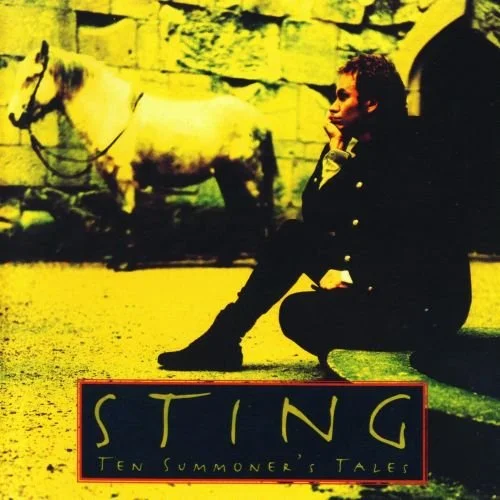
Editor’s note - Vinnie Colaiuta is one of my favorite drummers. I would go so far as to say that he is one of the most tasteful drummers in the realm of popular music from the ridiculous - Frank Zappa, Megadeath - to the sublime - Joni Mitchell. What he plays on this song by Sting pretty much demonstrates his ability to make even an odd time song groove. Whether you like Sting or not (I do), this is a beautiful composition that merits study. His Ten Summoner’s Tales album is a masterpiece of rock and pop music in my opinion and deserves at least one uninterrupted listen. Timo Ickenroth leads us on a deep study of Vinnie’s well crafted and executed drum composition for this song, Seven Days. In the video below Timo plays the song with scrolling transcription.
When Sting once described a song from his 1993 album Ten Summoner’s Tales, he chose an unusual image. He spoke of a “hybrid creature,” a “three-legged animal with two heads” that first had to learn how to move. He was referring to “Seven Days,” a piece written in 5/8—a meter that is certainly unusual in pop music, yet one that still aimed to appeal to a broad audience.
“Seven Days” exists in a field of tension between mathematical structure and emotional accessibility, between conceptual complexity and danceable groove. While odd meters had long been established in jazz and fusion, they still carried a certain risk in early-1990s pop. A 5/8 groove could easily come across as awkward, overly academic, overly cerebral, and too distant for many listeners.
The fact that “Seven Days” not only avoids that risk but transforms it into musical strength is due above all to Vinnie Colaiuta’s drumming. His groove does not sound “odd.” It sounds natural—almost as if the meter were not unusual at all.
Colaiuta later put it quite plainly: the point was never to showcase the 5/8 meter. The point was for the audience to hear a pulse they could internally connect with.
The groove was not meant to impress. It was meant to carry the music.
Five Days of Bass and Drums
The creation of “Seven Days” was not a spontaneous stroke of luck. Before Ten Summoner’s Tales was recorded, Sting and Vinnie Colaiuta withdrew into the studio for several days, deliberately and exclusively with bass and drums—a kind of musical laboratory.
For five days they worked on grooves, refined patterns, shifted accents, and experimented with click tracks and loops. At that stage it was not yet about arrangements; it was about foundations. Before melodies, lyrics, or tonal colors could take shape, the rhythmic foundation had to carry the music and had to be secure.
It was in this setting that the groove for “Seven Days” emerged. Sting defined his goal clearly: the 5/8 meter had to be played in such a way that listeners would barely perceive its complexity. He wanted people to “lock into” the meter as effortlessly and familiarly as they would a 4/4 groove.
This working method says a great deal about Sting’s artistic outlook. It shows that, for him, groove is not treated as an accessory, but as a compositional core. In Sting’s music, groove is not a decorative element added to a finished song. It is part of the song’s compositional DNA. This approach also reveals the consistency with which Sting chooses his musical collaborators. He has worked almost exclusively with drummers who think far beyond a purely accompanying role—musicians capable of developing rhythmic concepts, shaping them, and making them structurally durable.
For Colaiuta, that meant not offering a prefabricated solution or pulling out some stock odd-meter pattern. Instead, it was a process of searching, rejecting, and refining.
Sting’s own preparatory work also played an important role. He had sketched out rhythmic ideas—on a triangle, for example—and in doing so had already formulated a basic concept for the pulse of “Seven Days.” Colaiuta transferred Sting’s idea to the drumset without distorting it.
In that sense, Colaiuta became the translator of a musical vision.
This shared process of development helps explain why the groove of “Seven Days” feels so organic. It is not merely the product of technical brilliance or instrumental virtuosity, but the result of deliberate reduction and musical prioritization.
Stability before complexity. Clarity before virtuosity.
A Note on Notation: 5/4 vs. 5/8
“Seven Days” is commonly described in different ways: Vinnie Colaiuta and Sting often refer to the groove in 5/4, emphasizing the quarter-note pulse, while many transcriptions, including the examples in this article, use 5/8 to make the groupings more visible. Both approaches describe the same musical reality.
In this article, the examples are presented in 5/8, as this perspective makes the eighth-note subdivisions and the “over-the-bar-line” phrasing easier to see.
• The 5/4 perspective emphasizes the broader pulse and the overall feel.
• The 5/8 perspective highlights the internal structure and the phrasing across the bar line.
Regardless of notation, the musical goal remains the same: to make the meter feel “round” rather than “odd.”
Practice Room – Groove Focus
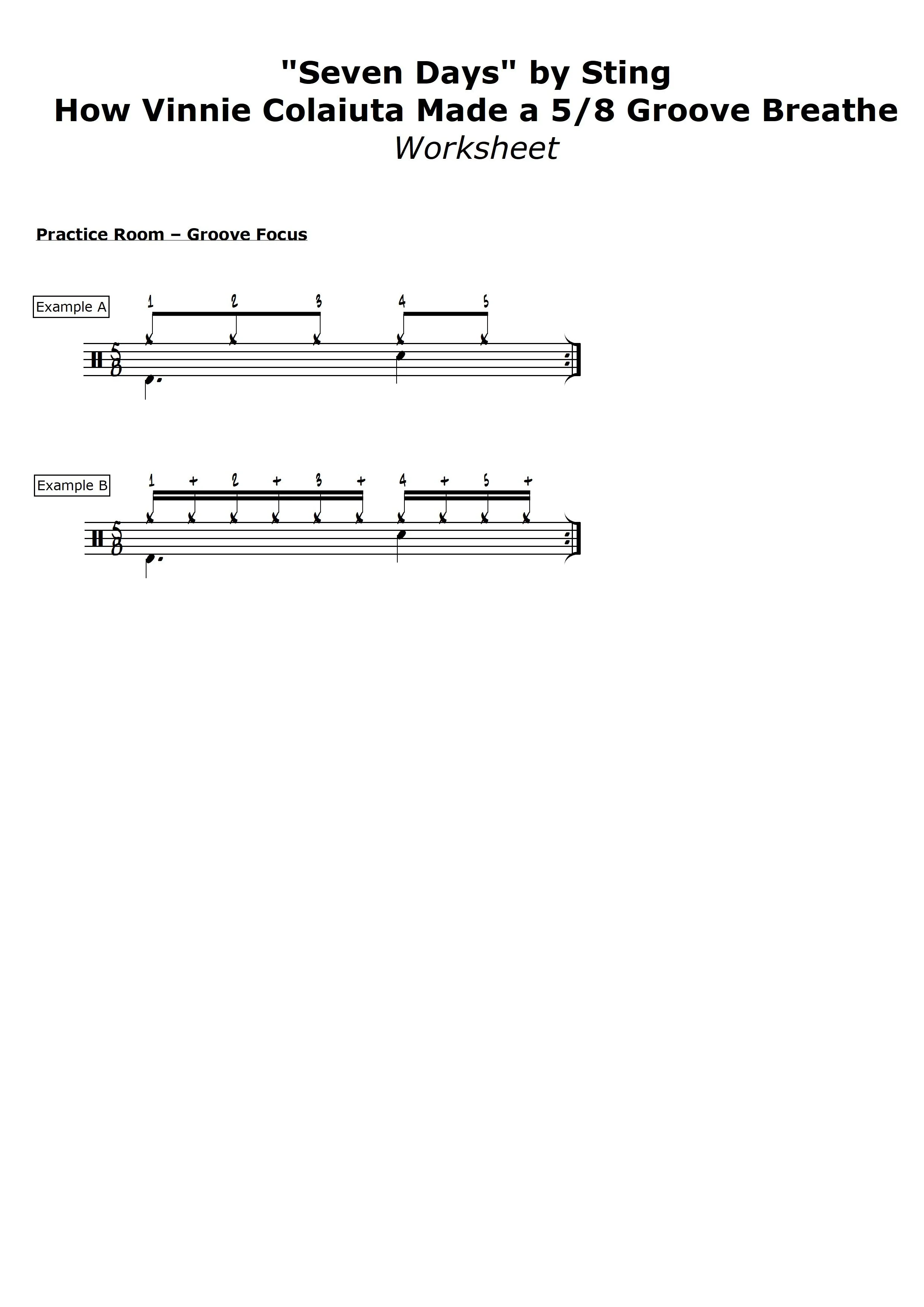
Before working on the actual verse groove from “Seven Days”, it is essential to establish a stable internal pulse in 5/8.
Choose a tempo at which you can play comfortably and without tension.
For several minutes (5–10), play a simple 5/8 groove using only a loop or a click:
• no fills
• no variations
• focus exclusively on pulse, feel, and stability
You may start with a basic subdivision (e.g., straight eighth-notes or sixteenth-notes) and a simple grouping such as 3+2 (bass drum on ‘1’, snare drum on ‘4’).
The goal is not to replicate the original groove yet, but to develop a reliable internal time feel within the 5/8.
The goal is not variety, but reliability.
Over the Bar Line
In a 1993 interview with Modern Drummer, Vinnie Colaiuta described his central technical approach to the verse in “Seven Days” as follows:
“I phrased it by playing over the bar line, so the hi-hat pattern resolves every two bars. That smoothes it out and gives it a regularity that 4/4 has.”
In practical terms, this means that his hi-hat pattern in the verse does not resolve within a single measure, but only across two measures. The phrasing deliberately extends across the bar line.
Rather than thinking in isolated 5/8 units, Colaiuta organizes the verse groove within a larger cycle. What matters is the connection of several bars into one flowing unit.
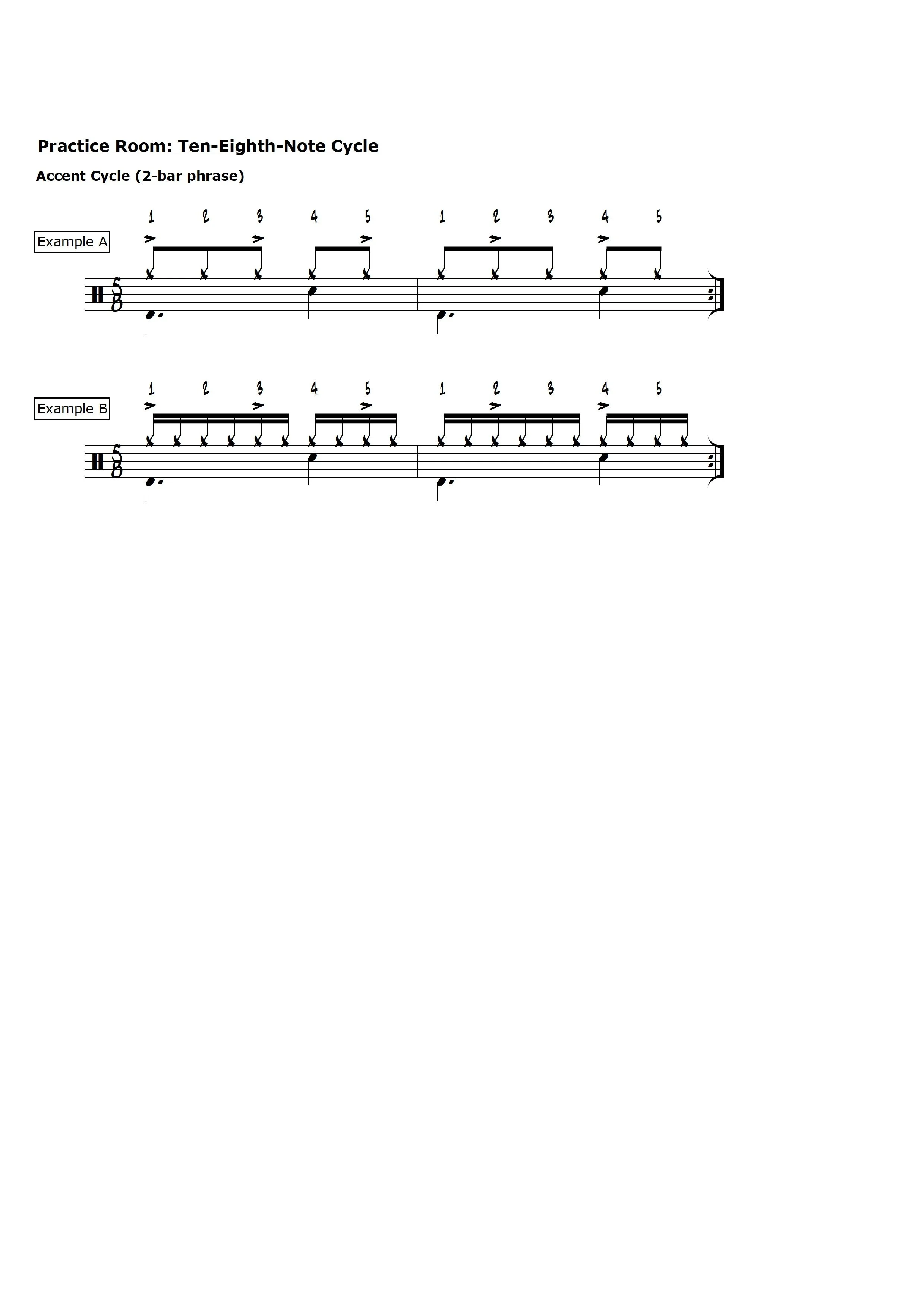
In practice, this creates a ten-eighth-note cycle:
Two bars of five eighth-notes each are perceived as a single phrase. The hi-hat accents do not come to rest on beat one, but at the end of this larger arc.
This has far-reaching consequences for the feel.
Anyone who mentally starts over in every measure will inevitably create breaks. The pulse becomes fragmented and the music loses its flow. Colaiuta’s approach prevents exactly that. The verse groove breathes across the bar line.
You do not hear a beginning and an end; you hear motion.
This principle explains why “Seven Days” sounds so little like counted odd meter. The music is not experienced as groups of five, but as continuous musical arcs. The metric structure remains intact, but it is embedded within a more familiar phrase structure.
Colaiuta himself said that his phrasing in “Seven Days” gives “a regularity that 4/4 has.” What he meant was not simplification, but a psychological effect: the ear recognizes a pattern before it recognizes numbers.
The listener follows the phrase, not the meter.
Practice Room: Ten-Eighth-Note Cycle
Play two bars of 5/8 as one continuous phrase, using a steady subdivision (e.g., eighth-notes or sixteenth-notes on the hi-hat). Keep the bass drum on 1 and the snare drum on 4.
Apply the hi-hat accent pattern from the original verse groove:
• bar 1: accents on beats 1, 3 and 5
• bar 2: accents on beats 2 and 4
Instead of thinking in two separate measures of five, think in a cycle of ten eighth-notes. Maintain a consistent pulse throughout.
The goal is to blur the bar line.
Backbeat in 5/8
In addition to phrasing across the bar line, there is another central element that makes the groove of “Seven Days” so accessible: the placement of the snare drum.
In a masterclass, Vinnie Colaiuta explained:
“The key was to leave the snare on 4. In a 5/8 meter, people often expect the snare to emphasize 3 or 5 in order to mark the meter. By placing the snare almost like a normal backbeat, the song stayed ‘pop.’”
The placement of the snare on particular counts is therefore anything but accidental. In pop and rock music, the backbeat is traditionally anchored on 2 and 4 in 4/4 time. Even non-musicians respond intuitively to that familiar structure. It is part of a broadly Western musical conditioning.
Colaiuta uses this collective listening habit consciously.
By placing the snare consistently on 4, he creates a familiar reference point within an unfamiliar meter. The listener is given a stable point of reference, regardless of how the rest of the rhythm is moving.
The 5/8 meter is not disguised, but it is rhythmically softened. You still hear five beats per measure. Yet the sense of unfamiliarity is reduced. The groove feels familiar, even though its structure is not.
This procedure can be understood as a form of psychoacoustic masking. The metric organization remains intact, but it is overlaid by a familiar rhythmic anchor. The backbeat functions as a translator between structure and perception.
While the hi-hat unfolds its phrasing across two bars and thereby creates a larger arc, the snare brings the listener home in every single measure.
This double strategy—long-range phrasing and a familiar backbeat—is one reason why “Seven Days” remained radio-friendly without sacrificing its rhythmic distinctiveness.
Colaiuta later framed it this way: the goal was not to conceal the meter, but to make it so repetitive and clear that it would lodge itself in the listener’s memory. Only then could the contrast with other sections of the song become truly effective.
The backbeat is not used here as a mere time marker, but as a musical tool. It stabilizes the groove and simultaneously opens up space for more complex rhythmic motion on other levels.
Taken together, the over-the-bar-line phrasing and the stable backbeat show that Colaiuta’s approach was aimed less at mathematical systematization than at musical perception. What mattered to him was not how the meter was counted, but how it was heard.
Practice Room: Backbeat Illusion in 5/8
To better understand and hear Vinnie Colaiuta’s backbeat concept from “Seven Days”, it is helpful to compare it with a different backbeat placement in 5/8.
Choose a tempo at which you can play comfortably and without tension.
Play a steady 5/8 groove over four bars, using a consistent subdivision (e.g., eighth-notes or sixteenth-notes on the hi-hat). You may include the hi-hat accent pattern from the verse; if that feels too demanding, leave it out for now.
Play two bars of 5/8 with a different backbeat placement:
• place the snare on beat 3 (or alternatively on beat 5, or on both)
• keep the bass drum just on beat 1
• maintain a steady subdivision
Next, play two measures in 5/8 time using Colaiuta’s concept from “Seven Days”, so that you end up with a four-measure pattern:
• place the snare consistently on beat 4
• keep the hi-hat and bass drum unchanged
Notice how the perception of the groove changes. Even though the meter remains identical, the musical effect shifts significantly.
The difference is not in the notes themselves, but in their function.
By placing the backbeat on 4, Colaiuta does not hide the 5/8, he stabilizes it through a familiar reference point.
The goal is to rhythmically anchor the odd meter.
Do not focus on counting - focus on how the groove feels.

From the Song to Your Own Playing
Any engagement with “Seven Days” would remain incomplete if it ended with merely reproducing the original. As impressive as Vinnie Colaiuta’s groove is, its real value lies not in copying it, but in understanding it.
The principles identified so far can be transferred to many musical situations:
• over-the-bar-line phrasing
• stable points of orientation
• reduction to essentials
• hearing before counting
Together, they form a model that extends far beyond this one song.
Colaiuta’s approach demonstrates how complex metric structures can be translated into musical terms. That is where the real insight lies: not in copying a pattern thoughtlessly simply so that it can be reproduced, but in understanding the logic behind it. Only then can what has been learned be meaningfully applied in another context.
From Pattern to Principle
A common mistake in working with transcriptions is to reproduce individual grooves in isolation. The result is often technically correct, but still largely dependent on the original.
The more productive path is different.
Instead of asking,
“How does he play that?”
the better question is,
“Why does that work?”
In the case of “Seven Days,” that means asking:
• Why does the hi-hat stretch across two bars?
• Why does the snare remain on 4?
• Why does that create stability?
Anyone who understands these relationships can transfer them into new contexts.
Developing Your Own Grooves
The next step is to formulate your own concepts.
One possible approach:
1. Establish a grouping (for example, 3+2).
2. Define a point of orientation (backbeat or bass drum).
3. Build an over-the-bar-line phrase.
4. Reduce it to a functional core groove.
5. Orchestrate it gradually.
This way, what emerges is not a “Seven Days clone,” but a personal groove with its own identity.
Practice Room: Transfer
The goal of this section is not to reproduce the groove from Seven Days, but to transfer its underlying principles into new musical contexts.
Step 1 – Establish the Core Relationship (5/8)
Start with a simple 5/8 groove using a steady subdivision (e.g., eighth-notes or sixteenth-notes on the hi-hat).
Keep bass drum on 1, snare drum on 4
Now introduce a hi-hat phrasing that extends across the bar line:
• create a repeating accent pattern on the hi-hat that resolves over multiple bars
• avoid resetting your phrasing at the beginning of each bar
• maintain a consistent internal pulse
For this exercise, you may choose a grouping of three, as Vinnie Colaiuta hints at similar phrasing ideas in the verse of Seven Days.

However, this is only one possible approach. Feel free to experiment with different groupings and develop your own phrasing concepts.
Once the groove feels stable, become aware of the two independent layers:
• the bar structure (5/8)
• the phrasing line (spanning multiple bars)
Do not try to “fit” the phrase into the measure. Let the phrase move freely across the bar line, while the backbeat remains fixed.
You are not playing “in” the bar, you are playing across it.
Step 2 – Reverse the Concept (4/4 Context)
Now transfer the same principle into a different metric context.
Play a steady 4/4 groove: hi-hat with a consistent subdivision, bass drum on 1 and 3, snare drum on 2 and 4.
Add an over-the-bar-line phrase using groupings of 3, 5, or other uneven cycles.
Example:
• create a repeating 5-note accent cycle on the hi-hat
• let the pattern resolve independently of the 4/4 bar line
• do not adjust the backbeat
The groove remains stable, while the phrasing moves against the structure.

The principle from “Seven Days” is not tied to 5/8. It is the interaction between:
• long-range phrasing
• stable reference points
• controlled repetition
The goal is to understand how phrasing, placement, and perception interact and to apply that understanding in your own playing.
From Learning to Musical Attitude
The transfer of “Seven Days” into your own playing is therefore not primarily a technical process, but a musical one.
Colaiuta’s playing is so convincing because it is not built from arbitrary formulas, but from decisions. That attitude can be learned—not through imitation alone, but through conscious engagement with sound, time, and function.
The real success of an analysis is not measured by how closely you come to the original, but above all by what you integrate from it into your own musical language.
Hearing, Thinking, Shaping
“Seven Days” is not a lesson in one particular 5/8 groove. It is an example of how musical intelligence can overcome technical complexity.
Vinnie Colaiuta’s playing is so persuasive not because it is complicated, but because it is thought through, audibly structured, and musically grounded.
The analysis of this song shows that groove does not emerge from formulas, but from decisions:
• decisions about phrasing
• decisions about sound
• decisions about function
These decisions cannot simply be memorized. They develop through listening, reflecting, and experimenting.
Anyone who transcribes, analyses, and practices consciously is not merely collecting material, but shaping a musical attitude of their own. Transcriptions are not ends in themselves. They are tools for sharpening one’s musical thinking. They help us understand patterns, develop options, and make more conscious choices.
In this sense, engaging with “Seven Days” is not a completed project, but a point of departure—for a deeper understanding of musical responsibility.
Or, to put it another way:
A meter is only a frame. How it sounds is up to us.
Timo Ickenroth, April 2026
The author:
Timo Ickenroth is a drummer, educator, and author living in Germany. He teaches at the University of Koblenz-Landau and the RPJam Academy, co-hosts the podcast “Schlagabtausch,” and has written several instruction books for drummers. His latest work is Jazz Standards on the Drumset – The Art of Interpretation, available via Hudson Music: https://hudsonmusic.com/product/jazz-standards-on-the-drumset/?wcacra=1961717
Further Resources by Timo Ickenroth
◼️ YouTube: https://www.youtube.com/@JazzDrummersCorner
◼️ Patreon: https://www.patreon.com/JazzDrummersCorner
◼️ Instagram: https://www.instagram.com/timo.ickenroth/
◼️ eBook: https://hudsonmusic.com/product/jazz-standards-on-the-drumset/?wcacra=1961717