
By Eddie Z (Ed Ziehm)
I have spent most of my life behind a drumset. I started playing at 11, began gigging at 14, later studied at Berklee College of Music, and spent years doing what working drummers do: bands, rehearsals, load-ins, recording, road work, and learning how to make a song feel good from the back of the stage.
What I did not expect was that the drumset would eventually become the front of the stage.
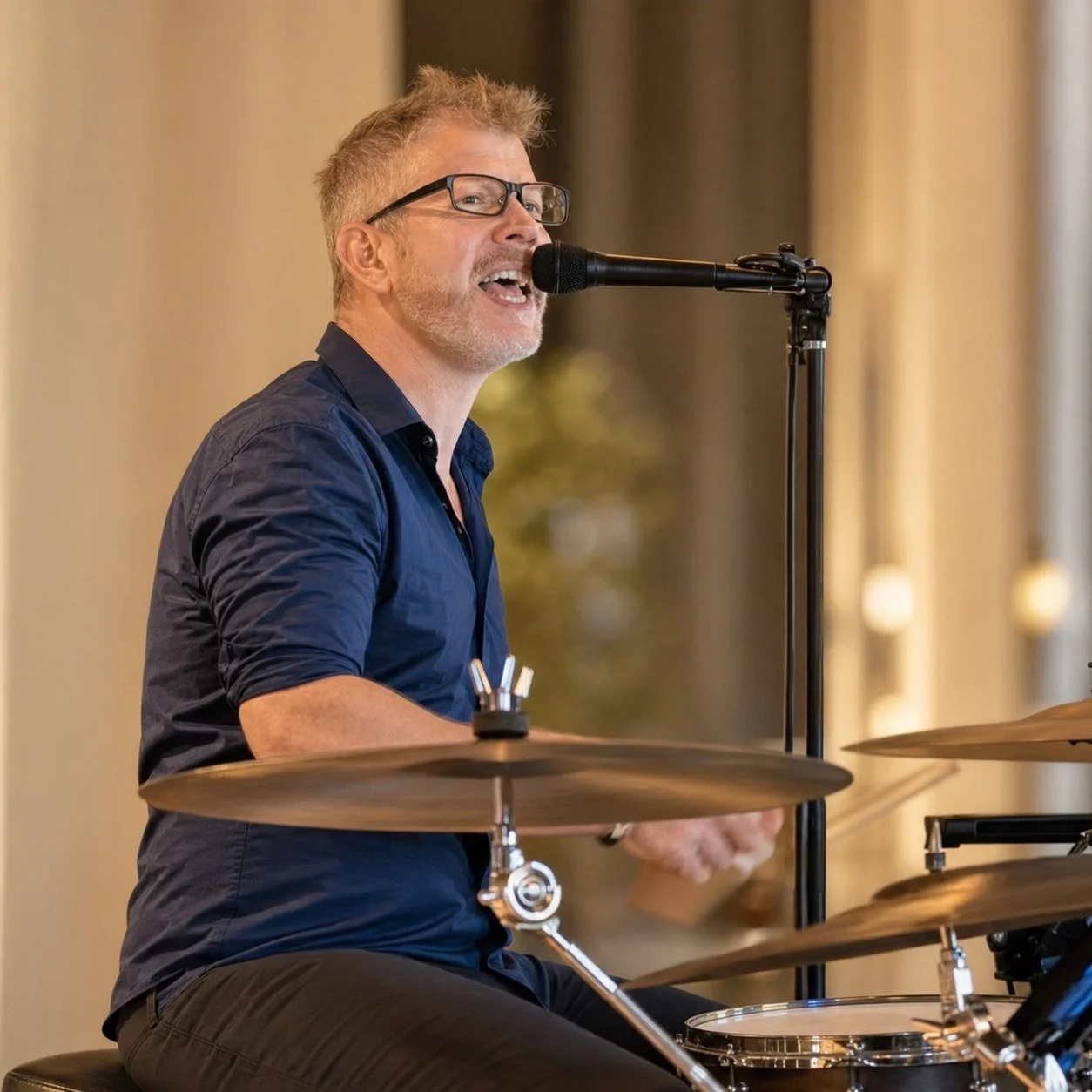
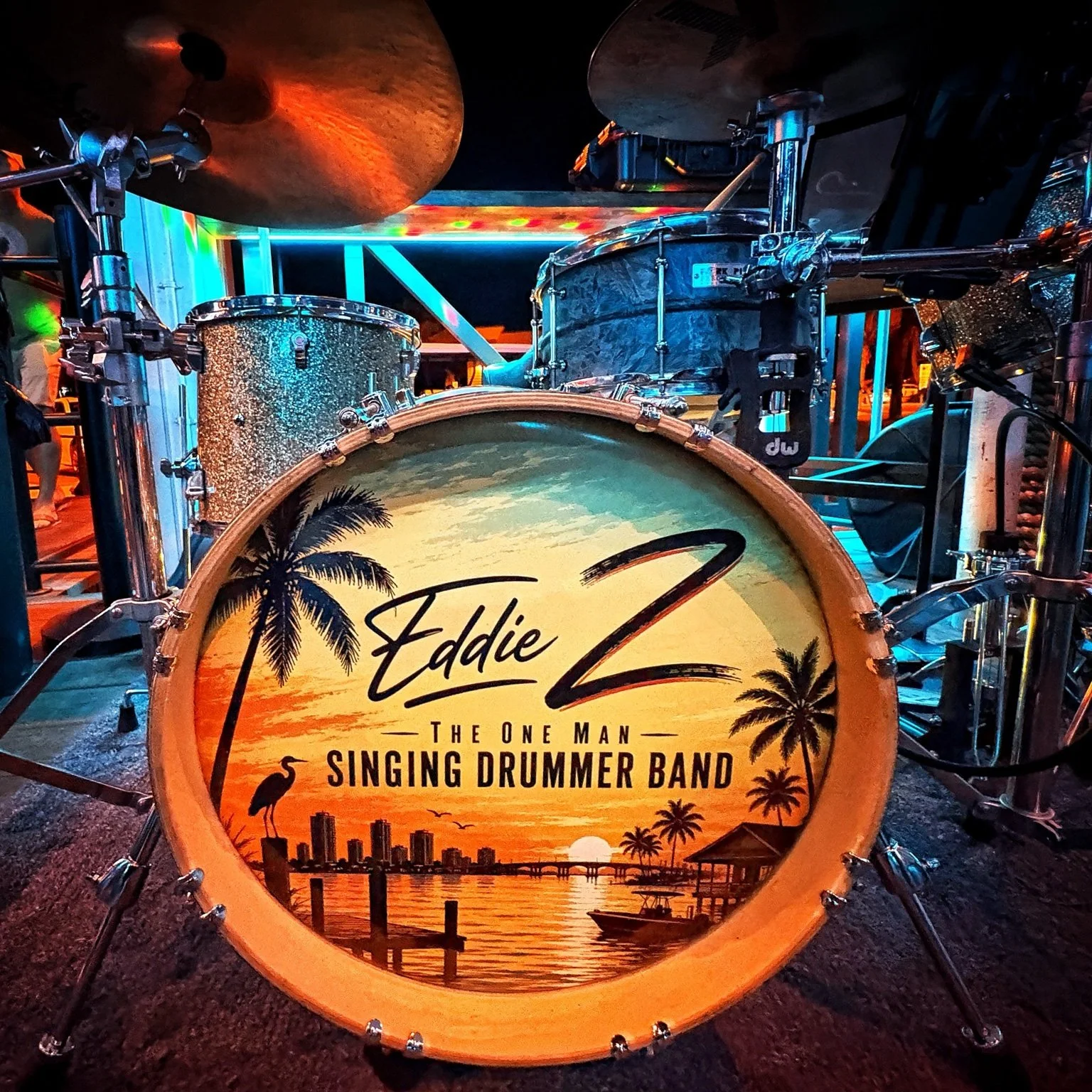
On July 21, 2023, I launched Eddie Z — The One-Man Singing Drummer Band. The basic idea sounds simple: I sing lead and play live drums while professionally produced backing tracks supply the parts that are not physically onstage. These tracks are built from separate recorded parts, often called “stems” — for example, bass, guitars, or keyboards — that can be adjusted or left out of the mix to make room for what I perform live. In practice, it turned me into the drummer, lead singer, bandleader, sound engineer, playback operator, stage manager, DJ between sets, and road crew at the same time.
In 2024, I performed 230 shows. These days the act stays in the 200-plus-shows-per-year range. That repetition has taught me more about what a drummer can control — musically and professionally — than almost anything else I have done.
THE DRUMMER IS NOT FOLLOWING THE BAND ANYMORE
In a normal band, the drummer is responsible for time, dynamics, feel, and transitions, but there are other musicians sharing the responsibility for the performance. In a one-man format, every decision becomes exposed. If the energy drops, there is nobody else to pick it up. If a transition feels awkward, I have to fix it while singing, playing, and preparing the next track.
That changed the way I think about drumming. I am not simply accompanying a song. I am conducting the entire event from the kit.
The biggest lesson was that more drumming is not necessarily better drumming. Because the backing tracks already contain a complete musical environment, the live kit needs to add humanity, impact, and movement without fighting the arrangement. I leave room. I change fills from night to night. I push and pull energy based on the room. I use cymbal choices and dynamics to make sections feel live instead of trying to prove that I can play over everything.
The goal is for people to feel a band, not hear a drummer playing along with a computer.
BUILD THE TRACKS AROUND THE LIVE DRUMS
The most important production decision is obvious but easy to get wrong: the backing tracks have to leave a real job for the drummer.
If the backing production is too dense, the live drums feel pasted on top. I want the kick, snare, cymbals, and fills I play in the room to matter. That means the arrangement has to breathe. The playback should support the performance, not compete with it.
I also think in terms of live pacing rather than record sequencing. A song that works perfectly on an album can feel wrong after two hours in front of a mixed-age crowd. My repertoire is now hundreds of songs across rock, pop, country, funk, disco, reggae, yacht rock, alternative, and several decades of familiar music. The hard part is not knowing enough songs. The hard part is choosing the right next song.
A drummer normally thinks about the next four bars. As a one-man band, I have to think about the next forty-five minutes.
CONTROLLED VOLUME IS A MUSICAL SKILL
One of the first concerns I hear from venues is, 'You are a drummer — is this going to be too loud?'
That question made controlled playing one of the most valuable parts of the act. I perform country clubs, restaurants, resorts, private events, active-adult communities, bars, and outdoor venues. Those rooms cannot all be treated the same. A dinner audience at 6 p.m. and a packed bar at 10:30 p.m. may require completely different versions of the same drummer.
I use a compact kit and play for the room. The PA does not need to overpower the acoustic drums, and the drums do not need to overpower the PA. The trick is learning to make the groove feel authoritative at a lower physical volume. That has probably improved my touch more than years of practicing loud.
THE TECH HAS TO DISAPPEAR
The show depends on technology, but the audience should not feel like they are watching me operate technology.
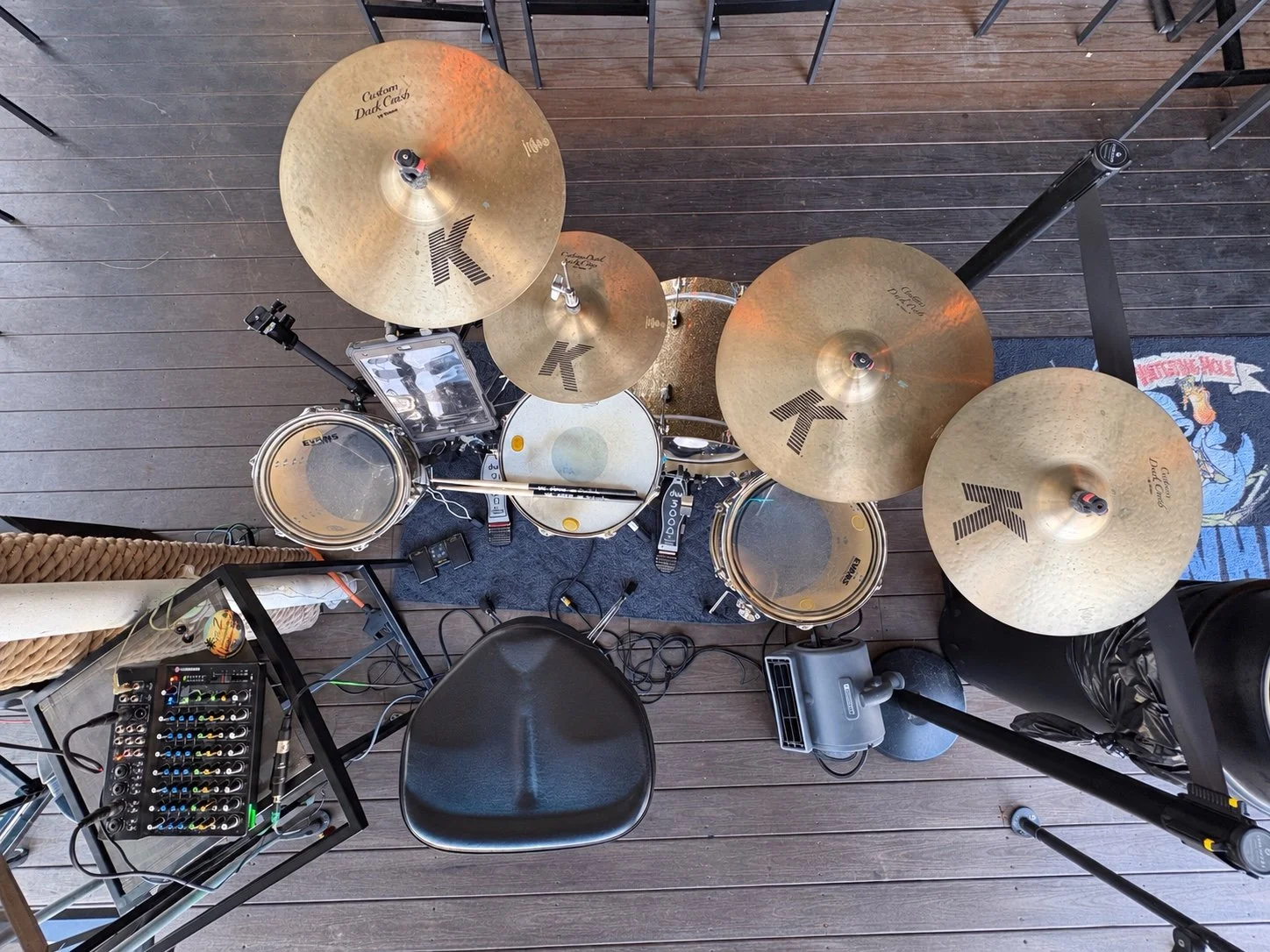
My setup includes drums, lead vocal, playback, mixer, PA, monitoring, and a compact control system. Everything has to be reachable and predictable because I cannot stop playing to troubleshoot a menu. I build redundancy where I can, keep the signal path understandable, and try to remove every unnecessary piece of gear.
The best technology in this show is the technology nobody notices. They notice the singing drummer. They notice the groove. They notice that a full arrangement seems to be coming from one person.
That is also why I have become almost obsessive about setup time, cable placement, mounting, battery life, backups, and load-in order. When you are the entire crew, efficiency is part of musicianship.
SINGING CHANGES THE WAY YOU PLAY
Singing lead while drumming is its own coordination problem. The obvious challenge is independence, but breathing is just as important. A fill that is comfortable when I am only drumming can be a terrible choice under a difficult vocal phrase.
I had to learn where the vocal needs physical space. Sometimes that means simplifying the kick pattern, changing a fill, or deliberately keeping a groove steady through a phrase where the drummer in me wants to decorate.
The payoff is enormous. The drummer is normally physically separated from the front-person role. Singing from the kit breaks that visual expectation. People turn around when they realize the lead vocal is coming from behind the drums. That surprise is part of the act, but it only works if the playing and singing are both convincing.
THE BUSINESS LESSON WAS JUST AS BIG
Building the act also changed how I think about being a professional drummer. A working musician is not only selling notes. Venues are buying reliability, adaptability, communication, appropriate volume, quick setup, a broad repertoire, and a performer who can read a room without creating extra problems.
A compact one-person production has practical advantages. I can fit into places that cannot accommodate a full band. I can change the set quickly based on the demographic. I can handle a cocktail-hour atmosphere and later turn the same setup into a dance-oriented show. I can load in and strike without a crew.
None of that replaces musicianship. It gives the musicianship more places to work.
WHAT I WOULD TELL ANOTHER DRUMMER
If another drummer wanted to build a hybrid solo or small-format act, I would suggest five things.
First, make the live instrument essential. Do not build such a complete backing track that you become optional.
Second, practice transitions as seriously as songs. Dead air destroys momentum.
Third, learn your own sound system. Even if someone else runs sound later, understanding gain structure, monitoring, and playback will save shows.
Fourth, learn to play quietly without sounding timid. That skill creates work.
Fifth, treat reliability as part of your technique. A great fill does not matter if the playback device is dead, the headset is not working, or you arrived without the cable that connects the whole rig.
I still consider myself a drummer first. The difference is that I no longer think the drummer has to live at the back of the band.
The drumset can be the rhythm section, the command center, and the visual center of the entire show. After hundreds of performances in this format, that is probably the biggest thing I have learned: the traditional role of the drummer is much larger than I used to think.
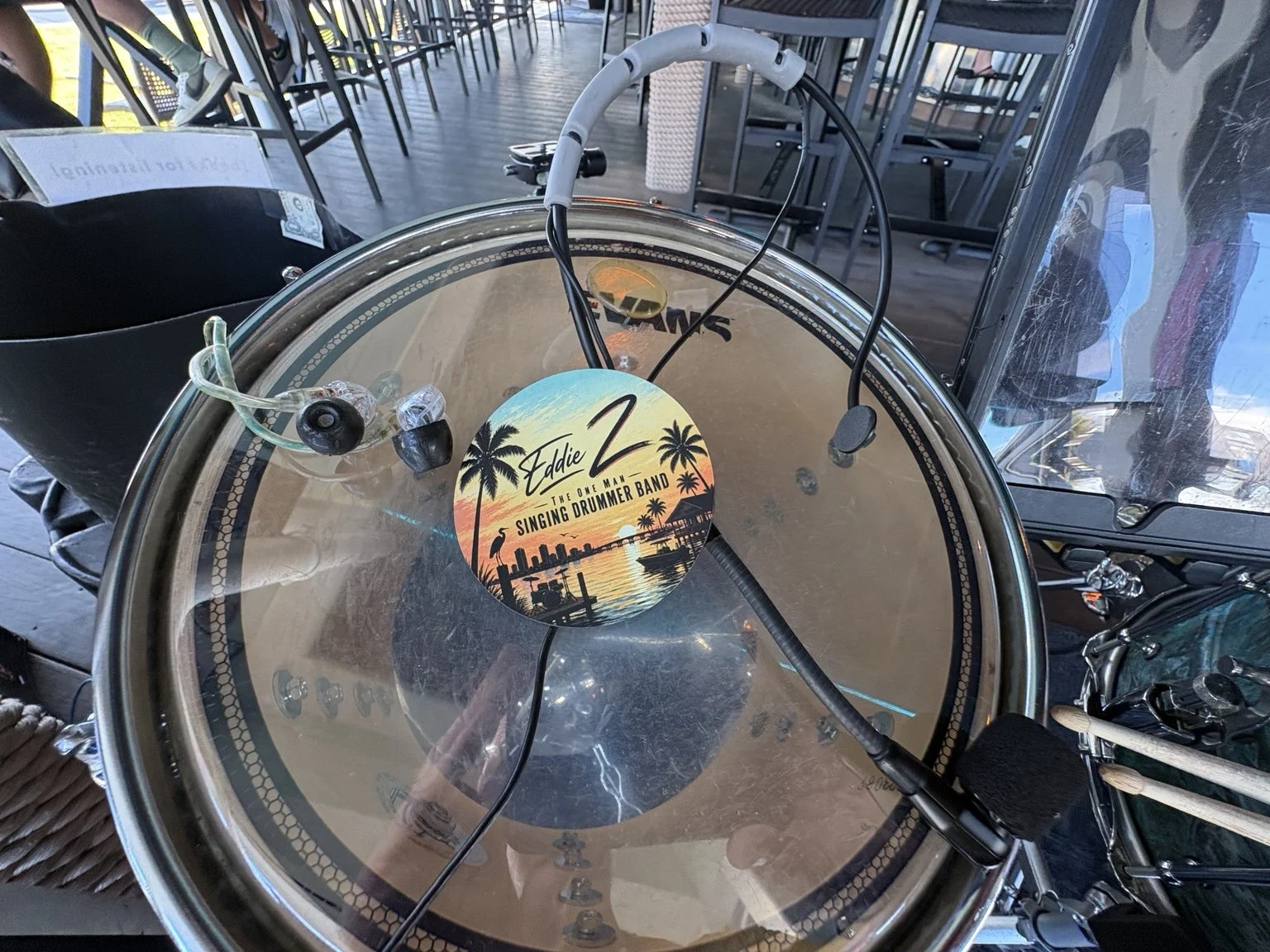
I’ve been putting this rig together to keep everything compact, portable, and efficient while still delivering a full live drum and vocal performance. It’s been working great for the 200+ shows I do each year.
Here’s what I’m currently running:
DRUMS & HARDWARE
PDP New Yorker compact acoustic drum kit
Zildjian K Custom cymbals
Aquarian Super-Kick II bass drum batter head
Remo Emperor X Coated snare batter head
Evans EC2S tom batter heads
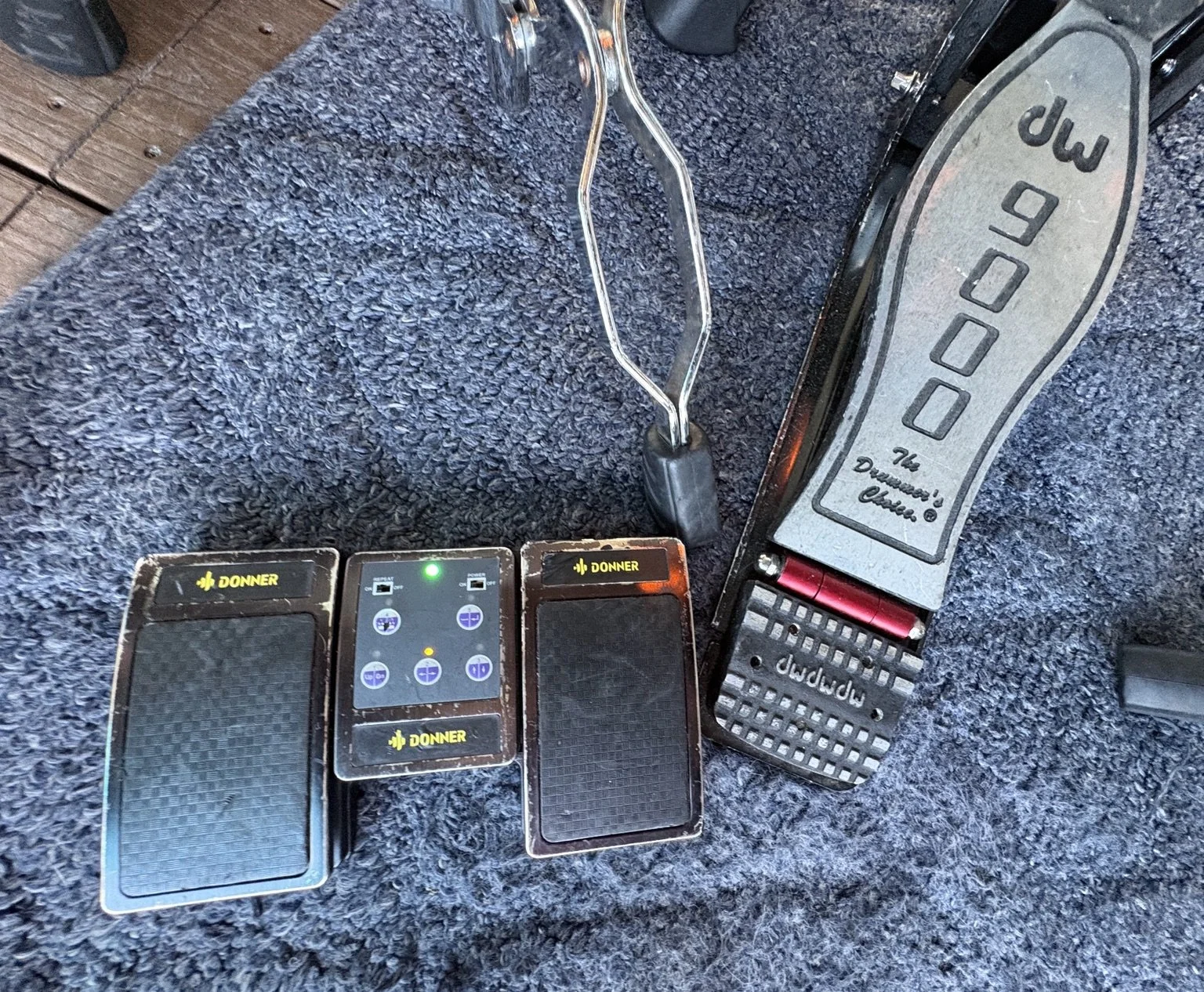
DW 9000 Remote Hi-Hat with 2-foot cable and foot pedal
DW 3000 bass drum pedal
DW CP9120AL 9000 Series Heavy Duty Air-Lift Throne with Tractor Seat
Yamaha drum and cymbal stands
AUDIO & PA
Harbinger 12-channel mixing board with Bluetooth
Harbinger 1,000-watt subwoofer with stick-style column PA
Shure SM35 headset vocal microphone
Shure SE215 in-ear monitors
PLAYBACK & ACCESSORIES
Apple iPad
Hercules iPad mount
Donner Bluetooth two-pedal footswitch
Personal cooling fan
I’ve attached four photos, including an overhead view of how I’ve arranged everything to keep the kit within reach while I’m singing, drumming, and controlling the backing tracks.
It’s a pretty unconventional setup, but it allows me to deliver a full-band sound while keeping the entire operation manageable for one person.
ABOUT EDDIE Z
Ed Ziehm performs as Eddie Z — The One-Man Singing Drummer Band. A Berklee-trained drummer and lifelong working musician, he performs 200+ shows per year throughout Southwest Florida and is available for club, resort, corporate, private, and destination engagements.
YouTube: https://www.youtube.com/@eddiez-theonemansingingdrummer
Instagram/Facebook: @eddiezdrumband
Contact: eddiezdrumband@gmail.com | 239-404-0901