
Arrival
I didn’t go looking for a story when I bought this drum kit. At the time, I thought I was simply stepping into vintage drums more intentionally than I ever had before.
The kit came from California and was shipped to me in Nashville. There was no in-person exchange. No handshake. No shared moment of standing over the drums together. Just photos, messages, trust, and eventually a delivery truck pulling away.
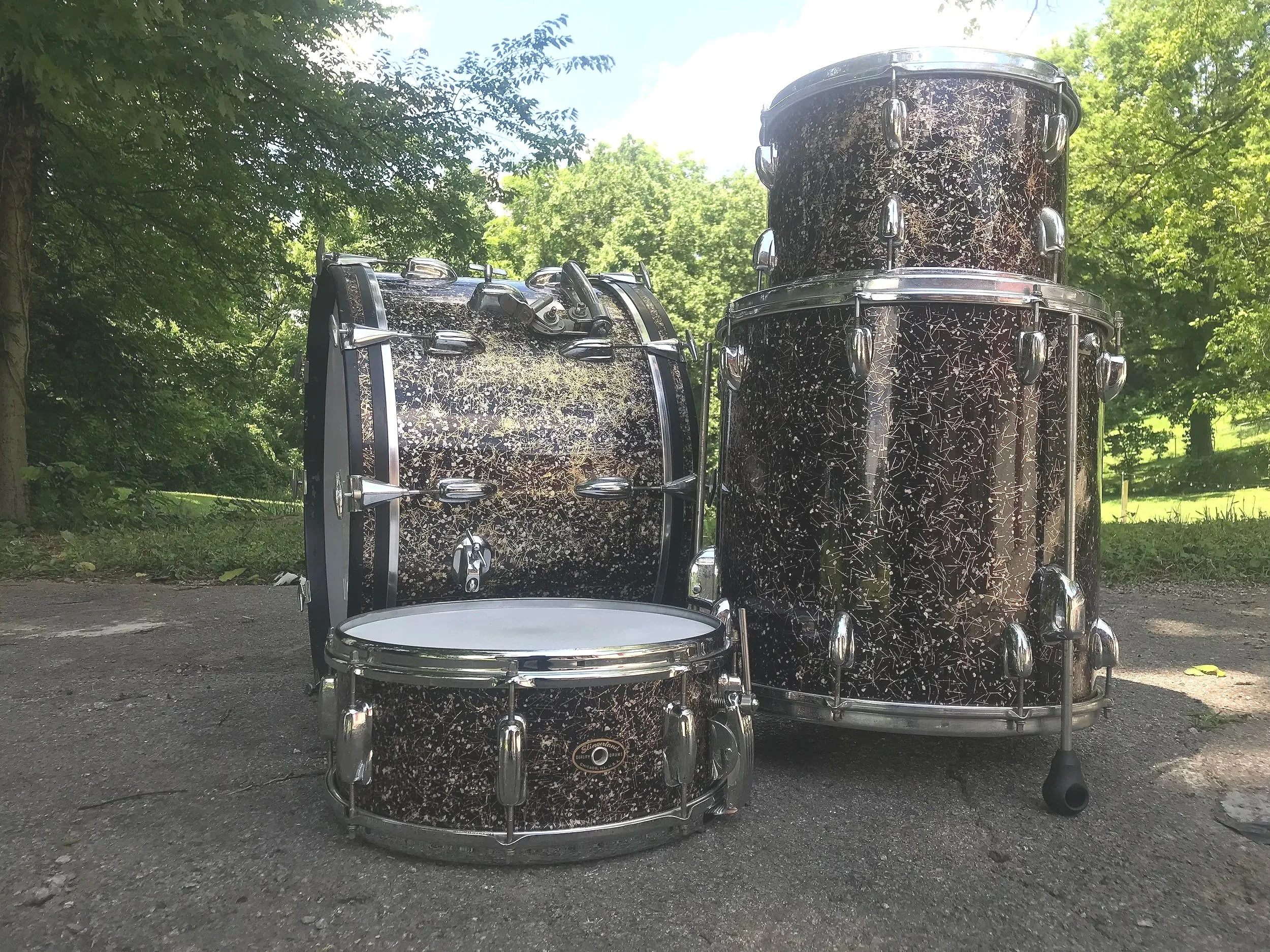
On paper, it was straightforward: a 1958 Slingerland Capri Pearl kit w/ a matching Radio King snare. The kind of thing you research, price-check, and talk yourself into. But when the kit arrived, it didn’t feel like a transaction that had ended—it felt unfinished.
The seller mentioned Roy Harte and encouraged me to look him up. I tried. There was very little to find. That absence is what prompted the phone call. I wanted to know more. Not just about the kit, but about the person who had lived w/ it before me.
Everything I know about this kit comes from that conversation—not from archives or catalogs, but from one drummer talking to another. No script. No agenda. Just stories shared the way musicians have always shared them, casually and honestly, trusting that the other person will understand what matters and what doesn’t. That conversation shifted everything.
I learned that the kit had belonged to Roy Harte—a West Coast drummer whose name isn’t widely known, but whose presence was deeply felt by the people around him. The drums had lived inside Drum City, and later Vintage Drum City. These were places where drums were sold, repaired, taught on, rented, recorded, and talked about. They weren’t preserved as artifacts. They were used as tools.
What struck me most was that the kit hadn’t been protected by distance or rarity. It had been protected by care.
It had been played for lessons. Taken into studios. Rented out for film and television work. It carried the kinds of marks that come from being trusted to do what it was built to do. Not damage exactly. Just time, made visible.
By the time the call ended, I realized that what arrived at my door wasn’t just a vintage drum set shipped across the country. It was a piece of someone else’s working life, now resting in my hands.
This didn’t feel like ownership. It felt like stewardship. Like I had stepped into the middle of a longer story. One that started before me and would continue after me, whether I chose to acknowledge it or not.
The drums arrived in Nashville first. The story arrived later.
Who It Came From
I knew the name Roy Harte before I understood why it mattered. When you start looking into vintage drums, certain names surface again and again. Players, builders, companies whose stories have been documented, cataloged, and repeated. Roy Harte isn’t one of those names. Not because he didn’t belong there, but because history doesn’t always reward the people who do the work quietly.
Roy was a West Coast drummer, an inventor, a teacher, and the son of the man who owned Drum City, one of the two major drum shops in Los Angeles during the 1950s and ’60s. After the shop went defunct, Roy didn’t let it disappear. He kept the building alive as a place where drums still moved through hands and rooms and time.
By the 1990s, Drum City had become something else entirely. Lessons happened there. Musicians rented rooms. Drums pulled from decades-old stock were put back into use. Roy gave lessons on the same kits that went into studios or out on film jobs. The drums weren’t frozen in an era. They kept working.
Later, that space evolved into Vintage Drum City, a hub for players and collectors who needed repairs, parts, or answers. Roy was an encyclopedia. He knew every part, every company, every odd decision manufacturers made along the way. Not from books, but from experience.
What stands out to me isn’t just how much he knew. It’s how little of it made its way into official history. Roy recorded constantly. Clocking who knows how many hours of sessions and jams in his career. Yet his name remains largely absent from the usual narratives. Not because he lacked impact, but because he didn’t play the game of self-promotion. He didn’t schmooze. He stayed focused on the work.
The kit passed through that environment. It absorbed that way of thinking. Practical. Unpretentious. Used rather than displayed.
Understanding who Roy was changed how I see this kit. They aren’t important because of who owned them. They’re important because of the kind of life they were allowed to have. A life shaped by someone who believed instruments existed to be played, shared, and understood.
A Kit That Lived a Life
It’s easy to think of vintage drums as fragile things. Objects to be protected, isolated, or kept out of reach. But that wasn’t the life this kit lived.
Before it arrived in Nashville, before it was wrapped and shipped across the country, it spent decades doing what it was built to do. It sat in lesson rooms. It moved in and out of studios. It was loaded into vehicles and set up under lights for film and television work. When someone needed a drum set that looked and sounded right for a particular era, this one was ready.
It wasn’t preserved by avoiding use—it was preserved through use.
The marks on the kit don’t read as neglect. They read as familiarity. A floor tom wrap that split over time. Hardware that shows its age w/out apology. The absence of certain modern conventions, like grommets in the toms, reflects decisions made long before anyone imagined drums as collectible artifacts.
The Capri Pearl finish tells that story clearly. Thicker than most wraps of its time, it aged differently. It dried, shifted, and settled into itself. The split on the floor tom wasn’t the result of an accident. It was simply time doing what time does. It has been stable for decades.
This kit didn’t belong to one moment or one player. It existed in rotation. It was trusted. People put their hands on it w/out ceremony. It became part of other people’s music, even if no one wrote that down.
In a world where vintage gear is often treated like a trophy, this kit feels more like a witness.
What Was Passed Along
It would be easy to say that what changed hands was a drum kit. Shells, hardware, a finish softened by time. But that’s not what stayed w/ me after the conversation ended.
What was passed along was perspective.
The call wasn’t framed as a lesson, but it carried one. We talked about value. Not in the abstract language of collectors, but in the practical terms of someone who had spent decades living w/ drums. What they’re worth. When they’re worth it. How timing, need, and trust shape those decisions more than any guide or market trend.
There was no attempt to dress the story up. The kit was sold because it was time. Because houses fill up. Because even the best things eventually have to move on. That honesty mattered. It made the exchange feel human instead of transactional.
The conversation wasn’t about whether the kit was worth more. It was about whether it was going somewhere it would be understood. Somewhere it wouldn’t be stripped of its context or turned into a trophy. Somewhere it could continue to exist as an instrument w/ a past, not just an object w/ a price.
In that sense, what I received wasn’t a deal. It was trust.
Stewardship (Not Ownership)
What I took from that conversation only matters if it shows up in how I treat the drums now.
So I keep this kit in places where it can be listened to. Studios. Controlled rooms. Spaces where people arrive w/ intention. I don’t take it out casually, and I don’t let it become a backdrop for chaos. That isn’t about fear or fragility. It’s about respect.
When I do share it, I’m present. I set boundaries. I explain what it is and where it’s been. Not as a warning, but as context. I’ve learned that people handle things differently when they understand them.
I don’t chase restoration. The marks stay. The split stays. Perfection would erase evidence of the life the kit lived before it came to me.
Stewardship isn’t about locking something away—it’s about knowing when to say yes, when to say no, and why.
Lineage Continues
I don’t think of this kit as something I acquired. I think of it as something I stepped into.
It had a life before me, shaped by hands that used it w/out knowing where it would end up next. At some point, those hands let go. Now mine are here, doing their part, knowing they won’t be the last.
That awareness changes how I listen. It changes how I play. It even changes how I talk about the drums. I’m careful not to turn them into symbols or stories that belong to me alone. They already carry enough of their own.
Someday, these drums will move again. I don’t know when, or to whom. But I hope that when they do, they carry more than shells and hardware w/ them. I hope they carry the memory of being cared for. Of being understood as something made to last, not because it was preserved perfectly, but because it was treated thoughtfully.
If there’s a responsibility here, it’s a simple one. To pass along what was given, w/out adding noise or stripping meaning away.
That’s how lineage survives.
Not by being announced, but by being honored, quietly, from one set of hands to the next.
Editor’s note - from Wikipedia:
Roy Harte was a prominent American jazz drummer and co-founder of Nocturne Records and Pacific Jazz Records. In partnership with Remo Belli, founder of the drumhead manufacturer Remo, Harte established Drum City, a well-known retail drum shop located on Santa Monica Boulevard in West Hollywood, California. The store became a central hub for drummers, offering not just gear but also a sense of community and mentorship.
Drum City was more than a business—it was a cultural landmark. Harte was deeply involved in nurturing young talent, hosting annual drumming competitions for high school students and providing a welcoming space where aspiring drummers could learn and grow. His famous quote, "Drummers are a lot like hockey goalies; nobody knows how to talk to them except another drummer," reflected his deep understanding of the drummer’s unique role in music.
Harte’s influence extended beyond retail—he was a respected session musician, recording with artists like Laurindo Almeida, Shorty Rogers, and Bud Shank, and contributing to the development of West Coast jazz. He remained active in music and education until his death in 2003.