

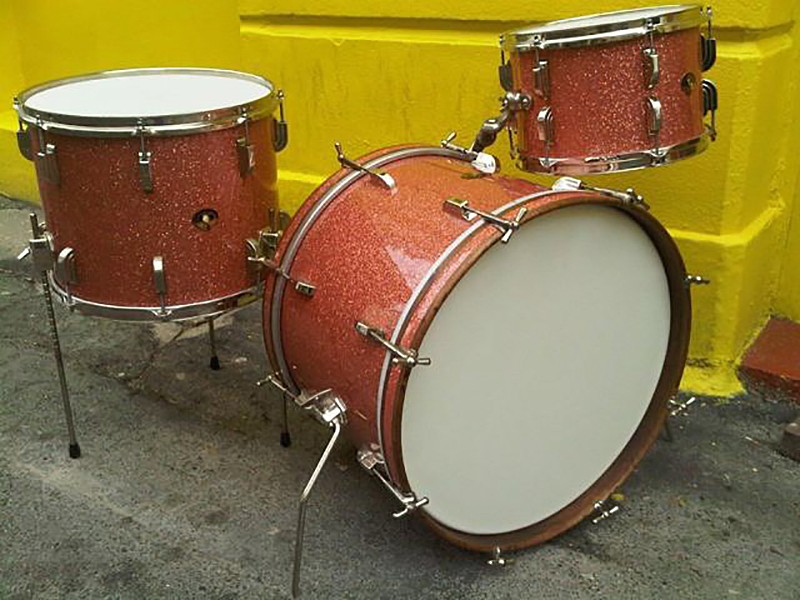
Thanks to Patrick Bradley for submitting his 1953 Leedy & Ludwig set - we love it!
WIW? Ludwig Imperials?
Got something that you want to ask the community what’s it worth? Send it in and we’ll post it here. – NSMD NSMD,
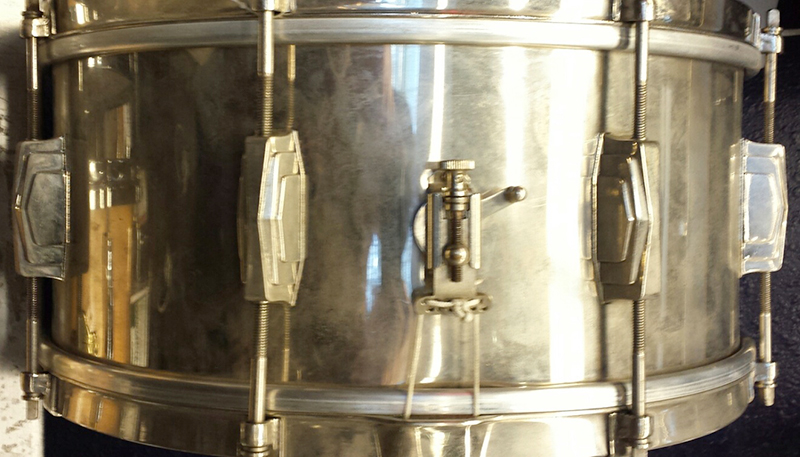
I am very interested in purchasing a drum but I'm not certain who made it. I consider myself to have decent vintage knowledge but not after seeing this one. The shell has no name or stamp on it what so ever. Also very strange is that there is no center bead in the shell. It has no extra holes drilled in it. The lugs appear to be late 30's Ludwig Imperials. The strainer also looks to be Ludwig, later 20's to early 30's. There is a welded seam on the interior of the shell. Can you please help or give me an idea of what type of shell it might be.
Thanks, Lance

What do you think? Let us know in the comments below!
Stanley Krell’s Rogers Drums, A Once In A Lifetime Find
by Robert Bernhardt
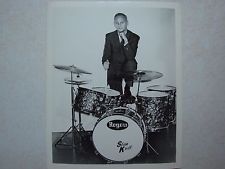
Recently I acquired a set of Rogers Holiday drums from the Covington, OH era. I bought Stanley Krell's drums. He was a Rogers endorser in the early 60's. I think these drums were stored in their cases for the past few decades at least. The snare drum with this set is a very early/rare pre-oval badge Dynasonic. According to one of the resident experts at the Rogers Owners Forum, this is a once in a lifetime find.
I found these advertised on Craigslist. With the ad already posted for six days I didn't expect to even get an email back from the seller. Sure enough I got a phone call within thirty minutes of my emailing him. I arranged to go have a look at the drums that afternoon, knowing I needed to act quickly if I wanted to have a chance at buying these. Luckily, because of the Thanksgiving holiday weekend, I was the first person to see these. I'm new to the Rogers addiction, so I hadn't even seen a Holiday set in person. The second I saw these I knew these were different than the Fullerton script logo drums I just bought a month ago.
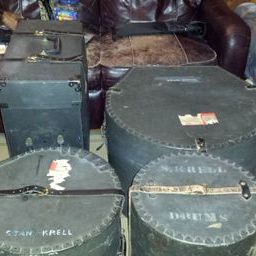
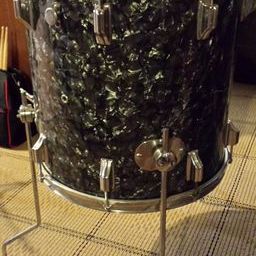
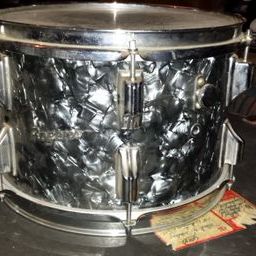
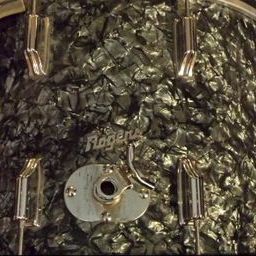
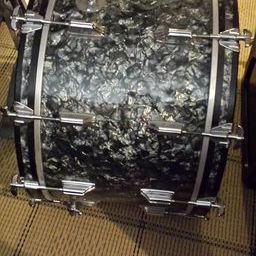
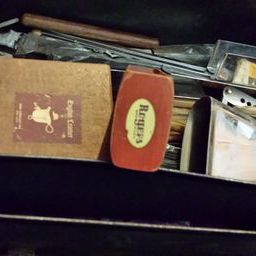
I bought these four cases full of vintage drums and drum equipment. The name on all the cases, as you can see, is Stan Krell. I got them from a wonderful guy named Joe, who buys estates. He got these with the rest of the contents of a home out on Long Island. The homeowner told Joe she bought these drums for her son, back in the sixties, from Stan Krell.
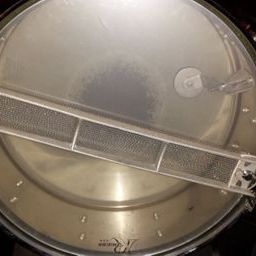
As you can see on the tag, the Dynasonic is serial number 3660. No oval badge, just the script logo. It seems to have the original reso head on the bottom. Needs a good cleaning but seemingly in very good shape for a fifty year old drum. The 12" tom seems to be the oldest, but I'll leave that for the experts. It's got a Cleveland sticker, serial 10880. The 13" tom has a Dayton sticker, with serial 88281. The 16" floor tom has a Cleveland sticker, serial number 42570. The 22" bass drum has a Dayton sticker, with serial 80690.
All drums seem to have the original Rogers heads still, with the exception of the snare. There is one beat up, 14" head in that rolling case though. Hard to tell if it's a Rogers now, but it's there nonetheless. I included a picture of a T-Rod and Claw as an example of the condition this entire set is in. I have a feeling these have been sitting in their cases since the sixties.
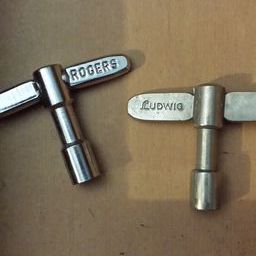
Camco bass drum pedal, Swivo HH stand, two 18" Zildjian Rides, 14" Zildjian hi hats, and what seems to be a Ludwig 10" splash cymbal. (Did they call them splashes back then?) The Rogers woodblock is interesting. Didn't do much research on it. I have to imagine that's rare. The cowbell seems very well made. No name on it, but it says Ludwig on it's hardware. A half dozen pairs of Regal Tip sticks from that time period. Some no name brushes, heavy and wiry. A Rogers drum key and a Ludwig drum key. The custom road cases themselves also just really add to the completeness of this find.
I'm going to play these drums. I'll probably re-skin them after an hour of light playing to preserve the heads, but I can't wait to get some time behind this set. I will never break any of this up either. That woodblock will not go up on eBay just because it's probably rare. I really think that Dynasonic should remain with the rest of this set too. Like I said in my original post, this is really like a time capsule. I definitely intend to keep it that way.
I welcome any info any of the experts would like to share regarding these drums. From what I can tell from the dating guide, the 12" was possibly made in 1957?!?!? The FT is early/mid sixties Cleveland while the 13" and the BD are mid/late sixties Dayton. That's all the research I've done so far.
My Drums - Their Story
I got to thinking the other day about my drums and their stories. Or is it about my stories attributed to the drums. Either way I believe that each drum, if it falls into the hands of a professional player, ends up with a story to tell. I am not a vintage drum collector but I have many drums and each has a tale to tell. Their story can range from how I got the drum, where it was used or the individual or company that made the drum.
I have already written about my 6 ½” X 15” single-tension Leedy Snare Drum - (March 2014). It opened the Eastman Theatre in 1922 with a fortissimo snare drum roll played by William G. Street for the Star Spangled Banner. The drum was then used by Oliver Zinsmeister in the “President’s Own” United States Marine Band and probably spent a few gigs at the White House. The drum is now here with me at the Eastman School of Music and has been used for many formal occasions involving the Eastman Theatre. Not a bad history for such a drum.
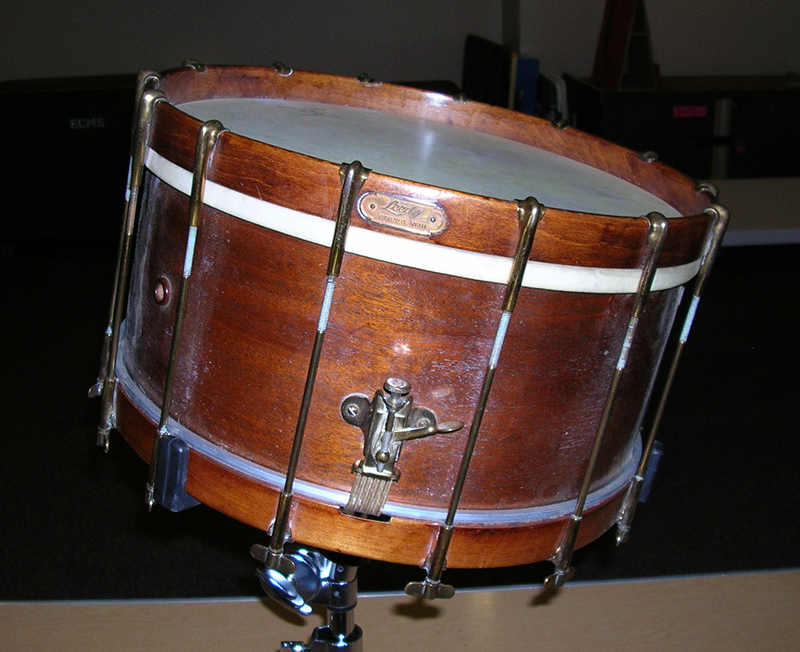
In another article for Not So Modern Drummer, I have written about the Rogers Drums that are part of the Eastman School of Music Percussion Department - (September 2014). I would like to single out one of the Rogers 6 ½” X 14” drums that is my personal snare drum. The Rogers Drum Company gave the drum to me since I was endorsing the drums and supplying the Eastman Percussion Department with their equipment. Now why is one drum so important? This drum was in my studio and played on by all the students for their lessons. It also had another function. It was the drum used for all the auditions at the school. I auditioned 1,618 students in my 49 years of teaching – only 258 of those who auditioned were accepted. This drum has seen the best and the worst. If it could talk, I am sure it would have stories to tell.

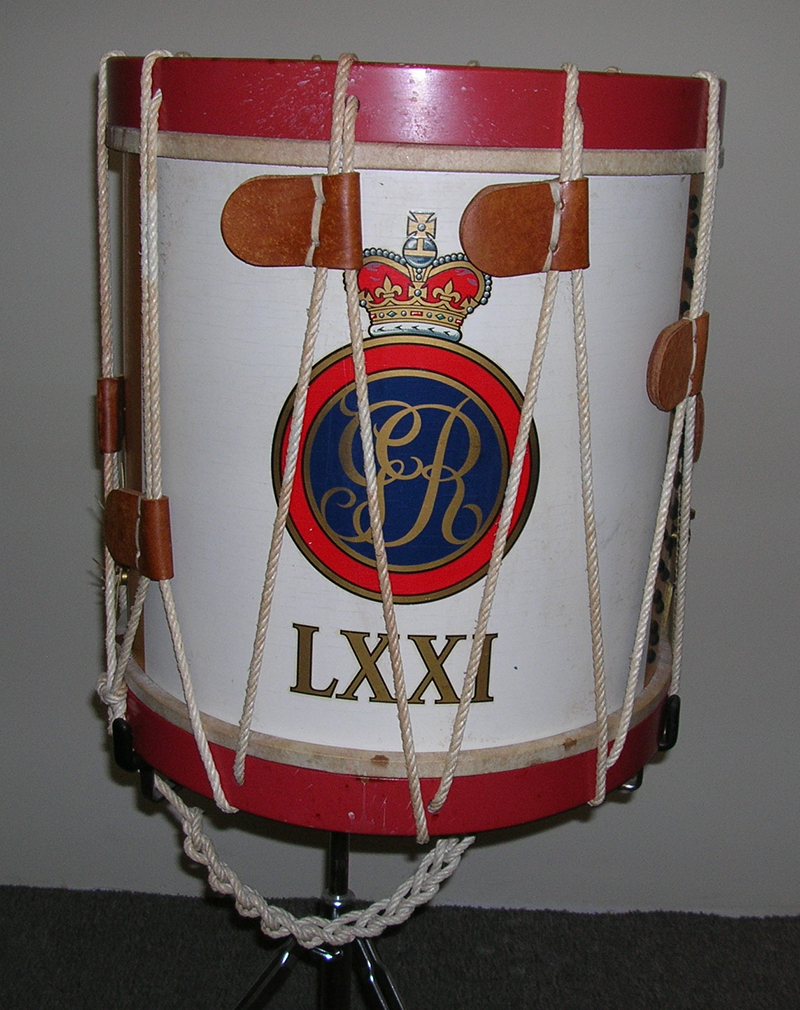
In 1976 the Eastman School of Music played host to the first Percussive Arts Society International Convention (PASIC). The Premier Drum Company was exhibiting at that convention and was featuring a rope tension drum 19 ½” X 17”. Jim Coffin was the man in charge of this exhibit and he being a friend of mind suggested that I buy one. I did and have had it ever since. I have played it on several occasions and each time I use it I am reminded of the convention and what a great event it was and the drums position in the history of drums. Inscribed on a plaque on the shell of the drum is the following:
REPLICA DRUM AS USED BY 71st (HIGHLAND) REGIMENT OF FOOT – FRASER’S HIGHLANDERS – 1776-1787 – LIMITED EDITION NO. 233- MADE IN ENGLAND BY THE PREMIER DRUM CO. LTD.
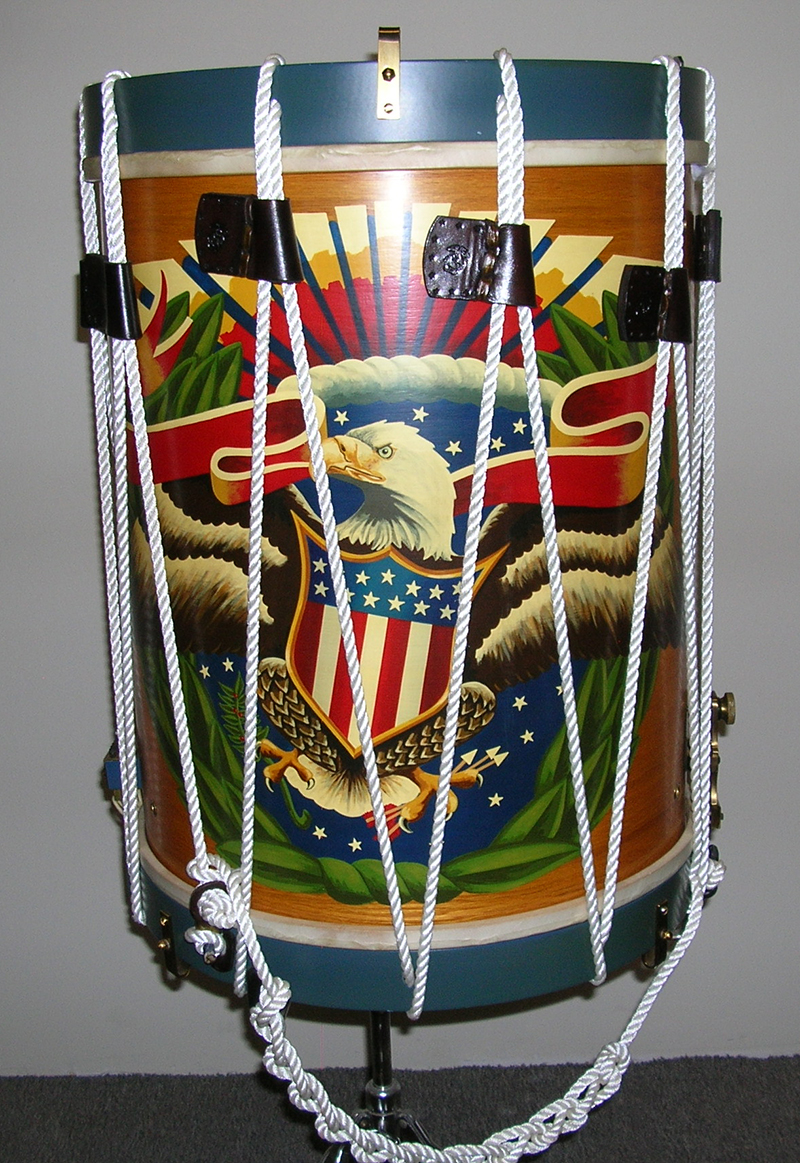
Having a son who is also a drummer/percussionist has its rewards upon reaching milestones in your life. When I turned 55 years old he had W.H. Reamer make me a replica of The Grand Army Republic (GAR) Drum with the emblazonment of the Eagle clutching arrows and a shield – 21” X 17”. Since I was also in the “President’s Own” United States Marine Band, W.H. Reamer emblazoned the shell with the Marine Corps Globe and Anchor, my name and dates I served in the band. This is a beautiful drum that sounds as good as it looks. I have used this drum on countless occasions for rudimental demonstrations, clinics, parades and lectures. Inside the drum across from the vent hole there is plaque that reads:
PRESENTED TO JOHN H. BECK BY JOHN R. BECK – FEBRUARY 1988
I also had W.H. Reamer make the same drum for my son. Now we have matching father and son drums. He was also in the “President’s Own” United States Marine Band and has the Eagle and the Globe and Anchor on the shell.
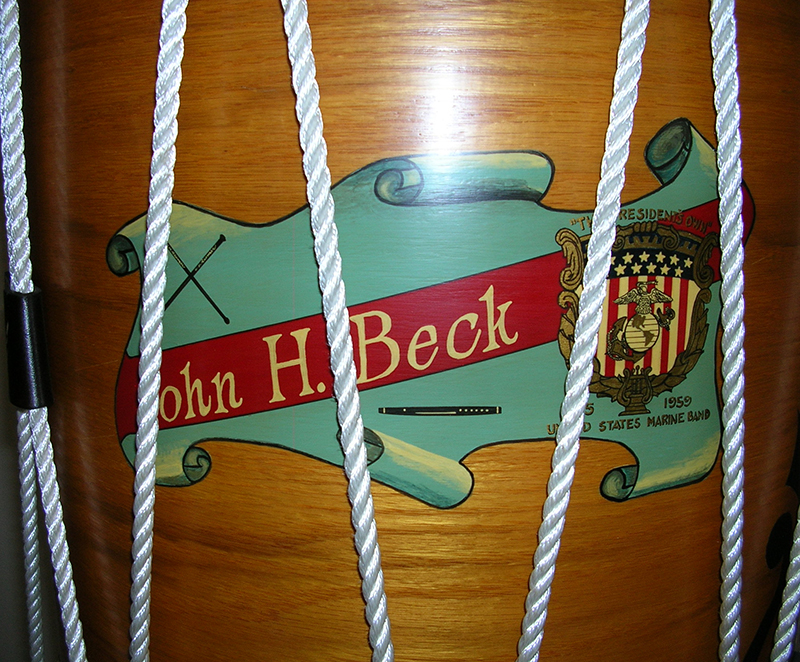
As I mentioned in the previous paragraph about having a son who gives great gifts at milestones in my life, the 6 ½” X 14” Orlich glass drum was a gift when I retired from playing timpani in the Rochester Philharmonic Orchestra after 43 years. As you can see the plaque reads – JOHN H. BECK – ROCHESTER PHLHARMONIC ORCHESTRA - 1959-2002. This drum was a big surprise to my students as well as some auditioning students. I always had my Rogers Drum for them to play on but had the glass drum there so they could experience its tone and feel that I might add is great.

There you have the story of MY DRUMS – THEIR STORY. You can decide if drums have a story or the player gives them their story – I think it is collaboration between the two or said in another way – IT IS A WIN WIN SITUATION.
1960s Leedy Shelly Manne Set
I really like Leedy drums. I know some of you share my passion for these fine American made drums. I just love the history of this company, and besides, the drums are high quality and beautiful. When I was a young boy there was a sign artist that lived next door to us. He painted signs for businesses and such, and he was a very good painter. On day I went over to his shop and there was a drum head he was painting for a local band. They were called The Wild Cherries. I remember the look of the letters on the head and what stuck out the most was the Leedy logo on the head. I had seen the Ludwig logo on Ringo's drum head and I was not as dumb as some people to think it was part of the band's name. I had never heard of Leedy drums and so I guess I was dumb at first to think the band's name was Leedy the Wild Cherries. I soon started learning information about Leedy drums from another drummer who told me they were the same as Ludwigs. That information wasn't exactly right even though Ludwig and Leedy were owned by the same company for many years, and Leedy and Ludwig were even combined for a few years in the early 1950s. Then I had a friend who had a set similar to the set I'm featuring from my collection this month. He told me Leedy was not just like Ludwigs they were just like Slingerland drums. He was also somewhat right, because Slingerland bought Leedy from Conn in the late 50s and basically made what some people call "Slingerleedys". This drum set from my collection is a Slingerland built Leedy set from the early 1960s.
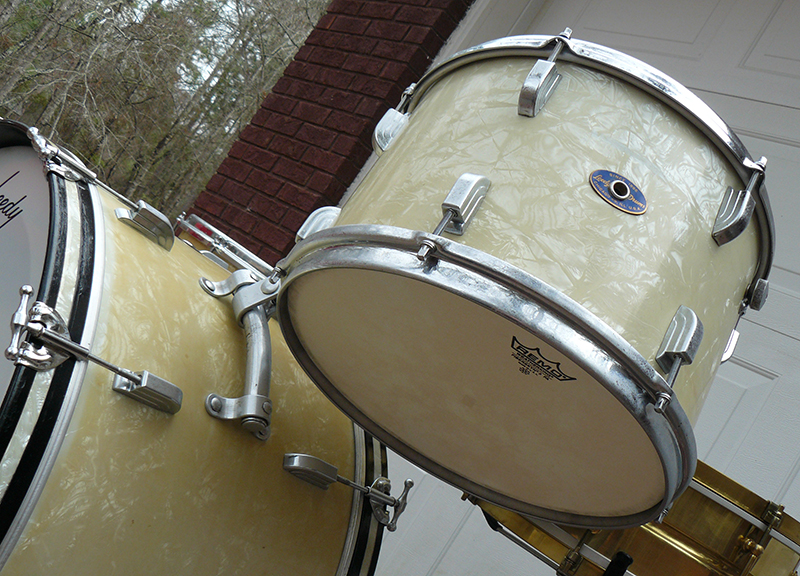
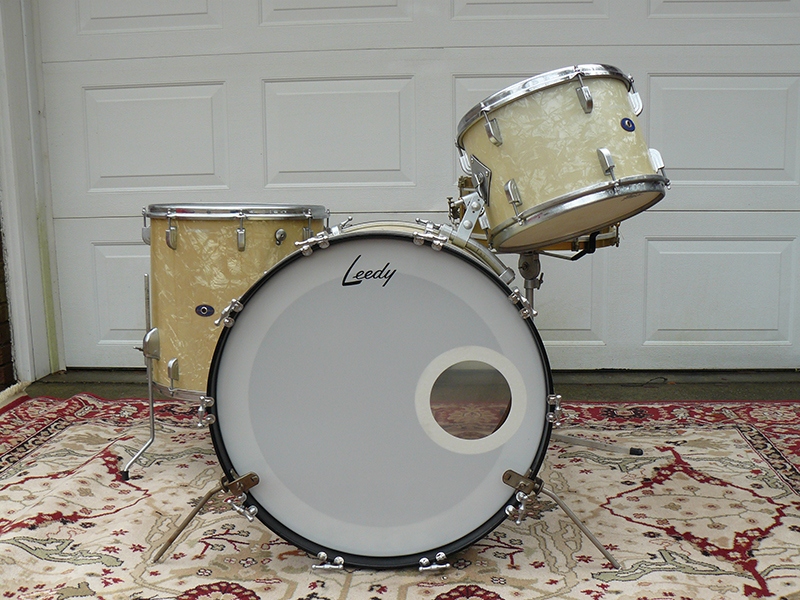
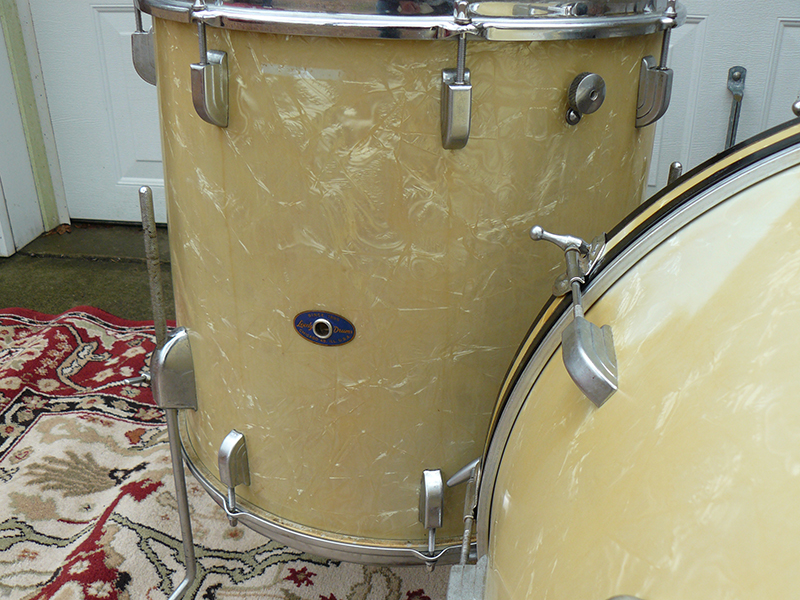

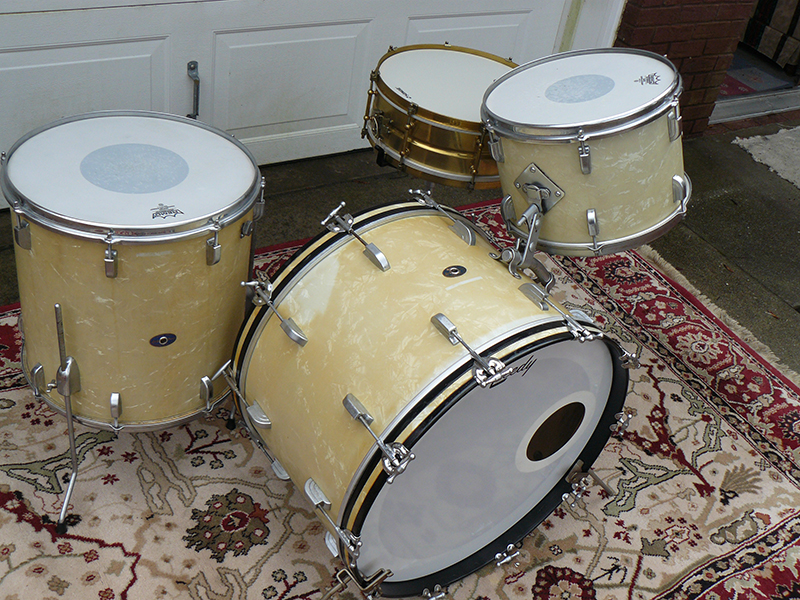

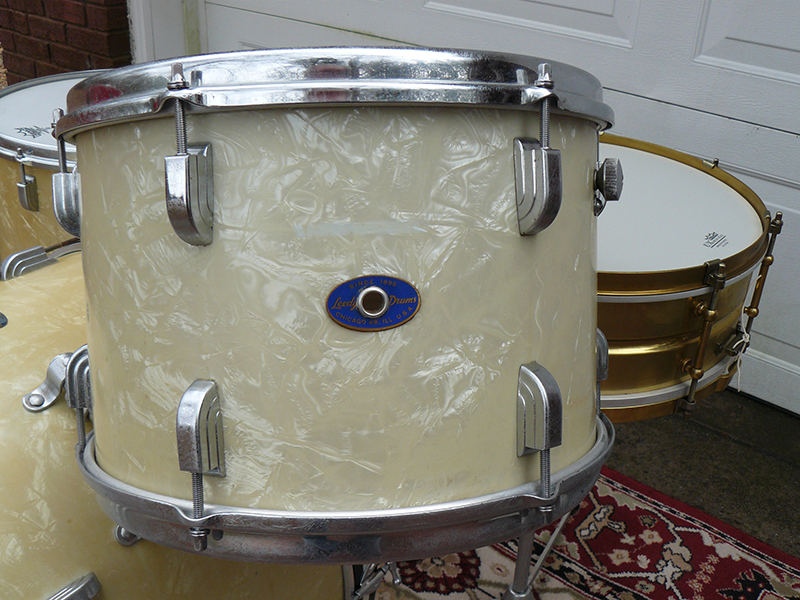
Leedy drums from this era (1956-1965) are very similar in every way to Slingerland drums with the exception of the lugs and badges. This set is a 22", 16", 13" set in standard depths. The lugs are Beavertail Leedy Lugs. You will hear the expression "Art Decco Design" when referring to these sleek modern looking lugs. The blue oval Leedy badges have Chicago 48, ILL. USA on them. This will date them 1960's. The first Leedy badge Slingerland made was a brass oval that dates drums mid 50s. The first blue oval badge '57-'58 didn't have the 48 after Chicago. The rims are "Stick Savers just like Slingerland drums. The Finish is yellowed white marine pearl. The set looks almost butterscotch. The yellowing is not consistent over the whole set. Something interesting to notice in the photos are the unfaded areas on the kick drum. The set had a cloth muffler across the batter head with excess cloth covering an area on the shell. Where the cloth shaded the shell the finish is still white. There is another white area where the front calf head was not tensioned equally. The place where the head covered the shell is still gleaming white. There was also a small sticker on the bass drum shell by the badge, and on the floor tom shell that covered a small spot. If the drums had been kept covered by a sheet when not in use they would probably be a lot whiter than they are now after 55 years. Any way, I still love that vintage "vibe" these drums have. They are beautiful to me.
I always share my adventures in collecting, because it is a lot of fun and exciting to score a great drum set. I buy some drums on E-Bay and I am not at all knocking that method of acquiring vintage drums, although It is like fishing in a barrel. It's more fun, and you really feel like you have scored when you find drums at good prices from owners or unlikely places. I realize that's more difficult now and it's becoming more difficult all the time. These drums were owned by my great friend Butch Braddy. I've told you before that he has helped me get a lot of drums over the years. He is the sales manager of the drum department at a large music store in a local city. He gets the opportunity to pass on or buy a lot of great vintage drums. I am so glad he's my friend. If he is letting something go or thinning his collection, I get a call. I try to keep some cash ready for just such an emergency. He called me recently to tell me about this Leedy set that he was parting with. I was there to lift his burden as soon as I could get to him. Thanks, Butch for this great set. Until next time, always peek into those dumpsters. You never know when someone has tossed out a Leedy Black Elite snare drum.
1928 Super-Ludwig Nickel-Over-Brass


As many vintage collectors will agree, the early 1920’s – 1930’s Ludwig heavy brass snare drums had a certain ‘mojo’; a magical feel and sound that you just don’t hear in modern drums today. I’ve been seeking out these rare drums for many years. One day, I came across Facebook posting from a drummer in New Zealand showing a late 1920’s, perhaps early 1930’s, Super-Ludwig 5 X 14”, 10-lug, nickel-over-brass snare drum in very good condition. I sent him a message inquiring about the drum. I was a little cautious at first, as he wasn’t using his given name on Facebook, and New Zealand was a long way to ship a vintage drum. We exchanged a few emails followed by an interesting long-distance call to the land of the Kiwi’s. The owner was a Scottish drummer now retired and living in NZ, now known by his stage name, Will McCee. The Super-Ludwig had been passed down to him by his brother, who inherited it from their father. Their father bought the drum around 1928. He described finding the drum in a shed, “He (Dad) was real fussy & when I unpacked this drum, it was covered in grease. It looked like a real mess, but after it was cleaned, we could not believe what we were seeing - even the snare throw-off looked like it just came out of the box. It has not been re-plated so it beats me what to say. I haven't even polished it, just soft clothed it… It looks like he played it with the snare guards off for some reason. They were packed in a box with the screws inside the case and were like new. I have no idea why, but that's the old man… I only wish I knew more about its history, but I do know he favored this drum over all others. When he got a new kit, he always ordered it without a snare drum and kept this drum.” So after some back and forth, we came to terms; he even threw in his Dad’s drumsticks, case and the (tattered) canvas bag in which he found the drum.
I waited patiently for the drum to arrive, but in the meantime, I did some catching up with a few vintage drum catalogs. In the 1928 Ludwig catalog, the Super-Ludwig No. 231 5 X 14” ‘All-around model’ was described as “the sensation of the drum world” and sold for a mere $45. Ludwig went to great lengths to describe the many attributes of this exquisite snare drum: “Perfect snare action control is the secret. The Super-Ludwig is so designed that snares are adjusted individually. Each snare can be tensioned separately. The snare throw-off is made in a parallel line. That means that the snares go off and on under tension. Once you make your snare adjustment, you can depend on it to remain exactly as you have set it. The snare action is absolutely certain. Playing is easier and you can get snap and instant response of all the snares from any point from rim to rim. The snares have a longer play and consequently are more free to vibrate. You can use either gut or wire snares and change in less than a minute. It has every good feature you ever desired in a drum. The Super-Ludwig fills the bill for the drummer who wants the best and will have nothing short of that. The Super-Ludwig Snare Control is positive. It is quick to act and there is only one main adjustment. (No more than the ordinary strainer.) This drum sold with gut snares, silk-wire covered or coiled wire optional. Wm. F. Ludwig, selected, batter head and Ludwig Crown Brand snare head.” That certainly would have sold me.
So to my relief, the drum arrived a short while later, with no shipping damage (never assumed given the distance). It had some minor pitting but was in overall excellent condition for being almost 90 years old. As described, the drum had a two-piece nickel-over-brass shell with the edges folded back to the inside of the shell (like the early Black Beauties), ten tube lugs, and a fully functional Super-Ludwig snare mechanism. “Ludwig” and in smaller block print, “Trademark”, were engraved into one of the upper panels. “Super-Ludwig” was hand-engraved into the bottom hoop (not stamped like later models). Included were Will’s Dad’s drumsticks, case and the tattered canvas bag that had protected it for some many years. I put modern heads on the drum, as the intention was not to let it sit idle on a shelf. I truly love the pop of the straight, single-flanged hoops and the deep, punchy sound one can get out of these heavy brass beauties. The Super-sensitive strainer may not be for everyone but I do think parallel action strainers give a more uniform, sensitive response. However, they have a tendency to disengage when played loudly.
I assured Will that I would take good care of his father’s drum, preserving it for the next generation. He seemed quite satisfied by this promise. I don’t think it was easy for him to sell. Will wrote later, “I am so pleased you like it. I'm glad you are not here to see the tears in my eyes - enjoy it as much as Dad did. Thank you for finding it when you did. I needed something to take my mind off my problems and I was worried that my gear would end up at some auction with people bidding who had no idea about drums - so it is a win, win situation.” This Super-Ludwig now sits in honored company with other heavy nickel-over-brass shell contemporaries, a Ludwig Super-Sensitive and a New Era (all 5 X 14”). But that’s another story… Now, I just need to find the 6.5” counterparts… :o).
1925-32 Ludwig & Ludwig 6.5x15 Black Ebonized Inlay Super-Ludwig Band Model
By Mike Curotto


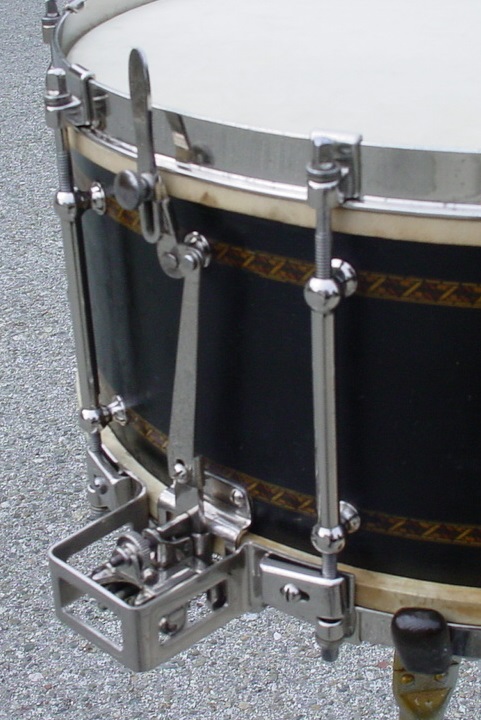

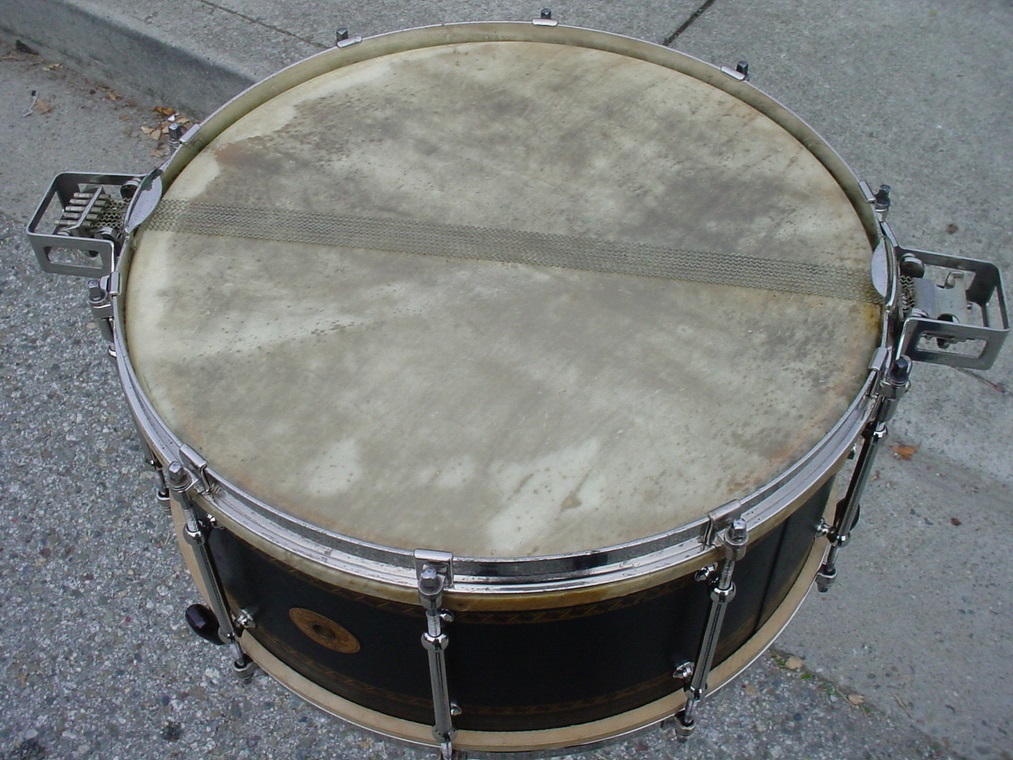

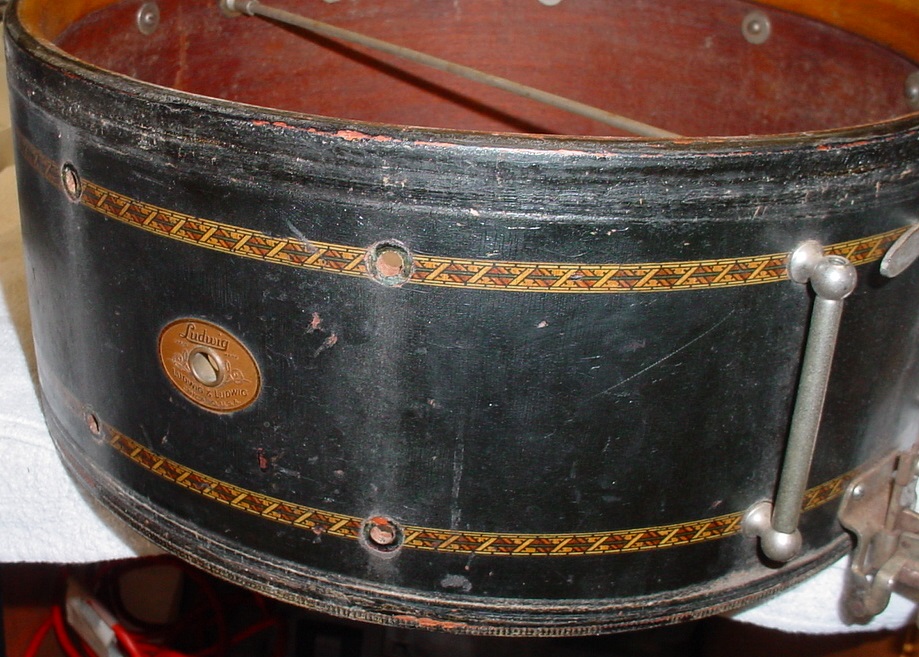

Hi all,
This snare drum was a gift to me from my good friend and fellow drum collector Bun E. Carlos. We had done a couple of big deals at the 2012 and 2013 Chicago Vintage Drum Shows so as a thank you Bun gifted me this drum.
1925-32 LUDWIG & LUDWIG 6.5 x 15 BLACK EBONIZED/INLAY SUPER-LUDWIG BAND MODEL
The Shell:
The Black Ebonized finish (1925-1939) was originally a special order but in later catalogs it was offered at no extra cost. The finish shows its age but is all there and cleaned up nicely with a product called Naphtha. I just learned about this product from a friend who does a lot of custom woodworking. I am happy with the outcome as this product did not harm the finish. The Black Ebonized finish is also high-lighted with two “decorative” faux inlay decals that surround the shell. The solid mahogany shell interior is in good shape and is factory-marked ”BLACK”. The brass oval badge is clean with a tight grommet. There is no tone control, definitely pre-1933.
The Hardware:
The nickel hardware is all original but it definitely needed a good cleaning and polishing. Everything came out great. The Super mechanism works perfectly. The bottom rim has the stamped “Super Ludwig” which puts it after the earlier engraved “Super-Ludwig” models. The original Super wires are intact and work well.
Of-the-era top and bottom calf heads rounded out this restoration. These 6.5 x 15 Super-Ludwig Band Models are classic examples of a great era. Thanks again goes to Bun E. Carlos for gifting me a great drum.
Enjoy!
WIW? Legend Copper Snare
Got something that you want to ask the community what’s it worth? Send it in and we’ll post it here. – NSMD Anthony Foti wants to know opinions on what this Legend copper snare is worth.
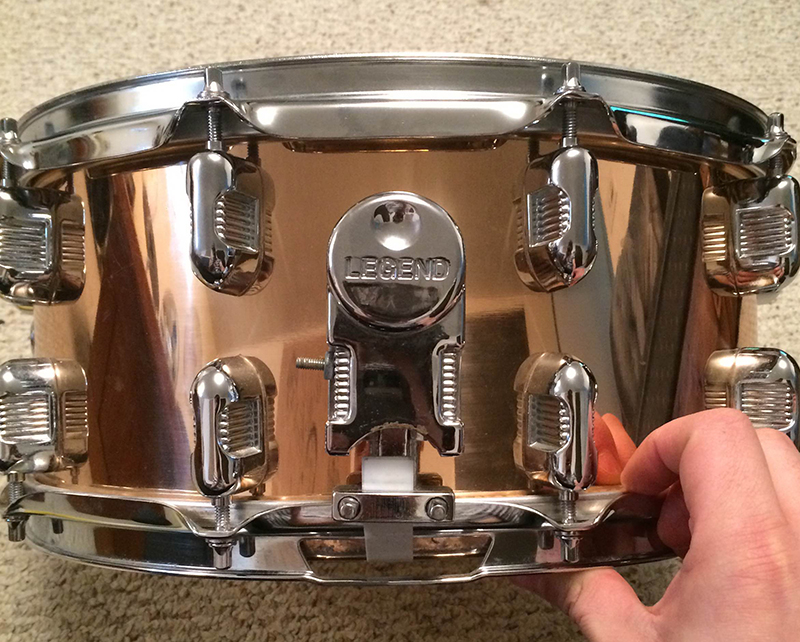
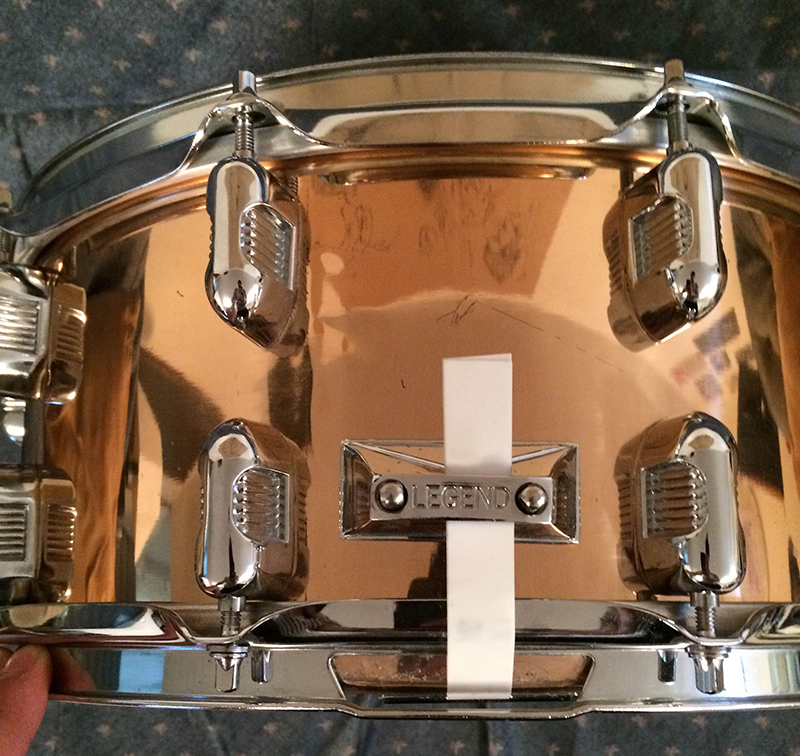

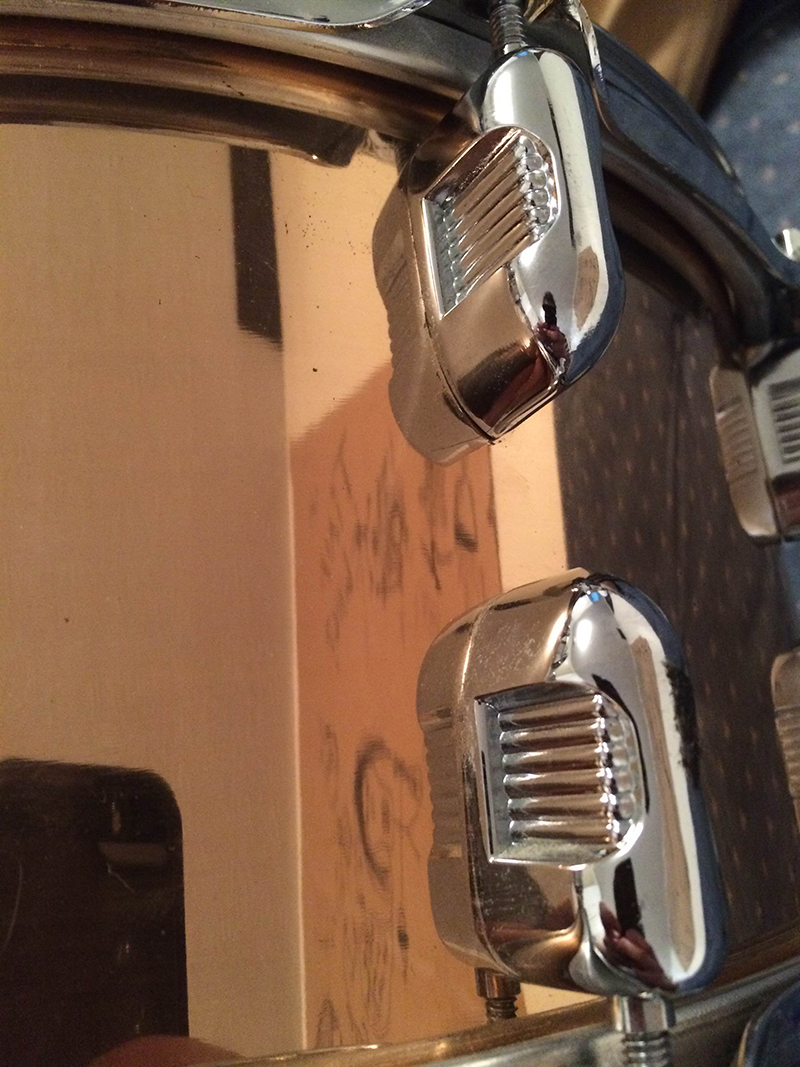
What do you think? Let us know in the comments below!
February 2015 - Brrrr!!

Ah, cold, cold, cold, February! You make us want to stay inside and obsess over our vintage drums! Not much to report from the Eastern front but these few tidbits-
Read more2x4 Famous Snare Drum
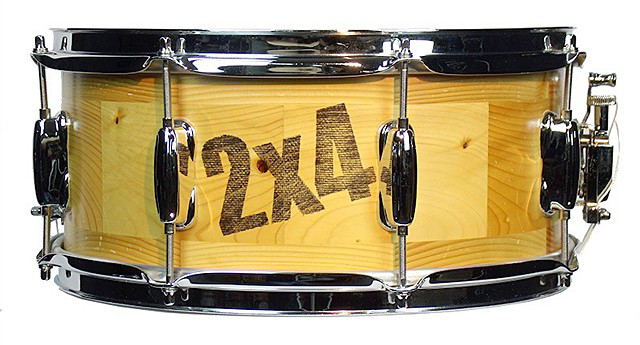
Famous Drums' "2x4" Custom Snare Drum
Put the Drums in the Organ, Please...


1932-34 Slingerland 5x14 Artist DuAll Model (“Pulley” Version)
By Mike Curotto
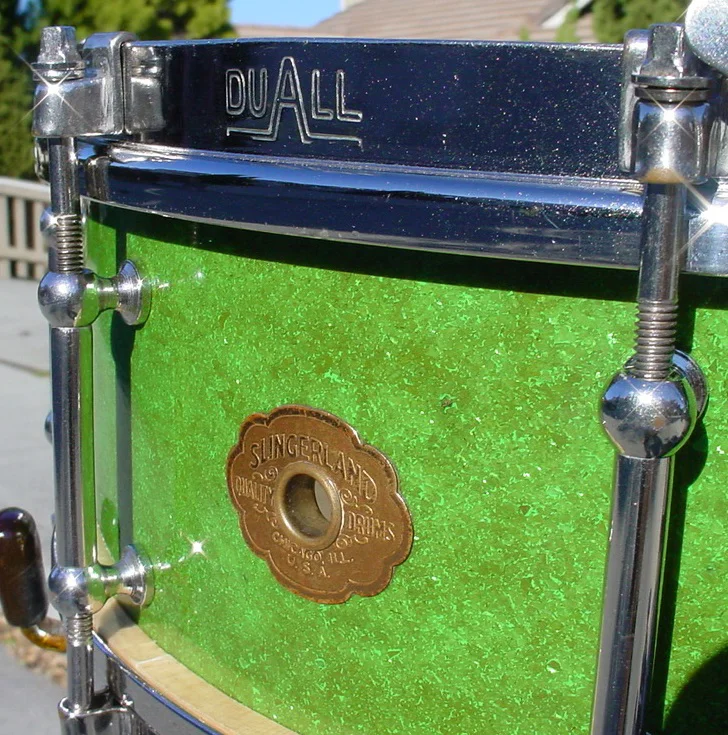



Hi All,
A few years ago I was contacted by drummer/educator Ed Soph who wanted some information about this drum. I told him what I knew and after a few months I was able to purchase the drum from Ed. Over the years I have discovered three versions of the Slingerland DuAll mechanism: 1. A center post very similar to if not a direct copy of the Super-Ludwig center post (usually equipped with a Tone Flange). 2. An interior “pulley” type mechanism instead of a center post (no Tone Flange). 3. No center post and no “pulley” mechanism (no Tone Flange). This snare drum has the “pulley” mechanism
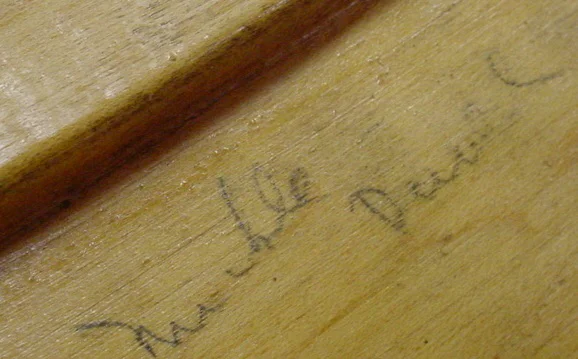
The Shell: Green Sparkle from the 1930s is notorious for having black “cancer” spots. Fortunately this drum is cancer free. The finish had the normal years of accumulated schmutz but everything cleaned up and polished up nicely. The interior of the solid maple shell was very clean with no re-ring separation other than a 2” section, no big deal. The shell has normal bearing edges top (no Tone Flange) and bottom . The cloud badge is very clean with a tight grommet. Lastly, a nice factory pre-assembly artifact was found on the interior of the shell...”Nickle DuAll”.
The Hardware: The nickel hardware was in great shape and was very easy to clean and polish. There were a few errant tension rods but I had the era-correct replacements in my parts stash.
The internal DuAll “pulley” mechanism is clean, well built and looks kind of artsy. The mechanism is smooth, works well but is not as solid as the center pole version that brought on the patent lawsuit by Ludwig & Ludwig. I’ve included interior and exterior photos of this version of the DuAll mechanism. The reader will clearly see the similarities to the already patented L & L Super-Ludwig mechanism of the same era. The manufacturer’s cartouche markings on the snare gates are “L” and “LL”.
The Slingerland Artist DuAll Model was only in production for approximately two years and due to this very limited production run Slingerland DuAlls are extremely rare. As far as my snare drum collection goes, my un-scientific guesstimate based on the number of Slingerland DuAlls I own vs. the number of L & L Super-Ludwigs I own is about 15:1 meaning for every DuAll I own there are 15 Super-Ludwigs that I own. If we look at the more realistic bigger picture out there in the collecting world my guestimate is more like 100:1. That’s just my very un-scientific observation. As always, feel free to weigh-in on the subject as I look forward to your comments and added information.
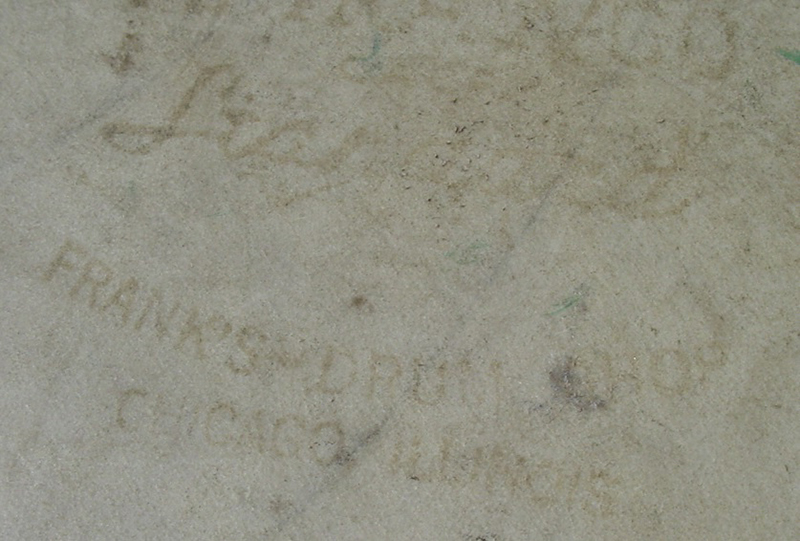
A nice Frank’s Drum Shop calf batter head, Slingerland slunk head and the original snares rounded out this cleaning/restoration.
Enjoy! Mike Curotto
Neal Morse Band, featuring Mike Portnoy - Alive Again Tour

THE "ALIVE AGAIN" TOUR - FIRST STOP, NASHVILLE! The Neal Morse Band will be performing their much anticipated debut album, "The Grand Experiment." The band, featuring award-winning drummer Mike Portnoy, will play ONE NIGHT ONLY in Nashville at Rocketown - Saturday, February 21st!
The Neal Morse Band (feat. Mike Portnoy) Saturday, February 21 at 7:30 PM Rocketown (White Building) - Nashville, TN
TICKETS ARE AVAILABLE ONLINE ONLY AND WILL SELL OUT! Visit www.rocketown.com/events for tickets and more information.
The Neal Morse Band will be hitting the US, Canada and Europe for a winter tour in 2015 and the complete event listing can be found at www.radiantrecords.com.
Castle Drums
Growing up in the shop of a Master Craftsman and Industrial Arts teacher, my Dad taught me a lot about making and fixing things. I learned about metal, leather, printing, mechanical drawing, and woodworking, among many other things. But the most important thing he taught me was quality. While making my rounds at the Nashville Drum Show, I saw many drums that were made with top-notch quality. But even amongst all the quality instruments that were present, some stood out a little more than others.
As I approached the Castle Drum Company’s booth, I at first thought I needed to get more sleep because the drums seemed a bit skewed. Taking a closer look I realized that my vision was fine and the drums were indeed, a bit skewed. David Cheney, the Master Craftsman behind Castle Drums, had come up with something special and a bit different. David had spent over a quarter of a century in fine woodworking as a maker of cabinets, building case work and furniture. Working with odd shaped and intricate pieces, his ability dictated a higher level of thinking about wood and the possibilities therein.
As many of us find as we become older and more proficient in life, we tend to start to figure out what we like and how we want to spend our time. David decided at one point that combining his love of woodworking and drumming might pacify that angst. After all, drums certainly can be made of wood. The one thing that he knew was that he did not want to be just another guy out there painting and assembling drums: he wanted to set himself apart from the rest of the herd. For that, David would have to dare to be different.
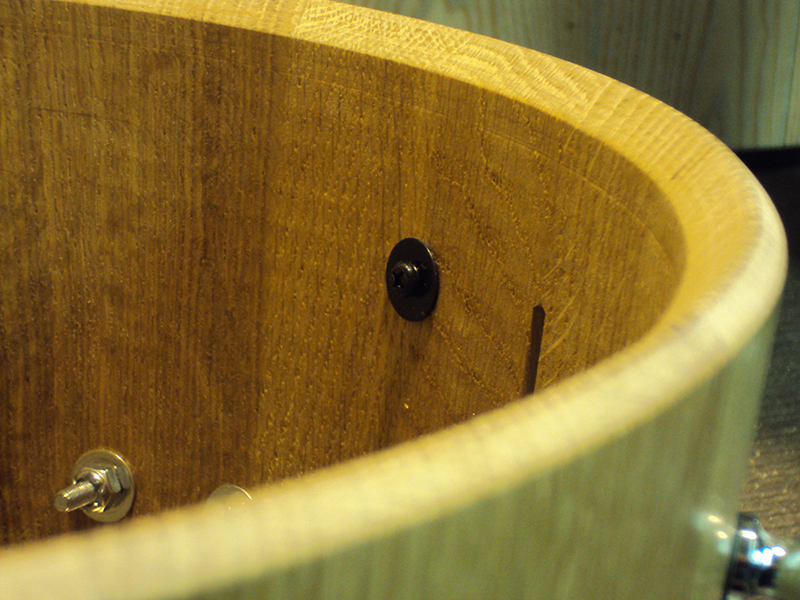
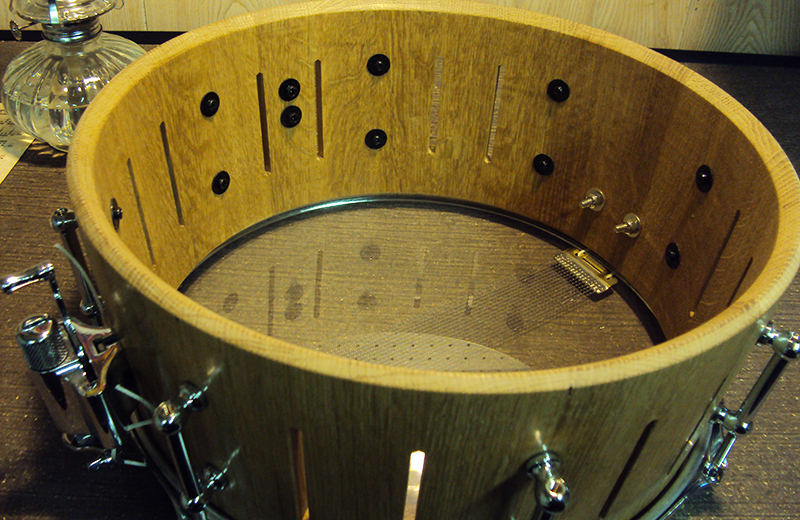
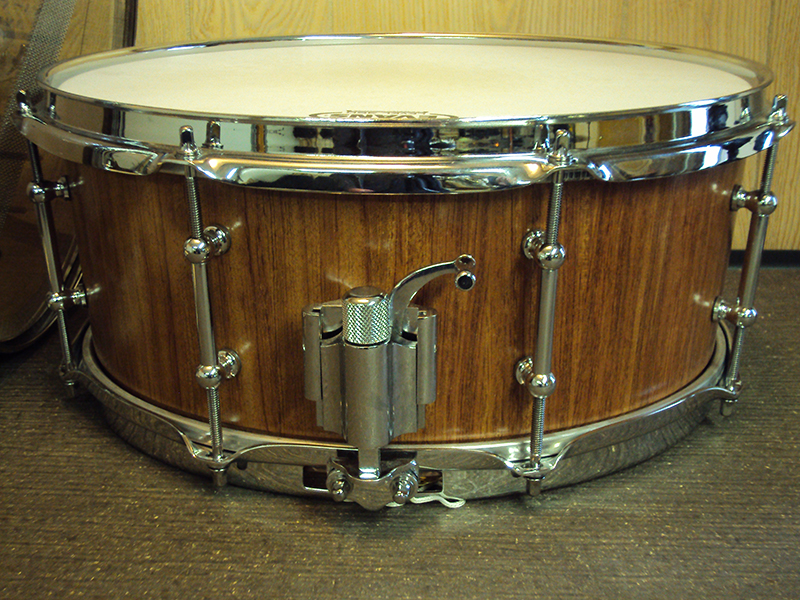
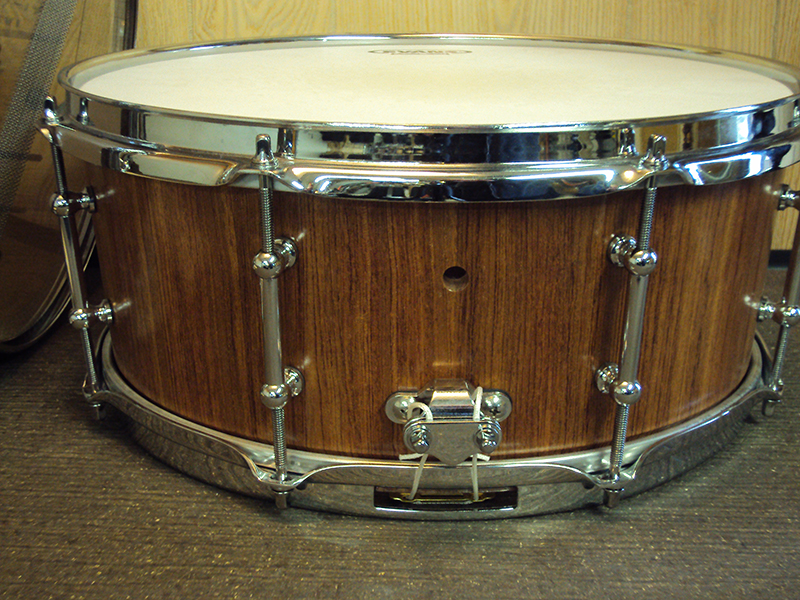
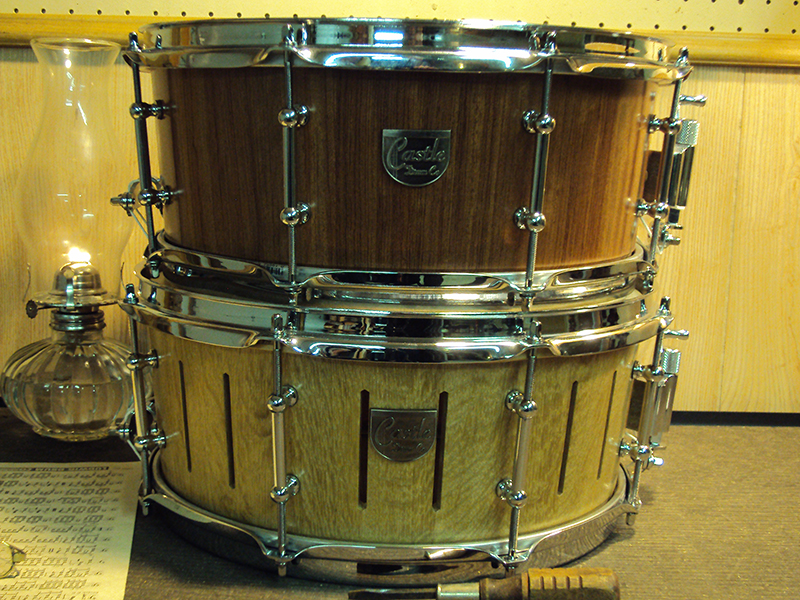
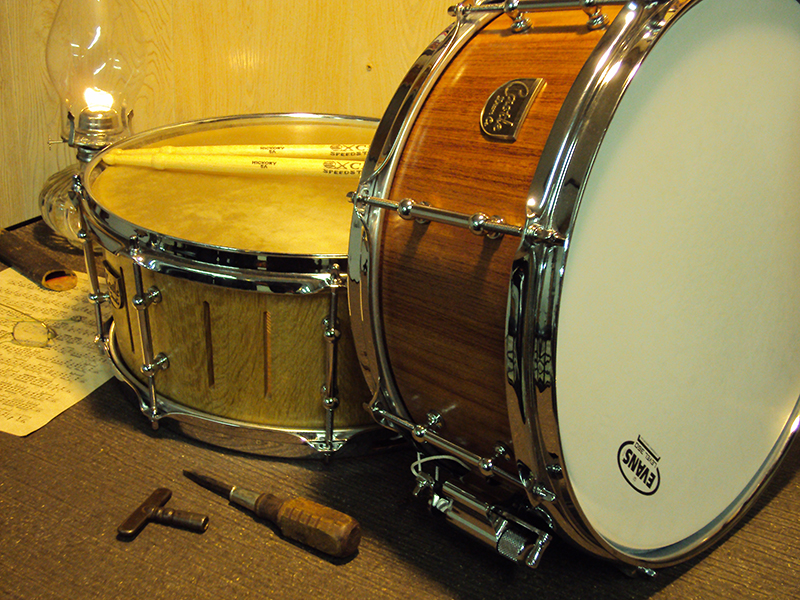
Keeping some of the principles of basic physics in mind, he rationed that if you could channel the sound waves of the batter head down to the snare head in a more efficient manner, you would have a more resonant snare response. Turns out he was right. By funneling the sound waves by way of a slightly conically shaped shell, that energy would become somewhat concentrated onto the snare head. With the application a vertical stave construction shell, the grain of the wood is also in turn aiding in directing the flow of sound waves toward the bottom snare head. This inner vertical grain direction also contributes to providing a little “extra” in bringing out the low-end fundamentals of the shell.
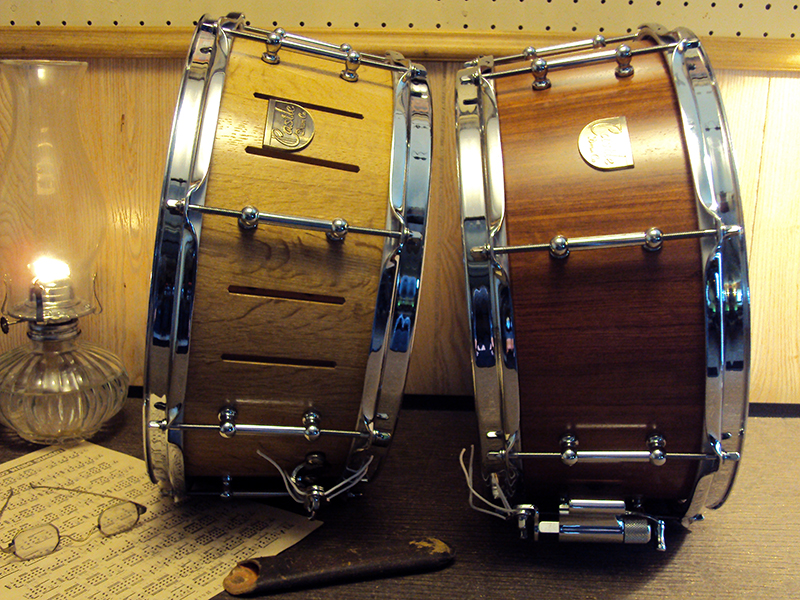
David sent me two drums to review for Not So Modern Drummer magazine: The Keystone and the Watch Tower models. Both drums were very similar but couldn’t be more different in some respects. Each shell had a 7/16” thick stave construction, six inches deep with a fourteen inch batter head. However, the shell tapered down to a thirteen inch diameter for the bottom snare head.
David told me that they did some sound testing with results indicating an average of “20% more bottom head movement, and about three decibels more off the resonant (snare) head than other drums.” These drums are very snappy and produce a great snare response with lots of volume.
The hardware on each drum was chrome plated and included triple flanged hoops, an RCK throw-off and butt, as well as tube lugs. Snares were 16 strand and Evans heads were applied top and bottom. The vent hole was left un-reinforced. Both drums came with very nicely worked 45 degree bearing edges, but, for that “vintage sound,” rounded edges are offered on request.
This Keystone model is made of Bubinga wood, while the Watch Tower drum came in White Oak. Tung oil was applied to the inside of each shell while the outside is nicely lacquered. In playing with different tunings, I thought the Bubinga drum was considerably brighter than the White Oak. The Oak had a much more porous and open grain while the Bubinga was a very tight grained wood; thus resulting in the expected and predictable timbres of each shell. Both drums exhibited a wide tuning range, both high and low. As always, I switched out the plastic heads for pre-mounted calf-skin heads from CT Pro Percussion. The calf skins worked out really nice as they added that warm and earthy sound and feel they’re known for.
I find both drums exceedingly versatile in application. However, the main difference in the two models was that the Watch Tower model has a series of vertical slits in the shell. This plays well with another basic principle of the physics of sound associated with drum design and engineering. Drums are thought to usually project sound mostly from the top and the bottom heads, throwing the sound vertically up and down. They do, however, have an inherent tendency to throw the sound horizontally through the shell. In opening up the lateral sides of the shell via the slits, the Watch Tower drum distributes the sound in all directions. My initial reaction to this is that I think this particular model is exceptionally well suited to the environments of orchestra, concert band, jazz or any “un-miced” small group situations.
The Castle Drum Co. uses a variety of hardware to choose from and includes, but not limited to: RCK, Trick and Dunnett throw-offs, die cast and triple flanged hoops, a variety of lugs, snares and heads. Wood ranges from maple, white and red oak, birch, ash, and mahogany. For something special, try an exotic wood such as zebrawood, purple heart or bubinga. If David can find it, he just might build you your next favorite drum in your choices of dimension and hardware.
I find these drums are in fact fun to play and easy to tune. They tune like a fourteen inch drum but snap like a thirteen. The stick-to-head response is really nice, offering an ease in playing involved passages at lower volumes. Back-beats are exceeding fat and full of rich snare sound. Sensitivity of snare response at the lower volumes is again, very good. As far as the higher volumes: they’re loud!
One of the more surprising and pleasant characteristics of the solid shell was that the effective strike zone was at least double the diameter of most other drums I’ve played. This certainly makes the drum much more forgiving than many if a player tends to play with a wider, wilder strike-zone. The slotted shell (Watch Tower model) did not have quite as wide a strike-zone as the solid shell due to the characteristics inherent to the open design, but was still exceedingly responsive across the head non-the-less.
In examining the Keystone model made of Bubinga wood in particular, I had a very hard time locating the individual wood segments as the joints are tight and the grain is matched as close as possible. After giving these Castle Drums a good go, I would really like to take a look at the furniture David Cheney makes. If the quality is even close, I think anyone who has any of his work must be very pleased. The craftsmanship and quality on these drums is of a very high standard. David’s passion and enthusiasm is very evident and the pride he puts in each drum is extraordinary.
Take a minute and visit the Castle Drum Co. on line. There is a very well made video with David in the shop and more models and options to ponder. If you’re looking for something unique and well made with extreme snare sound and response, not-to-mention a really big, fat back-beat, these drums deserve some real consideration.
From Lancaster County, PA…....Thoughts from the Shop.
Brian Hill
2003 6.5x13 Craviotto/Steve Maxwell Collection Birch Lake Superior Timeless Timber Model
Hi all,
Here’s a snare drum that I’ve had for a while. A good friend of mine was the original owner and sold the drum to me about 10 years ago at the 2005 Chicago Vintage Drum Show.
This is a very rare, special order Craviotto snare drum that was part of the Steve Maxwell Collection (Steve is the world’s largest Craviotto dealer). Only two were made in 2003; #1 is in my collection and #2 is in Sweden last I heard. The story is that the original owner (and possibly the collector in Sweden) wanted a Craviotto Lake Superior Timeless Timber 700 year old solid birch snare drum in a 6.5 x 13 size. The order was placed with Steve Maxwell. I was told by three very reputable sources, Johnny, Steve Maxwell and Joe Kenny that in the process of bending the planks/boards Johnny broke 26 boards in order to get two perfect shells. Steve Maxwell was kind enough to let me quote the “broken boards story” in his own words: ”The deal with the broken boards was this: It isn't just the fact that it is a 13 that makes it hard, (because Johnny does 13s, 12s and 10s all the time with no issues). The issue was that it is specifically the Timeless Timber that made it almost impossible to bend a 13. The reason is that the Timeless wood is exceedingly hard from being under pressure in the lake for about 100 years. As a result, the 14 was really the smallest diameter that could be rolled without it becoming excessively wasteful due to broken boards.”
2003 6.5x13 CRAVIOTTO/STEVE MAXWELL COLLECTION BIRCH LAKE SUPERIOR TIMELESS TIMBER
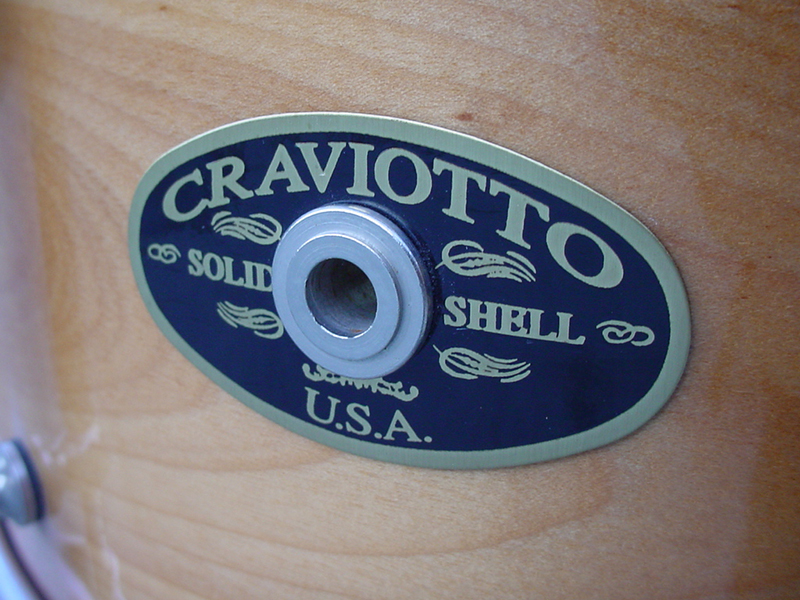
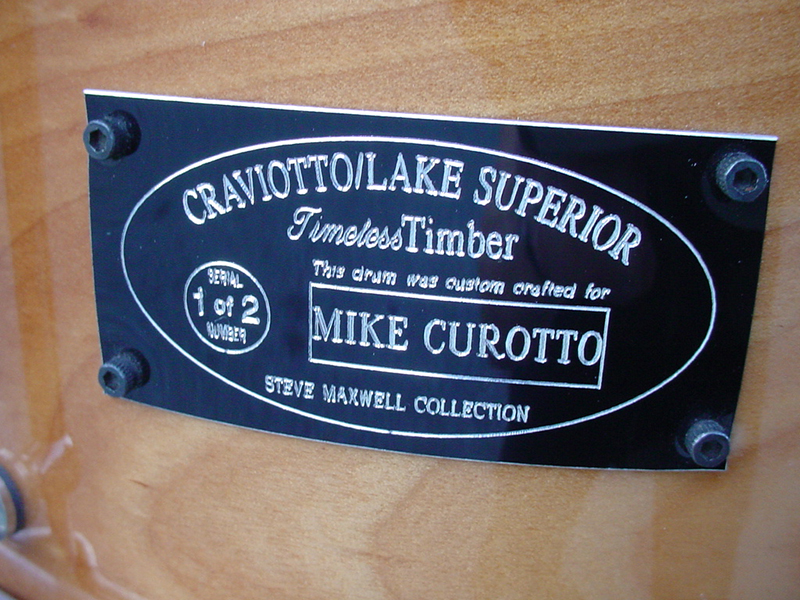
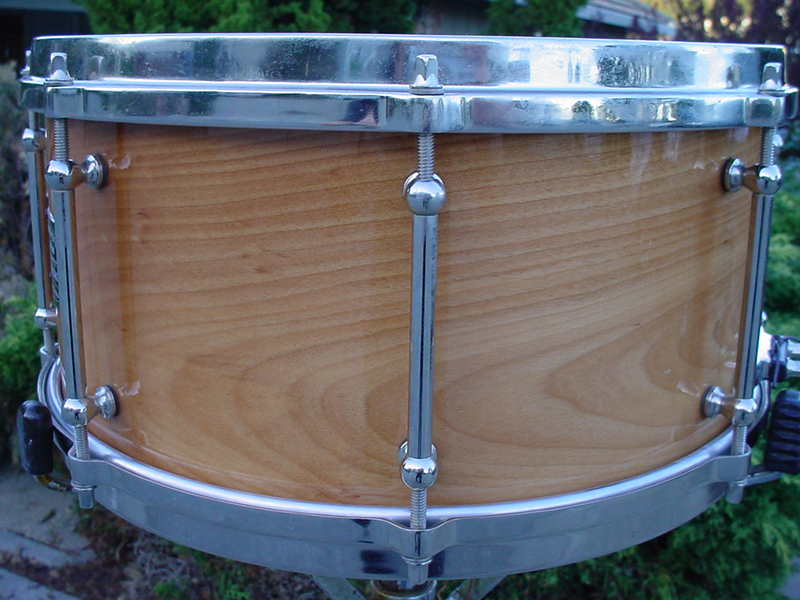
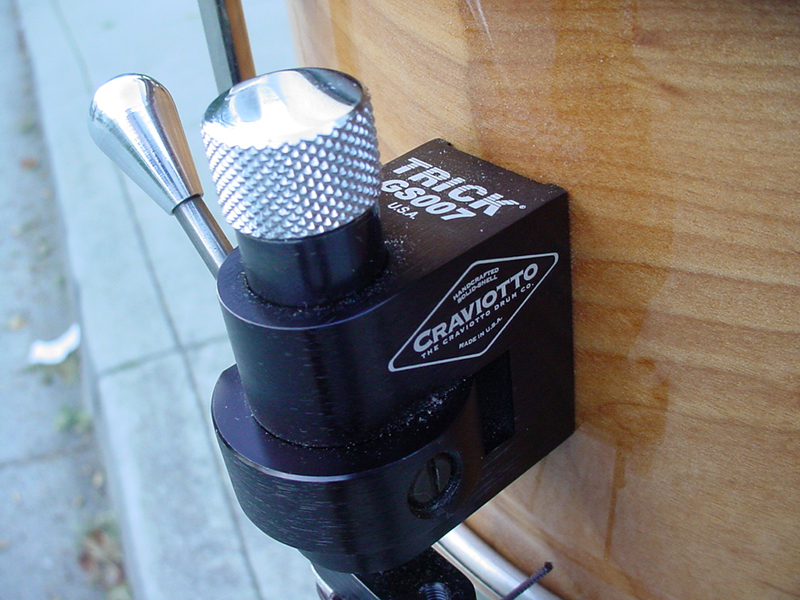
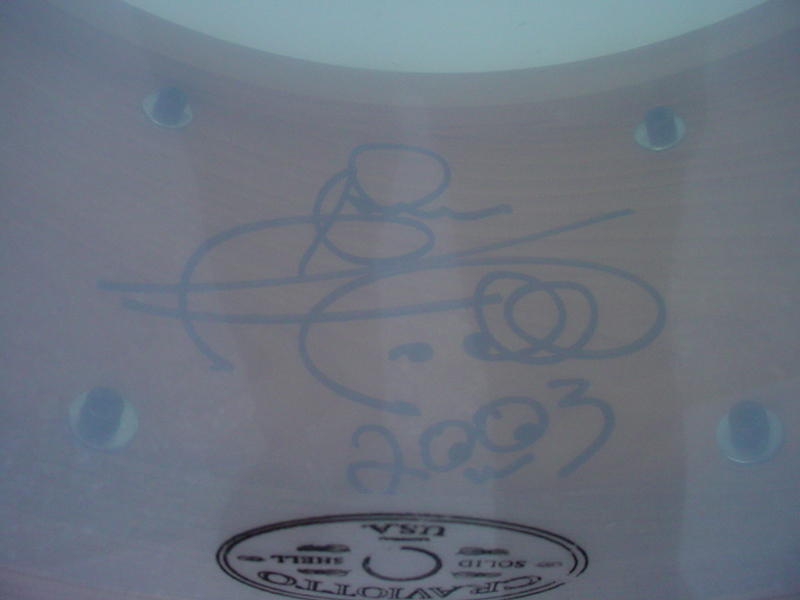
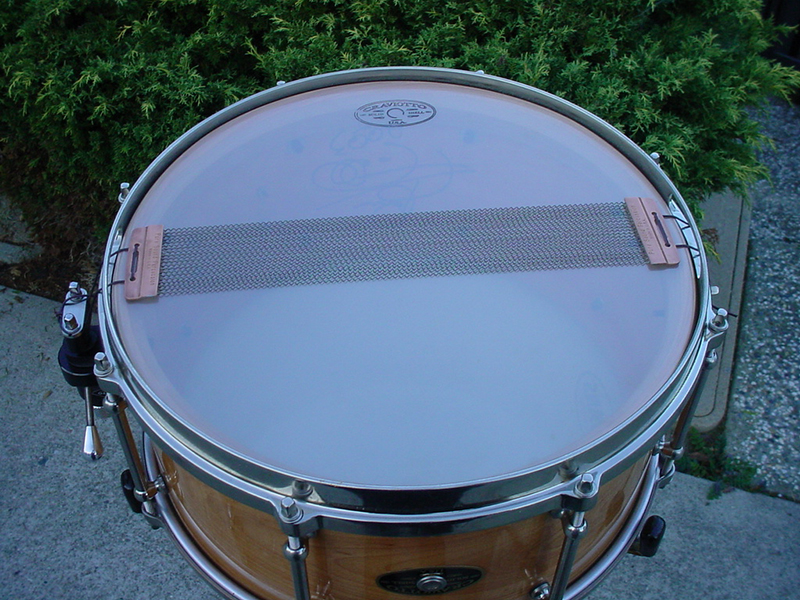
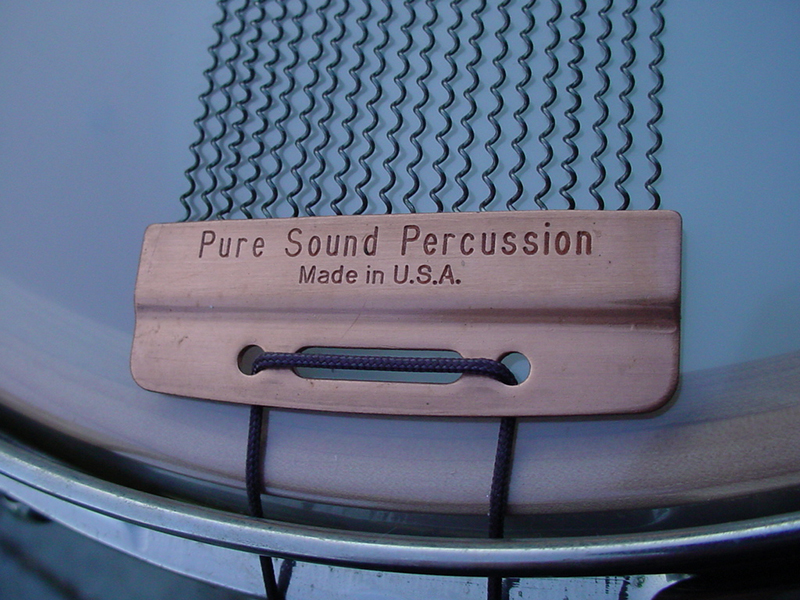
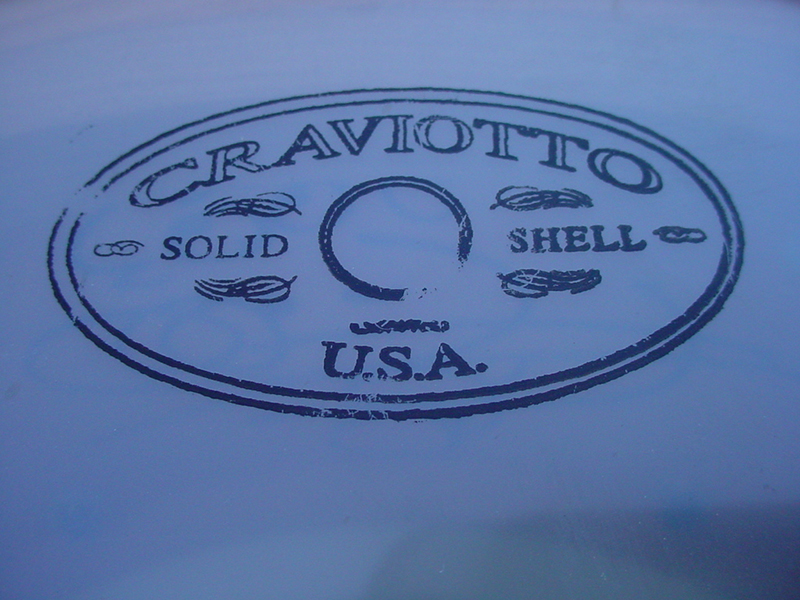
The Shell: The solid birch shell has the typical Johnny Craviotto craftsmanship that he is famous for. The interior is signed and dated 2003. After I bought the drum I asked Johnny if he would authorize a new/updated name plate for me. He came through like a champ.
The Hardware: I’m not sure about drum #2 but this drum has nickel plated hardware, die cast rims and a Trick strainer with the Craviotto logo.
The drum has an Evans G1 batter, Craviotto/Remo snare side and Pure Sound 20 strand wires. The drum has a great “pop” to it and is used all the time in my drum studio.
I felt that this very rare Craviotto snare drum should be shared with my friends, fellow collectors and the vintage drum community.
Enjoy! Mike Curotto
Vintage Drum Heads
With vintage English drums a common enquiry is ‘are my drums pre-international size’?
There is a fair bit of confusion over which English drum manufacturers made shells slightly undersized or oversized, and even then there are misconceptions over which size drums are affected. Here I hope to clarify this for you and give some tips on how to determine if your vintage English drum set takes regular sized heads, or is indeed in ‘funny sizes’!
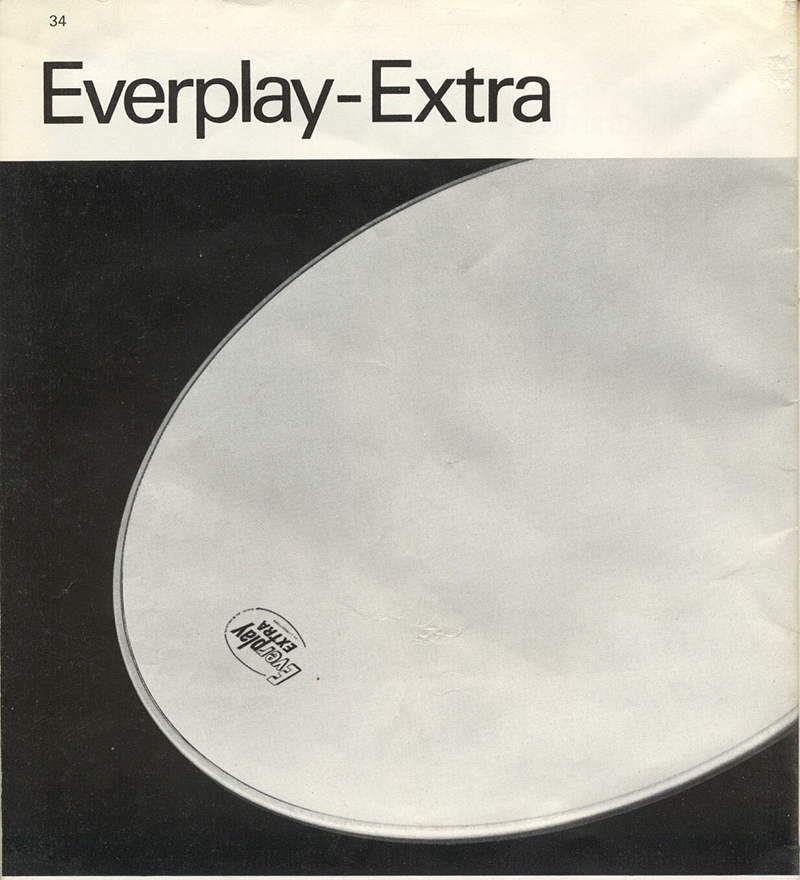
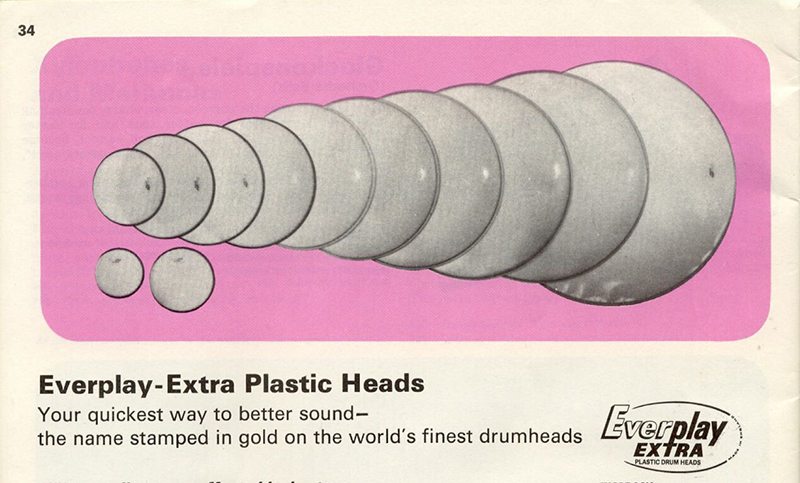
Premier made pre-international sized drums in a 20, 10, 12 and 16 (metric sized shells) on all sets pre-1967. All other Premier drum shells should be standard (international) sized, although there are exceptions (notably larger bass drums pre 1960, that were non-standard sized and fitted with calf heads – 22,24,26 etc). Premier made their own plastic drum heads ‘Everplay’ and ‘Everplay extra’ in the UK, but its worth a mention that in the 1966 catalogue they do an ‘American sized 12”, and 16” head and were manufacturing 13” heads although they didn’t have any 13” toms on their sets.
The actual measurements of pre international drums are as follows:
10” = 9 5/8” actual diameter 12" = 11-7/8" actual diameter 16" = 16-5/16" actual diameter 20" = 19-5/8" actual diameter
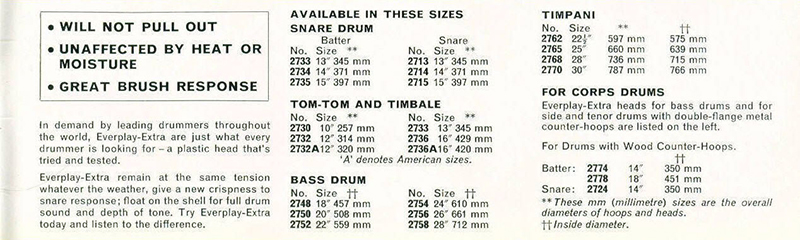

Sometime between 1968 and the early 1970’s all Premier shells became international (standard), and you can generally tell by the badge and kit set up. The 1968 Premier catalogue features a mixture of old and new set configurations but by 1972 all sets featured display configurations with regular shell sizes. It is in these intervening years that sets came out of the factory with just about every combination of standard and pre international sized drums. Typically there was a backlog of pre-international shells in the factory which made it into kit set ups, so many kits between 1968 and 1972 have a mixture of international and pre international shells, some with the earlier 1960’s badge, lugs and fittings, some with the later. It’s not unusual to have a kit with an international size bass drum and pre international 12 and 16 toms and often with a mixture of badges and fittings/mounts.
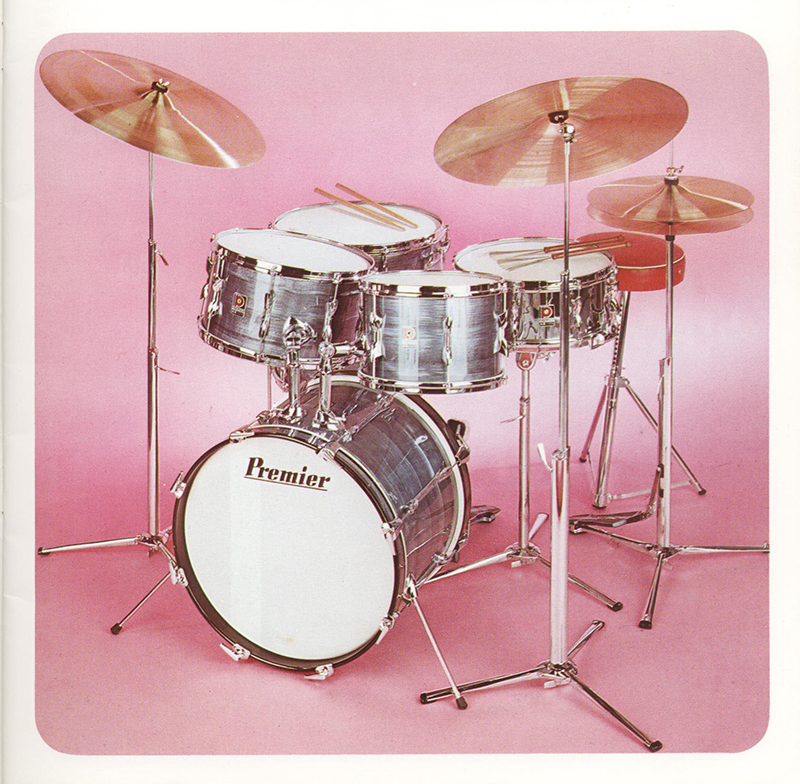
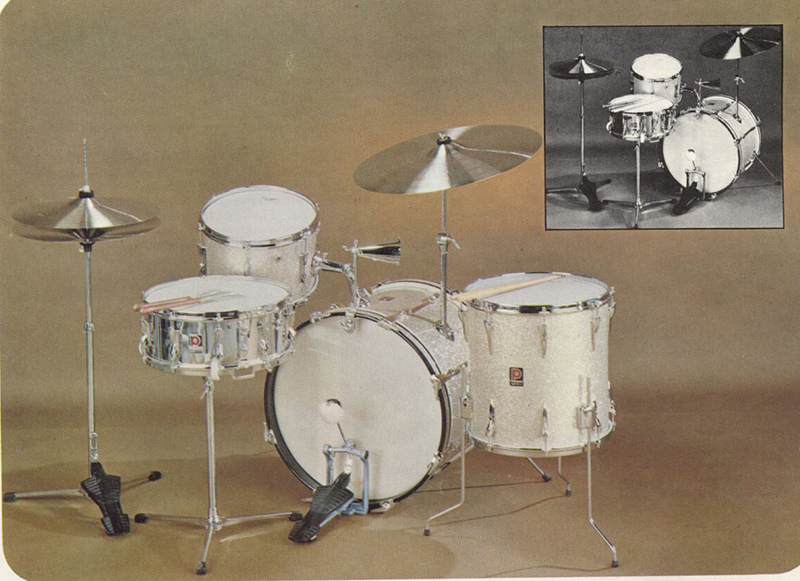
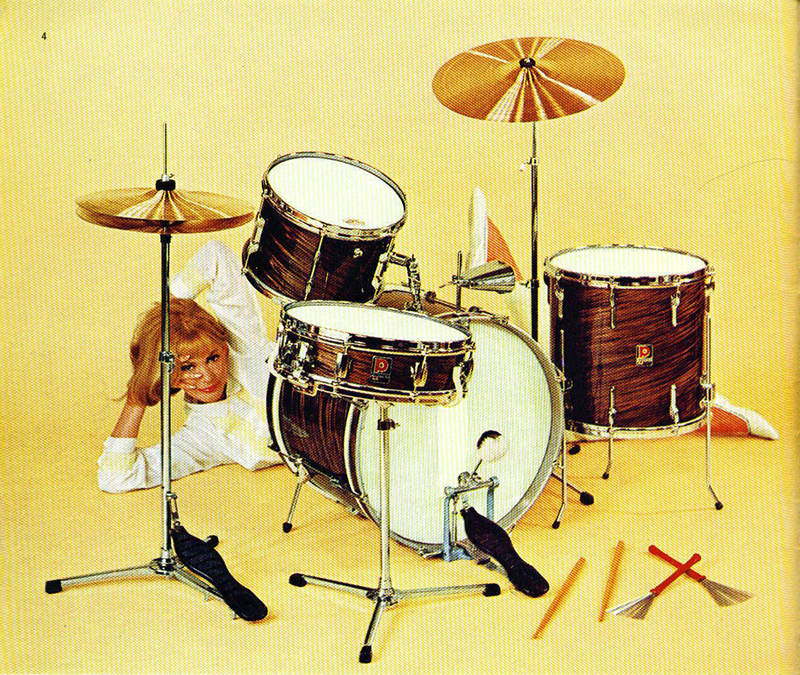
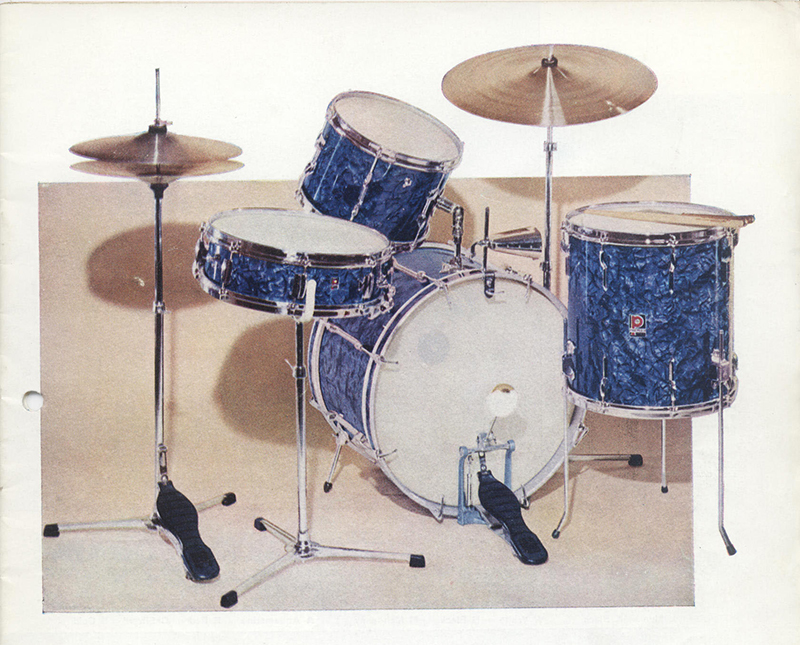
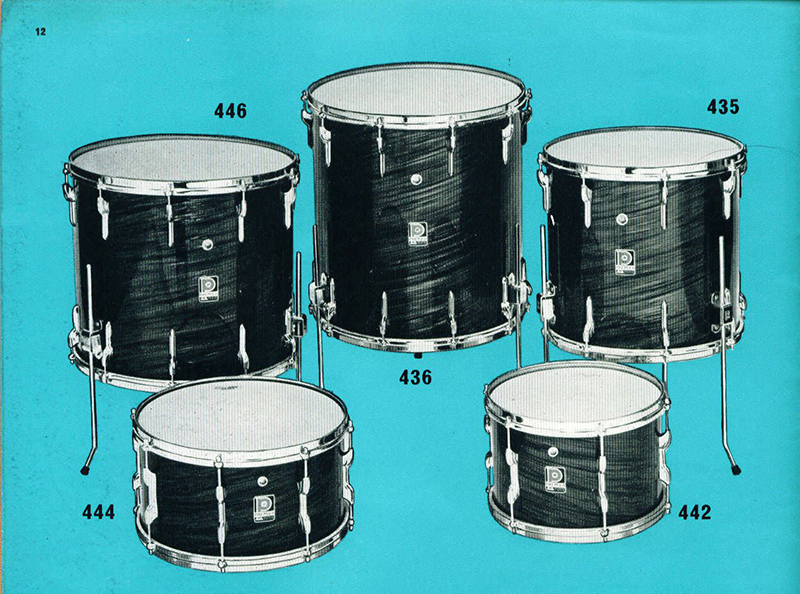
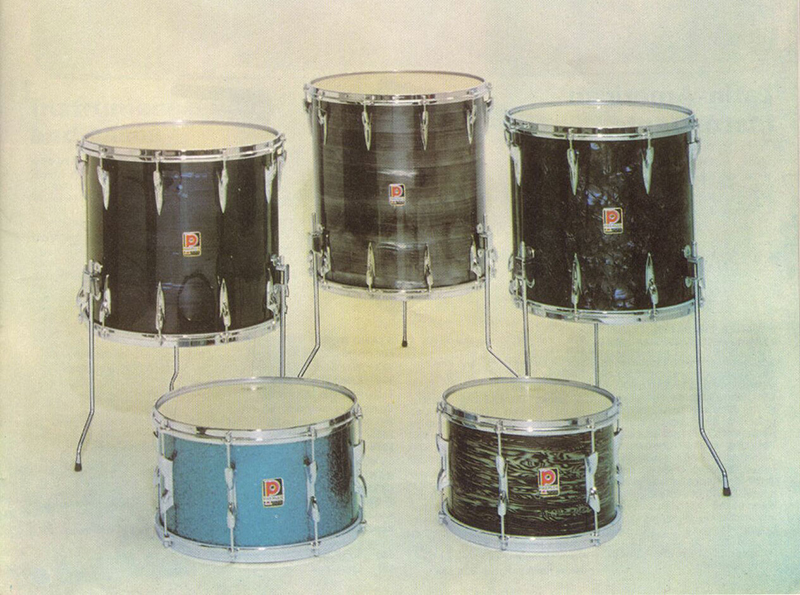
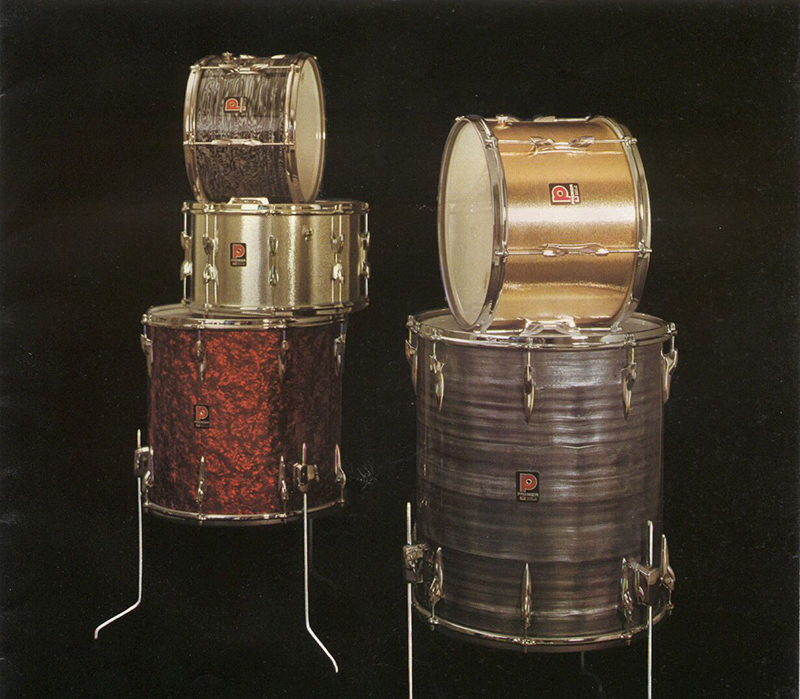
In the 1968 catalogue, Premier introduced the 14 x 8” tom (sometimes referred to as the ‘tuna fish can’ or the ‘pancake tom’) and its to be noted that this was standard sized. By 1972, Premier had introduced the 13 x 9” tom and from then all drums that came out of the factory were standard sized.
If in doubt when looking at a kit to buy, it’s worth noting that Pre international floor toms are always 10 lug, whilst the international shells were 8 lug. With the 12 x 8” tom and 20 x 14” bass drum, the lugs and badges are usually a good indication. If in doubt, its best to measure the shell’s diameter with the head off!
It should be noted that all Premier snare drums are a standard 14”.
Remo are the only manufacturer of pre-international heads, but now produce quite a range; coated and clear Ambassador as well as clear pinstripe are currently available. They will however make anything to order, in any size, so contact your dealer if you fancy something else or have an unusual size bass drum. I recently had some pre international sized Fibreskyn heads on a special order and have some other pre international head options coming soon.
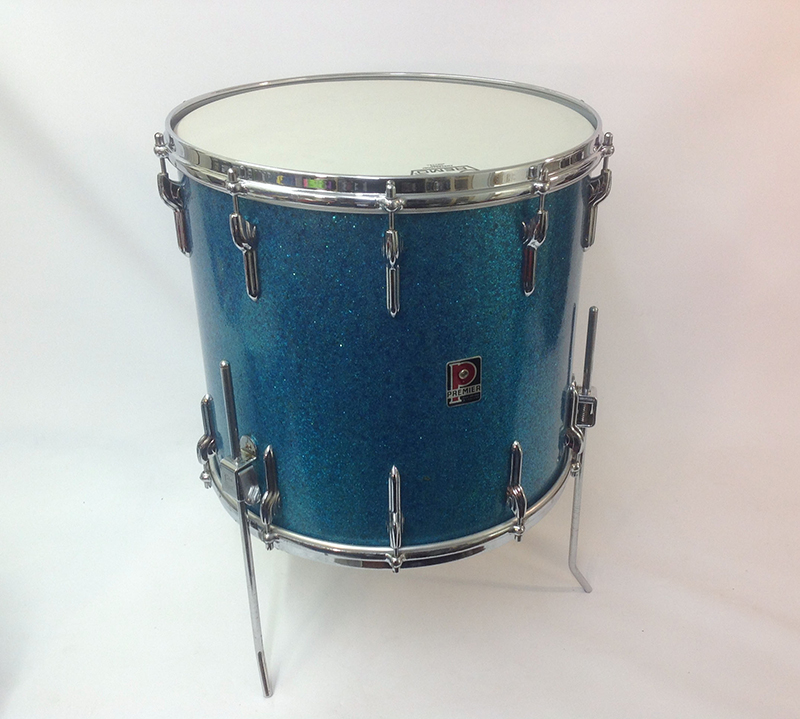
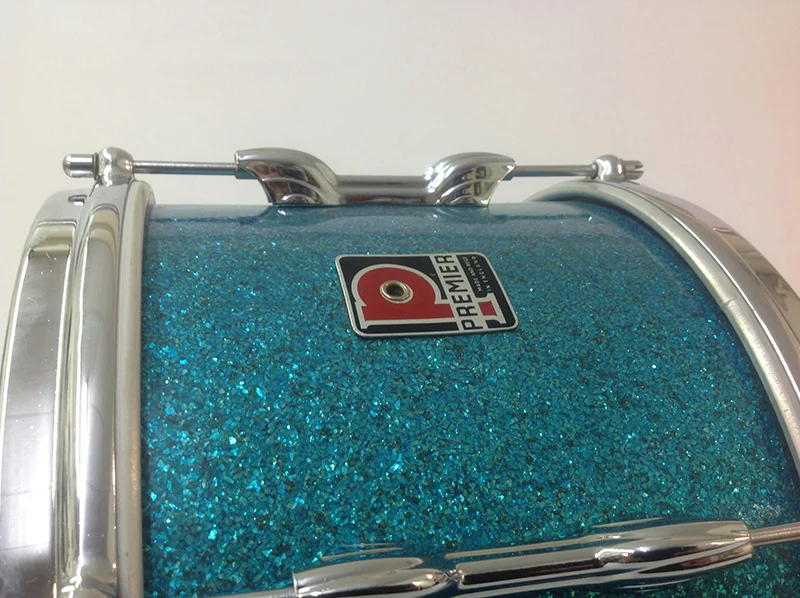
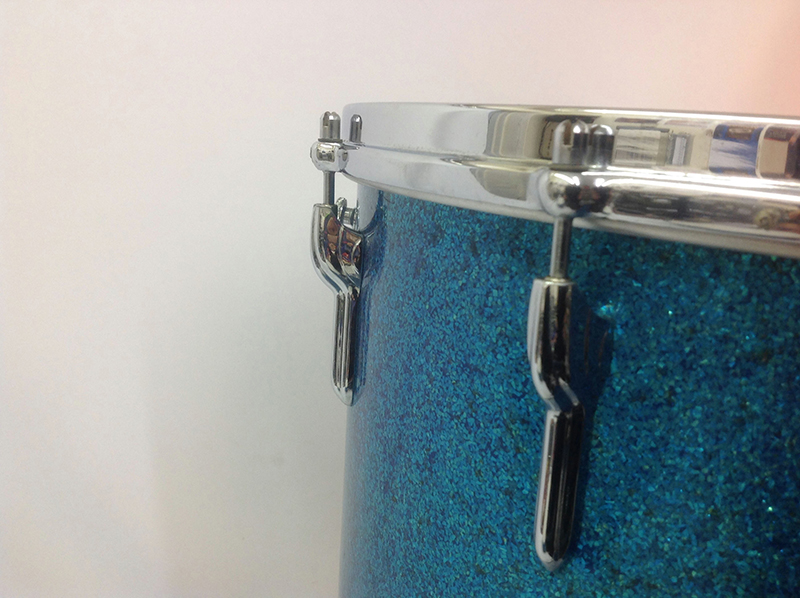
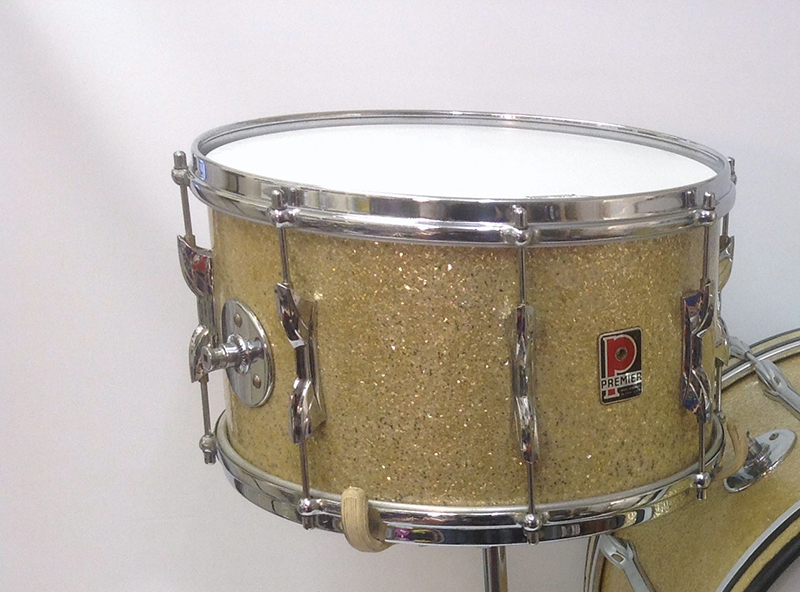
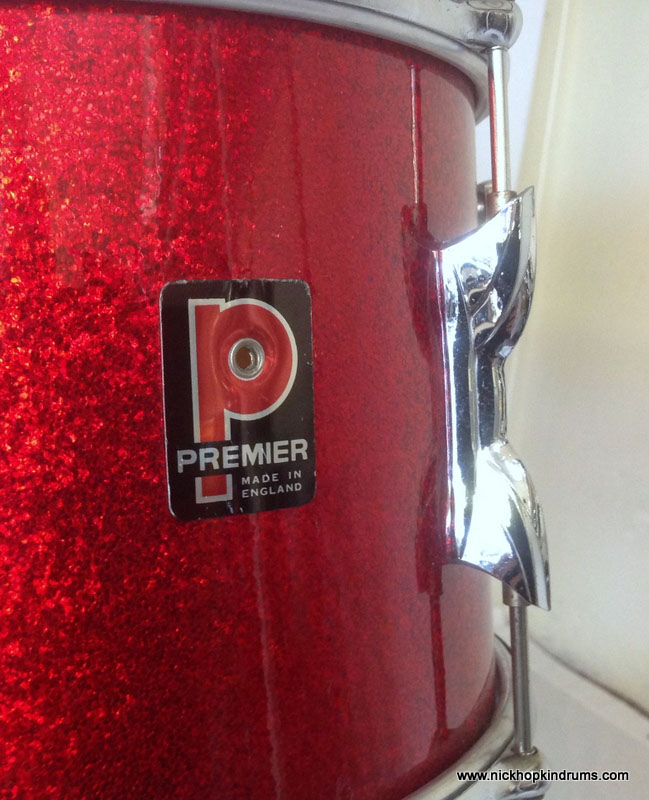
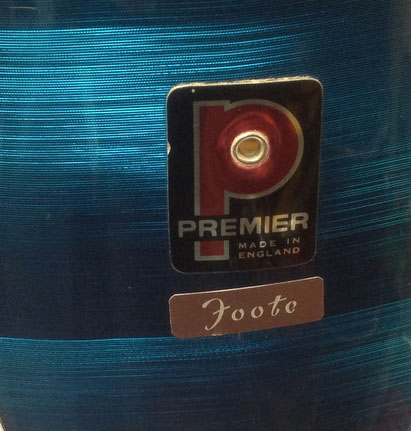
Other 1960’s English drums often require pre-international heads – Dallas (Carlton, President), Olympic, John Grey (Autocrat, Broadway) and some of their snare drums are slightly under or over 14”. Currently there are no heads available off the shelf for these snare drums, but as mentioned Remo will make heads to fit.
It’s worth noting that both Boosey & Hawkes (Ajax, Edgeware, Stratford), Beverley and Hayman never made pre-international sized drum shells so standard heads will fit these drums. I always have Remo Pre international heads in stock at Nick Hopkin Drums and can have anything made to order. Drop me an email if you want to discuss specifics for your set, or head options.
1960 English Rogers Set
It is hard for me to believe we are already in to February. Where did January go? My Mother told me when I was young and wishing for my birthday, Christmas, or school to be out that time would go a lot faster when I grew up. She was right, as always, and time now really get away in a hurry. I am looking forward, but not wishing my life away, to some great drum shows this year. I hope you can attend one in your area this year. Keep watching for the places and dates to be listed here in the magazine. Getting together with other vintage and custom drum collectors and players is always fun and educational. I am constantly learning information about vintage drums from my drum collector friends. A lot of my contacts and friends were made at drum shows.
I decided to feature a set this month for your enjoyment that I recently acquired. It's an early 1960s English Rogers set in rare Madi Gras finish. I have wanted a Rogers or Slingerland set in Madi Gras finish for years. I just love that finish. By the way, Madi Gras is this month in New Orleans. I've never been to Madi Gras, but I have that trip on my bucket list, but back to my desire for a Madi Gras drum set. I have been looking for a Madi Gras set to add to my collection, and as I was searching E-Bay a few weeks ago a set was there for sale. I really wanted them and had decided to place a bid when the end of the sale came around. I usually wait to bid until the end of the sale. I have jumped in right at the beginning, but usually I wait. Maybe you could leave a comment and share your E-Bay bidding strategy. The Madi Gras set on E-Bay was a Rogers set and that was fine with me. It's no secret to my readers that I love Rogers drums. While I was watching that set, another Rogers Madi Gras set showed up on Facebook. The set for sale on Facebook was the English Rogers set I am showing you. Yes, I made a deal with the seller and he shipped them to me from Canada. I am so excited about them.
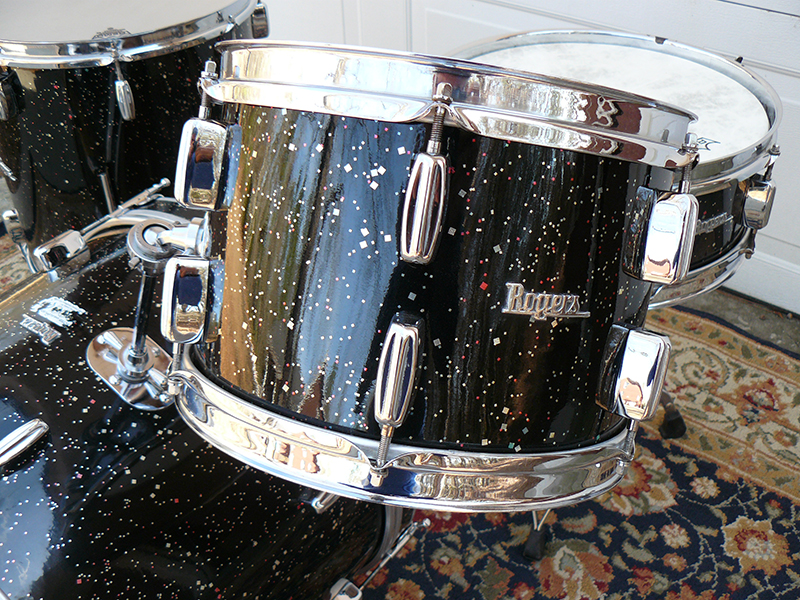
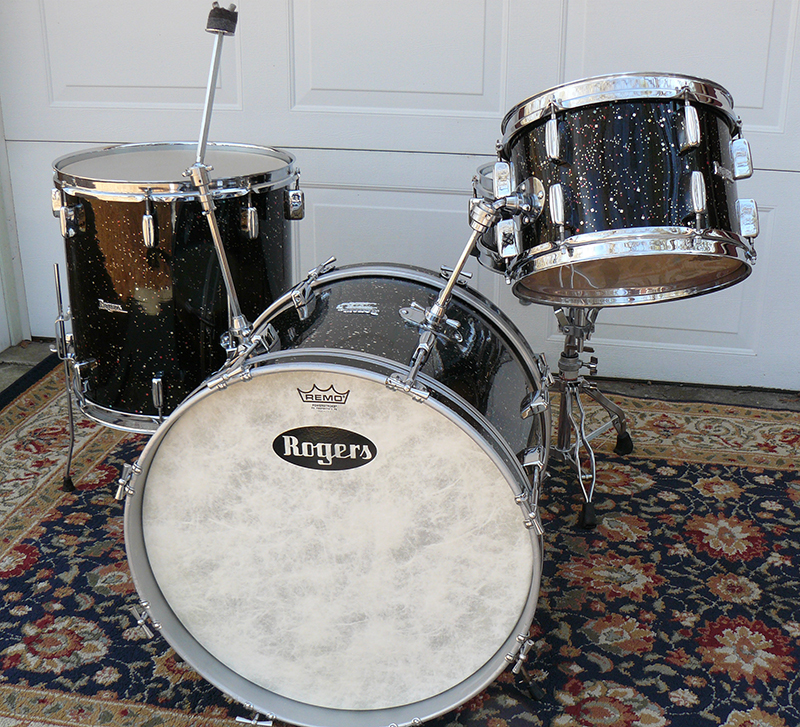

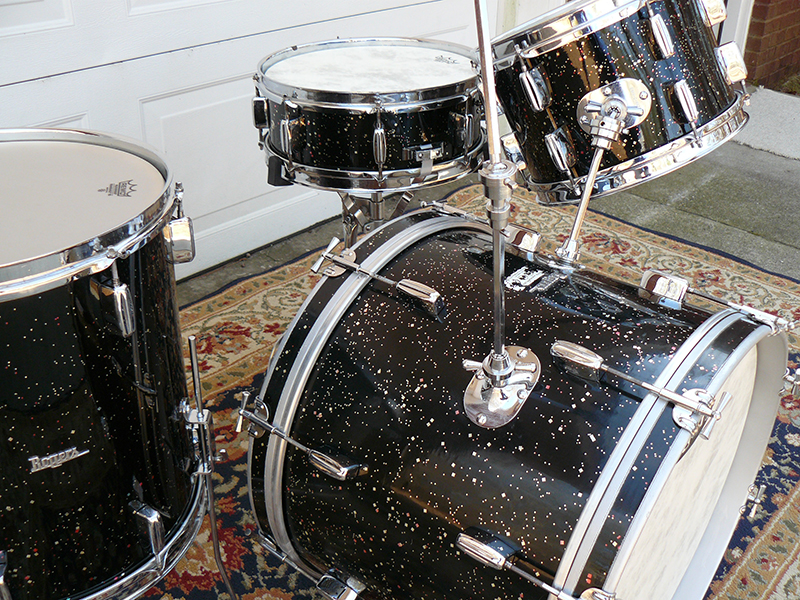
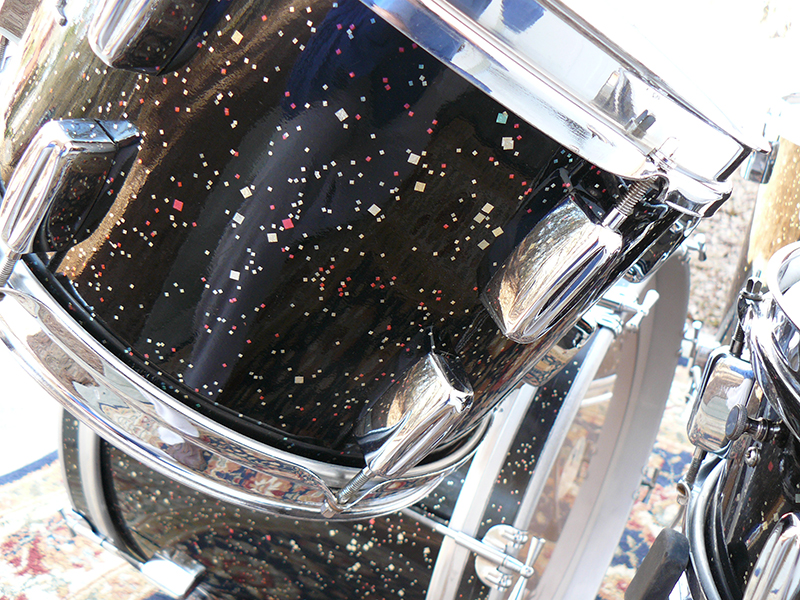
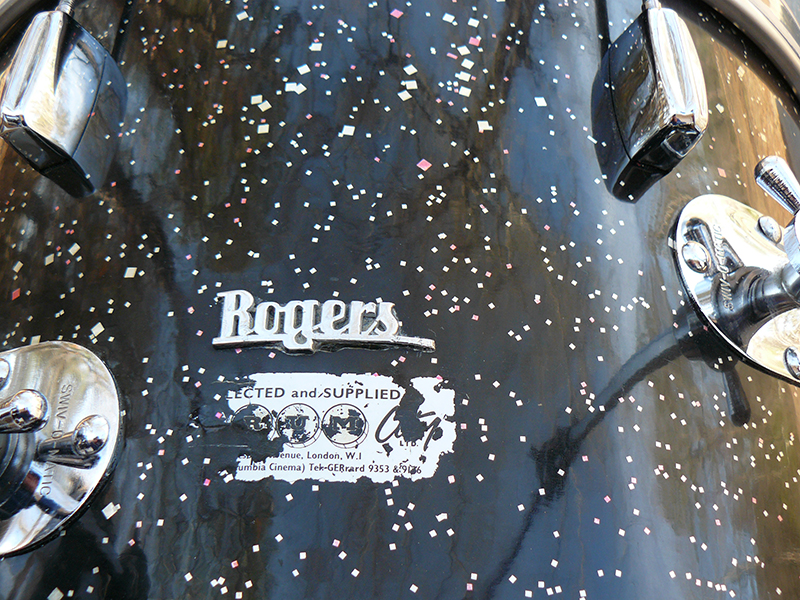
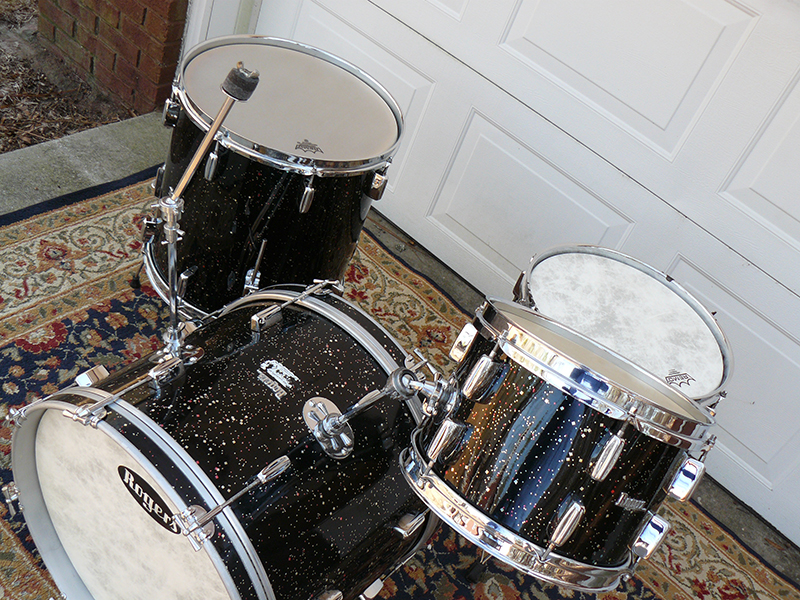
English Rogers drums were made in the 1960s at the Boosey & Hawkes drum factory in London. They had Ajax three ply shells with reinforcement rings. The interiors are clear coated not painted like American Rogers. The lugs are Bread and Butter style, and the mounts are Swivomatic style, but they are different from the USA parts. The Madi Gras finish is also different from the American version, not as busy. The script logo badges also look different. The sizes of this set are: bass drum 20"X15", floor tom 16"X16", mounted tom is 12"X8", and the matching snare is 14"X5". Many of you know that Dave Clark of the Dave Clark Five played English Rogers drums. English Rogers drums were not a huge success, but they are very cool drums. Many collectors want to have a replica of John Bonham's set or a Ringo's set. I would like to have a red sparkle English Rogers set with a Dave Clark logo head. He was one of my greatest influences.
My set was owned by a member of the Toronto Symphony who brought them from England. When he returned to England to retire he left the set in Canada with a new owner. There is a cool Drum City London sticker on the bass drum. I was tempted to try to finish removing it. It looks like someone started to take it off but didn't go through with it. I have decided to leave it. It has been there fifty years, and it adds to the story of the drums, so for now the sticker stays. The man who helped me buy these drums from the owner who acquired them from the symphony percussionist was a super guy. He did a great job handling the sale and shipping the drums from Canada to my door. I want to thank him again for the great job he did. Leave a comment if you have an English Rogers set or if you liked Dave Clark Five. Keep looking in those unusual places for a great old drum.
Mike Clark: Words of Wisdom, Part 4

Drummers who use traditional grip...Some people use the index finger over the stick along with the second finger etc. or some guys use the thumb as it is a strong appendage, or kind of open which they used to call rabbit ears...I really think all have certain advantages so why use just one?
OK, My humble opinion. To have a James Brown movie without mentioning Fred Wesley’s name, is like making a John Coltrane film and not mentioning Elvin Jones.
Drummers who want to play jazz, or whatever you want to call it… Check out ‘Do The Math’, an interview with Billy Hart. He talks about history, and his history…The ride beat, which drummers did what, and all kinds of great stuff for musicians who love this music.
Can never stop paying my debt of gratitude to...Philly Joe Jones, Papa Jo Jones, Max Roach, Elvin Jones., Tony Williams, Art Blakey, Tootie Heath, Mickey Roker, Billy Hart, Billy Higgins, Roy McCurdy Lenny White, Kenny Clarke, Gene Krupa, Buddy Rich, Clyde Stubblefield, Louie Bellson, Sonny Payne, Sam Woodyard, Louis Hayes, Jabo Starks, Dave Garibaldi, Bernard Purdie, Clifford Jarvis, and Joe Chambers.... I think about what these cats did and why everyday...Many more, but it would take forever.
Lenny White and I are working on a book about what it was like when he was with Return to Forever, and I was with Herbie Hancock. It also addresses many other things… Even though I lived it, I enjoy the proofing as I’m learning from reading it. At any rate, it’s way cool...Not just drum talk…There’s so much more.
Shelly Manne said…“The ride beat is the easiest and the most difficult thing a drummer will ever play”…Or something like that.
January 2015 - Happy New Year!
Well, let’s see. What’s new? The year! It’s a new year! All my vintage drums are now more “vintagey”.
The 2015 Nashville Drum Show is still a go for late September though I have not set an exact date yet. I want to move it to a new and better location this year and am working toward that end. Stay tuned.
There is a special deal on the paper back issues still in print– half price! $49 compared to the regular price of $99. That’s 29 issues dating from ’98 through 2012– all the paper back issues left in stock – for half price through February 15. Shipping is $11. That comes out to around $2 an issue!
(Click here to order)
Many of our readers have services and products that they need to spread the word about. Not So Modern Drummer is an excellent venue for advertising your self and your goods for sale on our website, in our monthly newsletter and in our email blasts to our 30,000 subscribers and our social media channels. We have special low rates for teachers, authors, vintage drum and parts sellers, and custom drum builders. We are currently offering a very popular heavily discounted package that includes ads on our site, in our newsletter and includes up to four product reviews. Please contact me about those special rates – george@notsomoderndrummer.com.
My condolences to the families, friends and fans of the staff workers of the Charlie Hebdo satirical magazine that were killed in Paris by militant religious and political extremists. All of us who understand freedom and enjoy the quality of life it affords us must condemn the actions of those cowards who killed in the name of God. Those of us in the journalism business have learned that freedom of the press and freedom of speech is more sacred than any religious or political ideology. Anyone who thinks that his god is commanding him to hate or kill is deluded and lying to himself and everyone else. We must strive for peace through education about freedom through the eradication of religious prejudice, and through the preaching of tolerance and the difference between faith and facts. We must also protect freedom of speech by standing up to those who think they can use fear and terror to suppress it.

George's Signature
(330) 338-6035 george@notsomoderndrummer.com
WIW? 40-50s Leedy Ludwig Kit

Got something that you want to ask the community what’s it worth? Send it in and we’ll post it here. – NSMD
Hello-
Here's an entry for What's It Worth: my uncle's old 40's-50's kit. Leedy Ludwig 20"bass and 13" tom. Not sure of franken-snare, has Leedy lugs, new bottom rim and snare throw off. I'm not a restorer, but I did get them player ready. Bass and mounted tom seem to be original, floor tom is his old high school marching drum recovered for tom use. I do have everything to make it back into the original marching share. All original Leedy hi-hat with 14" Zildjian cymbals. Leedy Ludwig bass drum pedal, with a clamp for mounted tom and clamp-on cymbal - older with 16" Zildjian crash-ride. No extra holes for tom or cymbal mounts. This what he was using until he bought his brand new set of '58 Gretsch Drums. They play and sound great. I know its hard to put a value on this unseen but they are in good -very good condition.
Thanks, Ronnie
What do you think? Let us know in the comments below!