
Several years ago, I stumbled across a Facebook post about an auction taking place in northern Indiana. The auction photos were, to put it kindly, pretty lousy. Someone had noticed a snare drum barely peeking out of one of the cases and posted photos asking if anyone knew what it might be.
Even after enlarging the images, the details were difficult to identify with any certainty - but there was just enough showing to make me wonder, “Was that engraving on a black-coated, maybe black nickel, shell?”
I decided to take a gamble. A pretty big gamble, actually. I bid high, thinking there was at least a chance this mystery drum could be an early engraved Ludwig De Luxe/Black Beauty. To make matters more interesting, I was out of town, and the auction house required on-site pickup. Fortunately, my dear friend Perry Curtis came to the rescue and agreed to retrieve the prize for me.
I won the auction. Great! There was just one small problem - I still had no idea what I had actually bought.
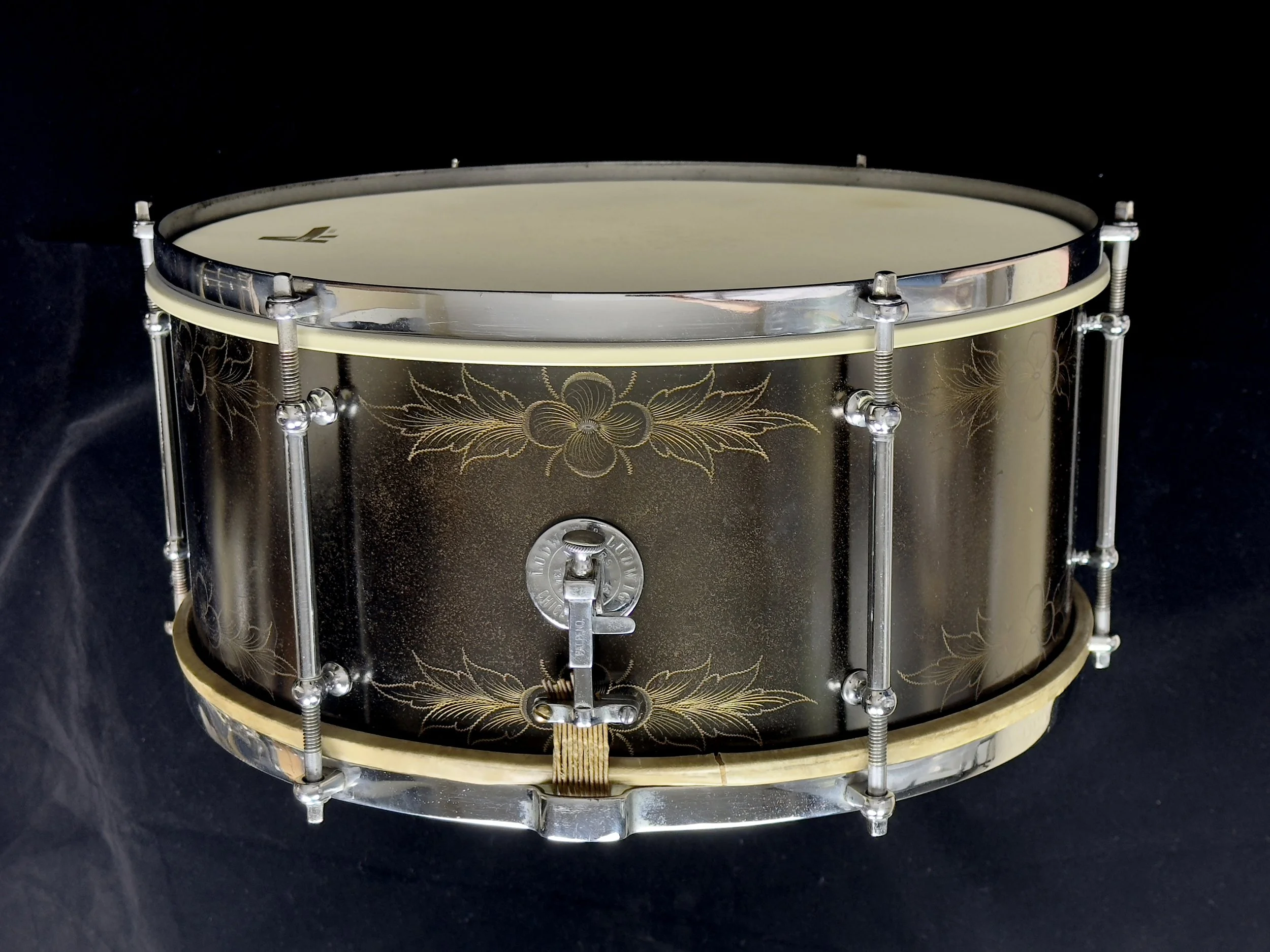
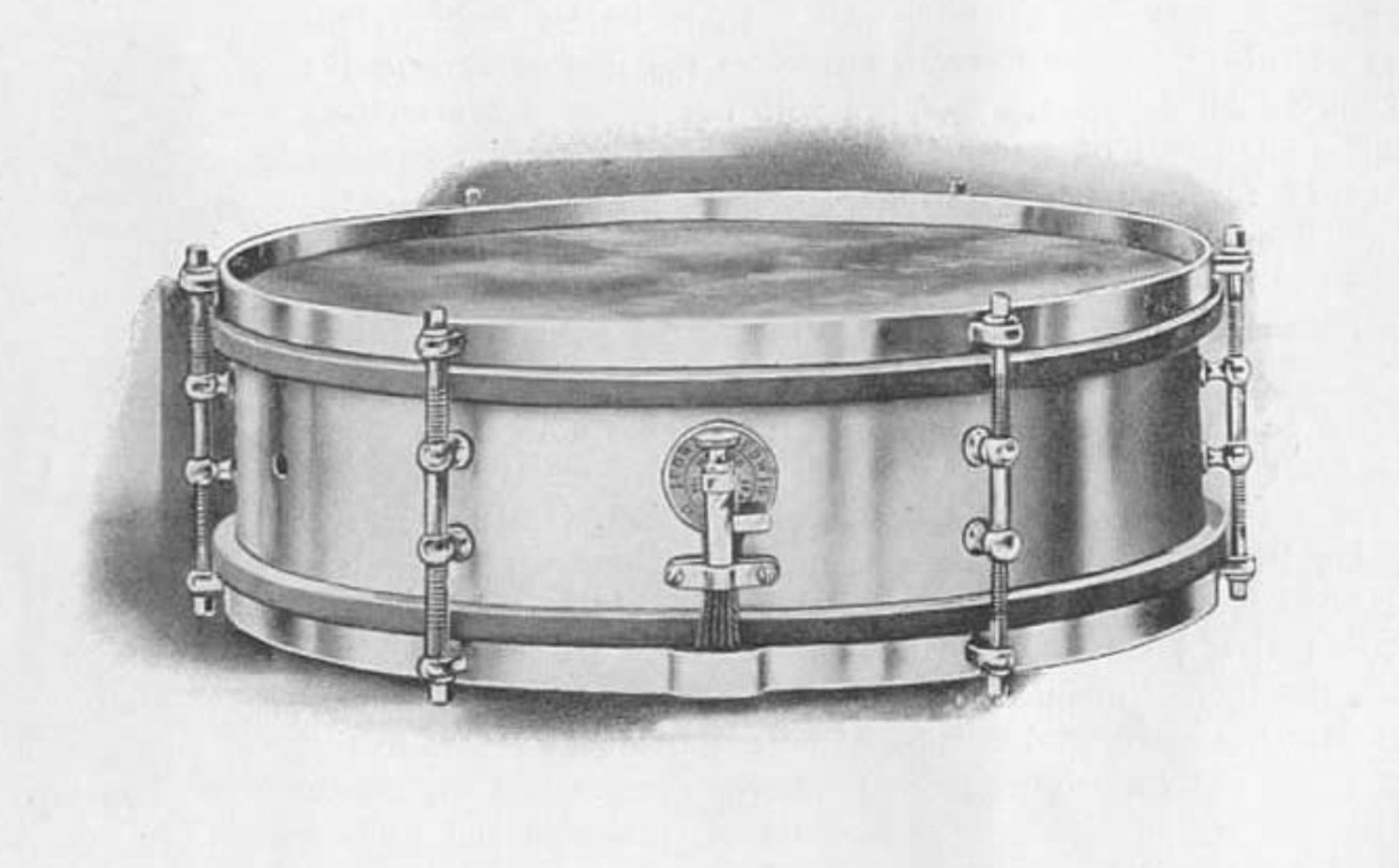
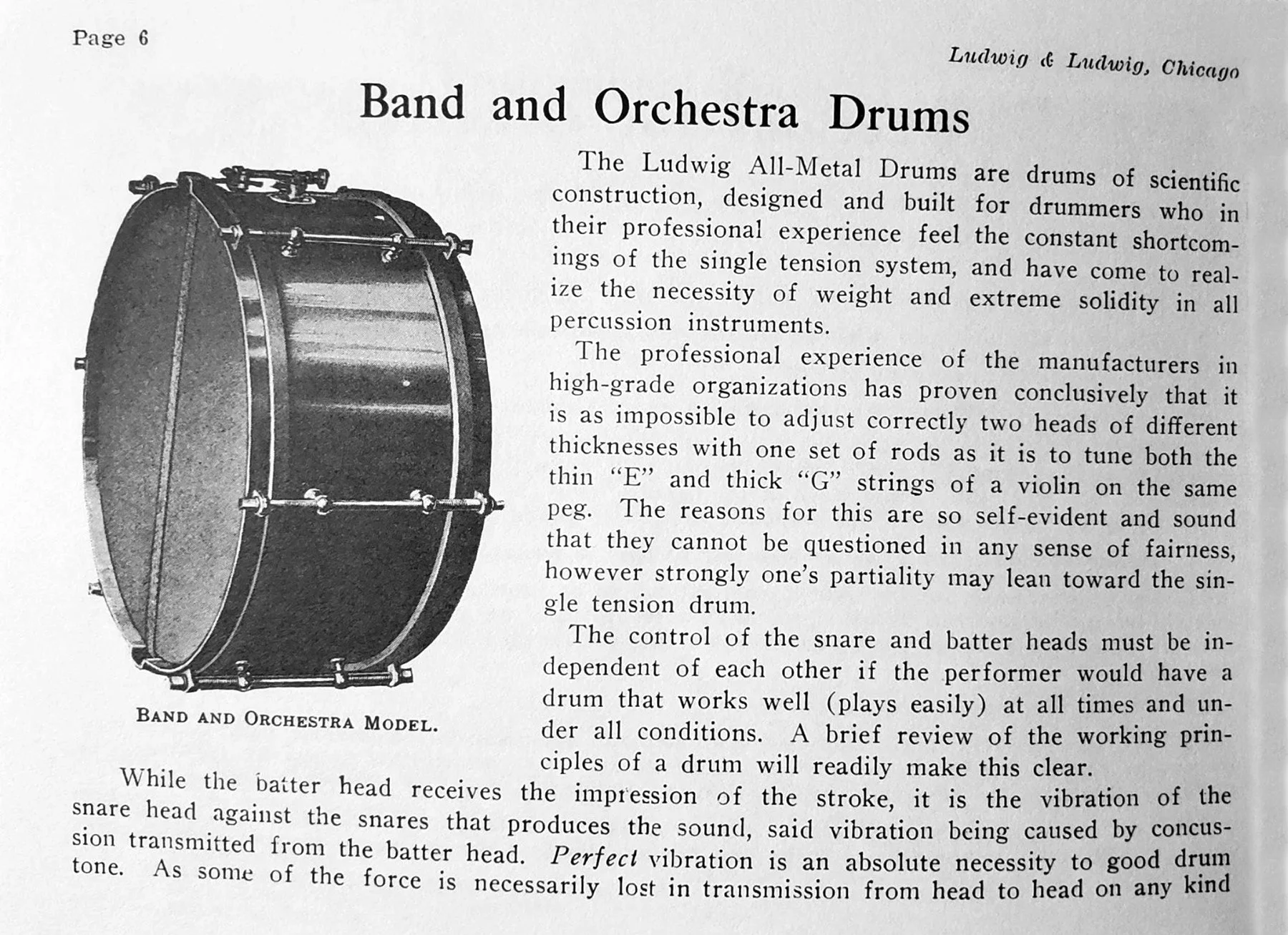
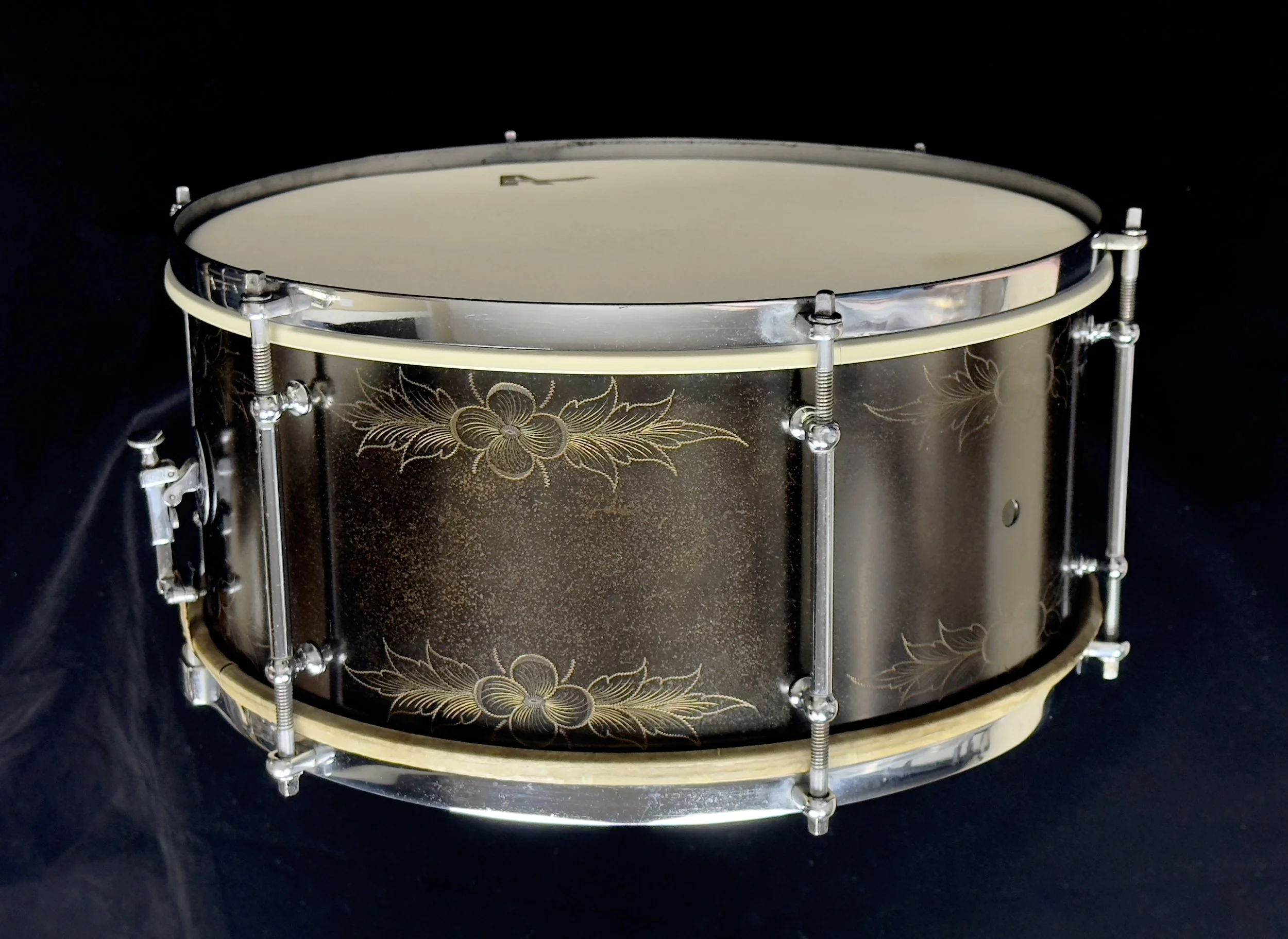
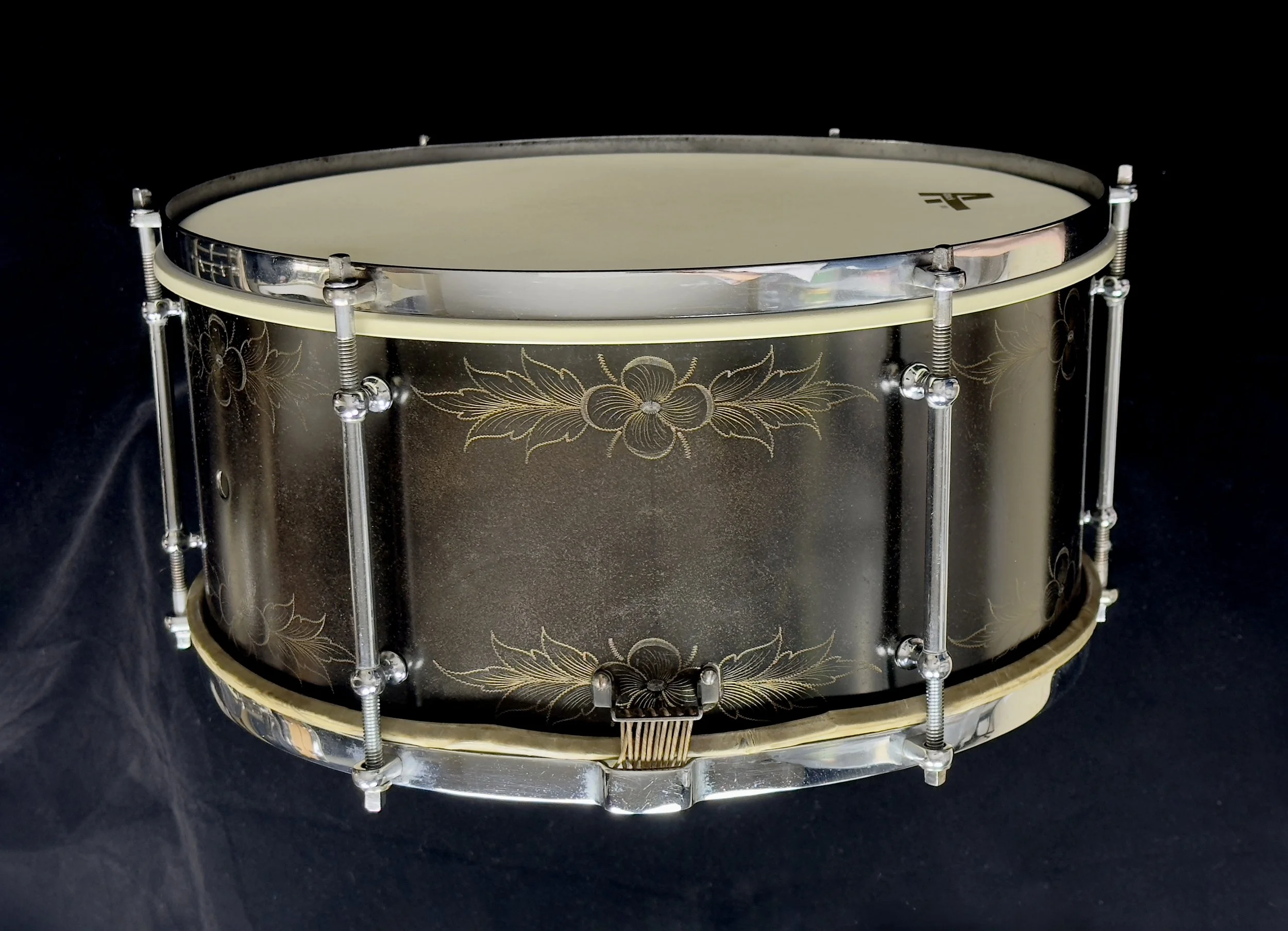
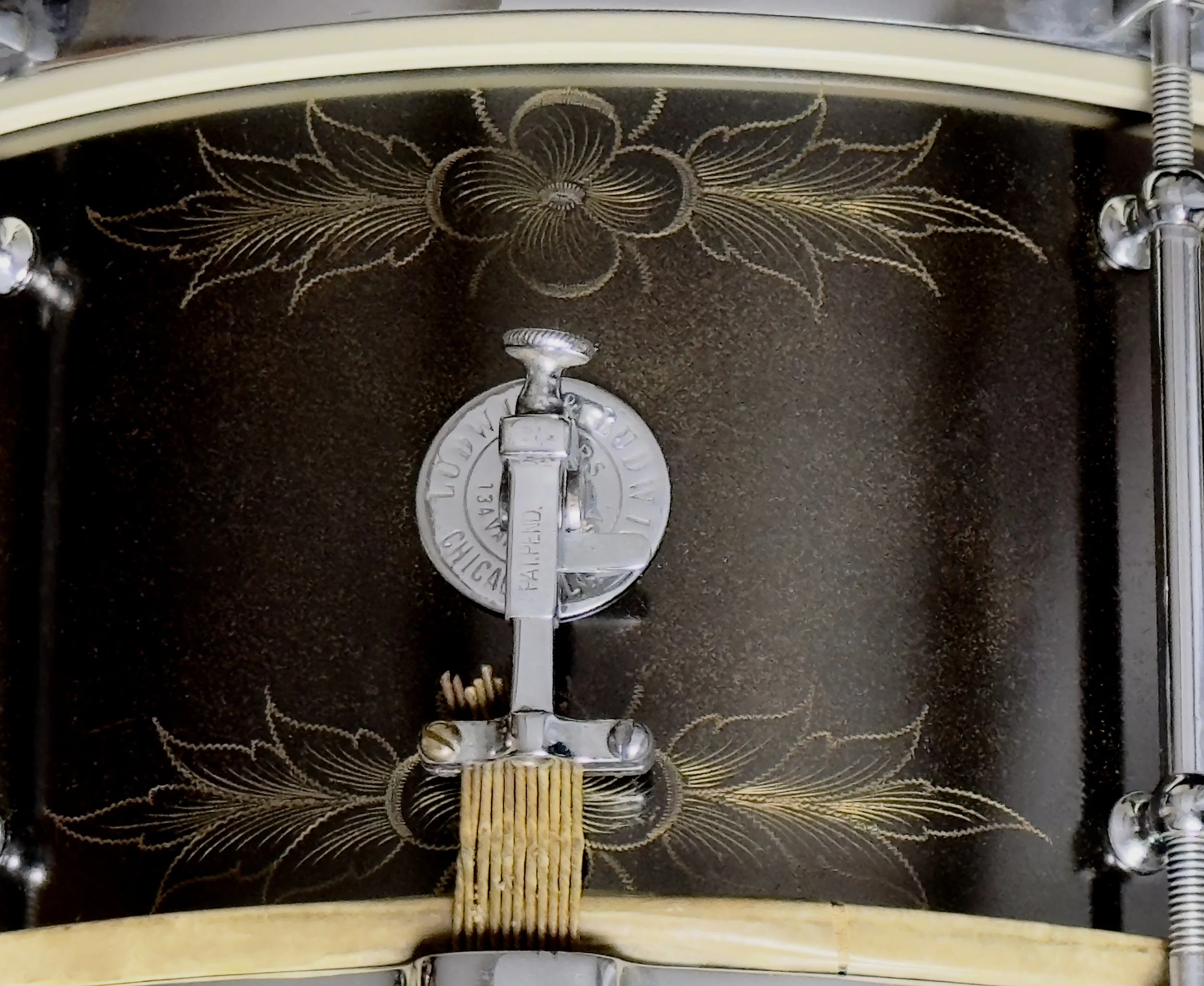
When Perry got the drum home, he sent me a few photos—and suddenly things got very interesting. It was indeed an old 6.5 x 14” Ludwig snare drum, apparently finished in black nickel, with a beautifully engraved shell. The strainer was an early, pre-1920s off-axis design mounted through a circular Ludwig & Ludwig badge attached to the shell. It had heavy cast/rolled (?) hoops featuring tension-rod eyelets welded directly to the hoops. I found a similar drum in a copy of the Ludwig & Ludwig 1912 catalog where these hoops were described, “Our reason for making the hoops as well as the shell of metal is twofold. First, to avoid the use of any material that will absorb or retain dampness. Second, it is our desire to use a very neat and narrow hoop so as to clear the drum for easy playing. In order to get the desired neatness and at the same time sufficient strength to withstand the strain of double tension, steel was selected as the most suitable substance. With hoops of steel only six rods are necessary on each side thus reducing the task of regulating the heads to a minimum. The screws are of steel and the tubes of brass, a combination that makes a perfect friction. The round headed lugs set at each end of the tubes are very substantial and act as a re-enforcement for the tubes, preventing any possibility of the tubes spreading and the threads stripping as in drums where the tubes are supported only by a single center lug.” So, the hoops were steel and the tube lugs were brass. One mystery solved.
And then there was the engraving. It was a beautiful, elaborate floral pattern unlike anything I had seen on any of my Ludwig Black Beauties – a center florette of 4 rounded petals with 5 sharp-edged leaves extending from each side. In fact, the engraving reminded me much more of the patterns found on some of my early engraved Conn snares. The shell itself was fairly thin, brass (?) based on the gold color shining through the engraving, with the bearing edges simply rounded over.
Needless to say, I was elated. Whatever this drum ultimately turned out to be, it was clearly something very unusual - a gorgeous, early engraved Ludwig snare that I had never encountered before.
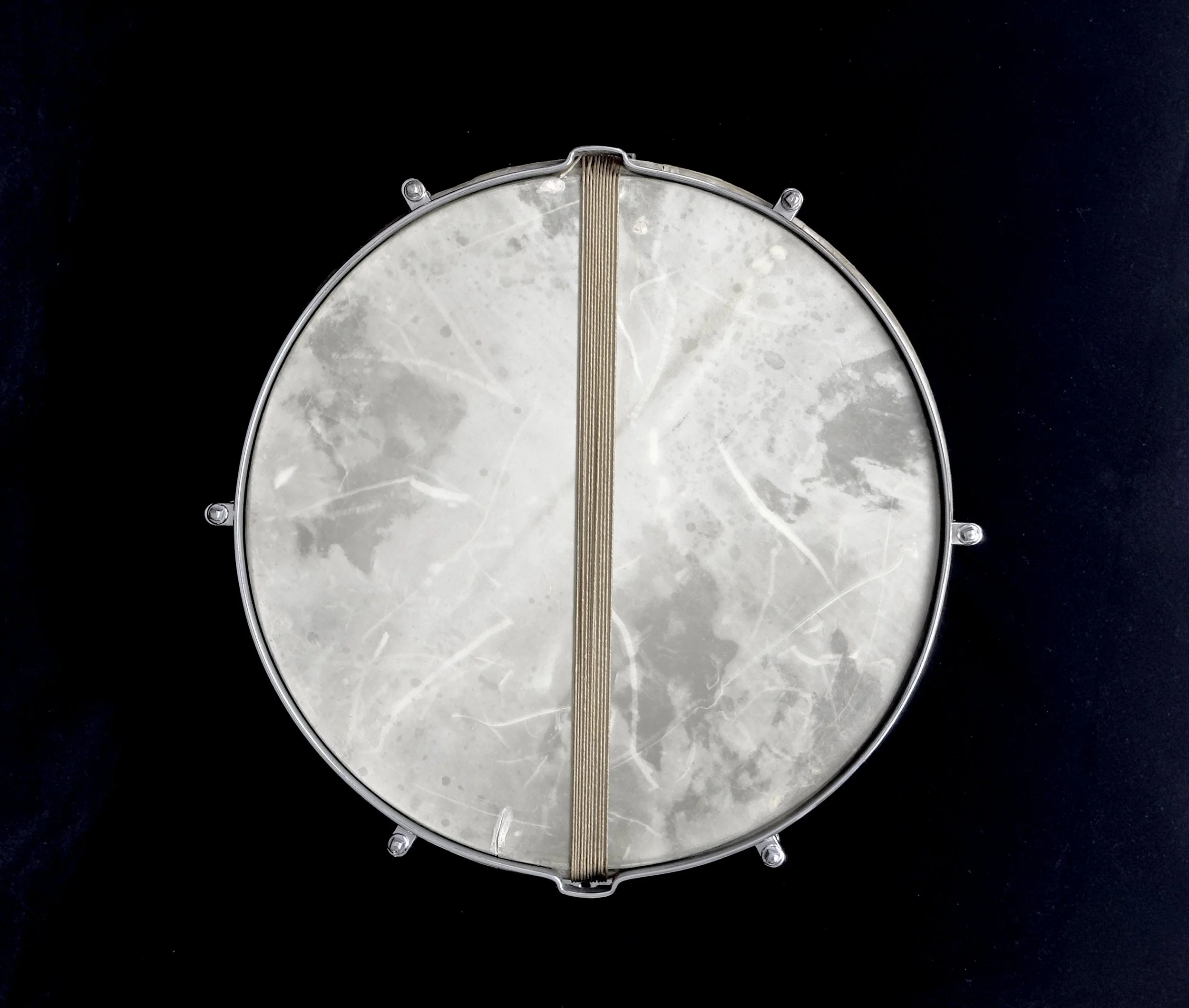
Unfortunately, it did not survive its century-plus journey unscathed. The drum was covered in generations of grime, dust, cobwebs and, judging by the smell, a fair amount of mold. I am unfortunately allergic to mold so had to limit my time with the drum until it was cleaned up.
I sent the drum to Mike Curotto for a careful restoration, and the transformation was remarkable. The original top calfskin head was torn, strongly smelled of mold, and actually overlapped part of the engraving, so Mike replaced it with a clean modern head. Hats off to Mike for the incredibly meticulous work. The drum came back looking absolutely beautiful. Even more intriguing, Mike, who has an extensive collection of vintage engraved snares, told me that he had never seen another drum like it. At that point, the mystery only deepened.
The auction house had no info on the original owner or any history related to the drum. I reached out to Bill Wanser of Olympic Drums, a noted drum historian, to see if he could help me pin down when this fascinating drum was actually made. I also contacted renowned engraver and drum historian, John Aldridge, to get his thoughts on the unusual engraving.
And that’s where the detective work really began…
Bill Wanser: “Your drum is, of course, very unique because of the black engraved shell that does not appear in any catalog or Ludwig Drummer publication as a drum that was offered to the public. Here is my assessment based on my catalog research over the years.
The 1911 snare drum of Ludwig & Ludwig had no bead, individual “tube” style lugs, six top and six bottom. Straight rims with ears attached and a round badge mounted behind the flip down strainer.
The 1912 catalog shows a drum like yours, minus the black plating and engraving, with a non-beaded shell, straight rims with ears attached, and a round badge mounted behind the strainer that has what appears to be a lever at the side to engage and disengage the snares. But now, six double ended “tube” lugs like your drum.
By 1913, according to the catalog from 1913, Ludwig drums now had a square-beaded shell, straight rims with rim clips instead of ears attached to the rims. They still had the same or similar strainer and a badge that is now cut to fit above the bead, not completely round but cut on one side.
So, I think that puts your drum between 1911 and 1913. Any later, and it would have other attributes of shell construction of the day.
Now the black plating and engraving I speculate was probably a special order. Since Ludwig did not have engravers to engrave their drums nor did they offer black plating at that time perhaps they farmed the plating and engraving out to someone who engraved, either from another drum company like Leedy or Conn or Wurlitzer? At this point, everything is just a guess or speculation, but that is the explanation I would favor.”
Note: My drum looks exactly like the Band and Orchestra model snare I found in the 1912 catalog, barring the absence of black nickel and engraving (as Bill stated). However, the hardware is very nicely plated in chrome. Chrome plating was not available until the late 1920’s, so it seems reasonable to assume that the owner had the hardware re-plated some years after the original purchase (perhaps the nickel wore thin?). One can only speculate….
John Aldridge: “One of the most common engraving motifs of the early 20th century was the flower pattern. You see it in hundreds of applications from stone carvings to drum and guitar engravings to stamped artwork on hand mirrors. The same style pattern was popular in Europe at the time as well: Six leaves (3 per side) around a four or six petal center flower. This particular iteration is very similar to the engravings done by Conn engravers in the early 20's. There is a Conn engraved, gold plated "triumphal" style drum in Mike Curotto's collection that is similar enough in style and cut that I would bet a nickel that it was engraved by the same hand, a few years later than this drum. Following in the footsteps of master engraver James Gardner, this drum was most likely engraved by Julius or Charles Stenberg. All three were working for Conn in the late 1890's. I think the Stenbergs were there into the late 1920's. Oh, and I Iove the engraving pattern on your drum. I'll be borrowing that!”
Based on the input from Bill, John, and Mike, along with what we can piece together from the early Ludwig catalogs, I believe this drum is—to the best of my knowledge—the earliest known engraved, black-nickel Ludwig & Ludwig snare drum in existence.
So how did it come to be? I tend to agree with Bill that the drum was probably custom ordered sometime around 1911–1913 (I tend to lean toward 1912) and that the engraving may have been done by an engraver associated with the Leedy/Conn factory. If that is correct, it raises a much more intriguing and admittedly speculative question: could this drum have helped inspire the Ludwig De Luxe, and ultimately the Black Beauty?
It’s a bold idea and one that is currently impossible to prove. But it’s certainly fun to consider. Did Ludwig receive other requests for custom engraved drums after this one? Did enough of these one-off instruments appear that the Ludwig brothers eventually realized there was a market for an elaborately engraved, black-nickel snare?
The Ludwig De Luxe doesn't officially appear in a Ludwig catalog until 1923, and the drums pictured there are all eight-lug models. Yet both Mike Curotto and I own six-lug, scroll-engraved De Luxe drums. That makes me wonder whether engraved De Luxe-type drums may have existed well before their official catalog debut - perhaps sometime in the 1914–1918 period. If so, this mystery drum could represent an even earlier step in that evolution.
We may never know the complete story. More than a century later, many of the answers are simply lost to time. But perhaps that is part of what makes this drum so fascinating.
Whatever its exact origins, this engraved black nickel snare drum is a remarkable survivor from the very earliest days of Ludwig & Ludwig, when the company was still finding its identity and experimenting with ideas that would eventually become part of American drum-making history. It is an exquisite testament to the exquisite craftsmanship, ingenuity, and artistry of that time.
One or more owners clearly treasured this drum over the years. Otherwise, it is difficult to imagine how such an unusual instrument could have survived for well over a century in such wonderful condition. Now free of gunk and cobwebs (and mold!), this drum shines almost as good as new.
My hope is that this article adds another chapter to its story: documenting what we know, preserving what we think we know, and, perhaps most importantly, recording the questions that remain unanswered.
The drum has survived for more than 100 years. Hopefully, its story will now travel with it for the next 100.
My sincere thanks to Bill Wanser, John Aldridge, and Mike Curotto for their time and expertise!