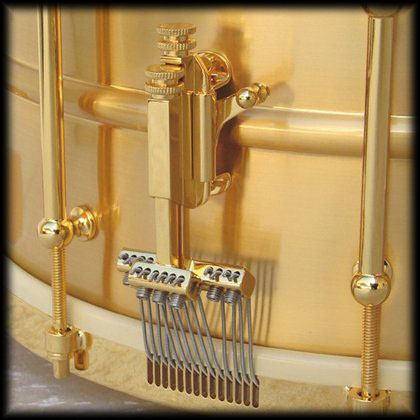
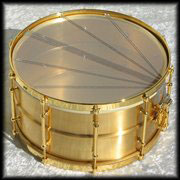
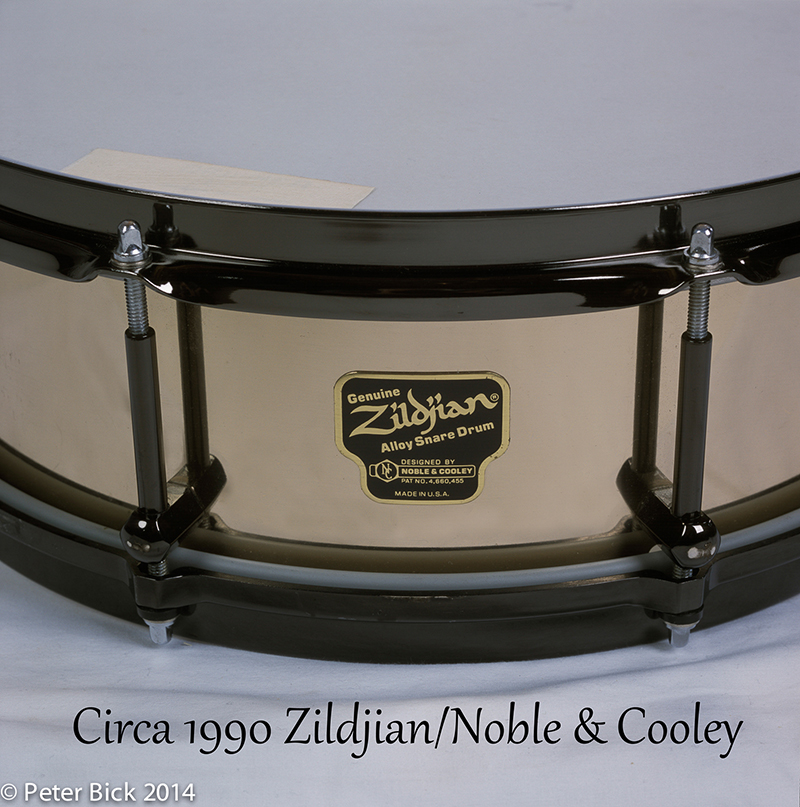
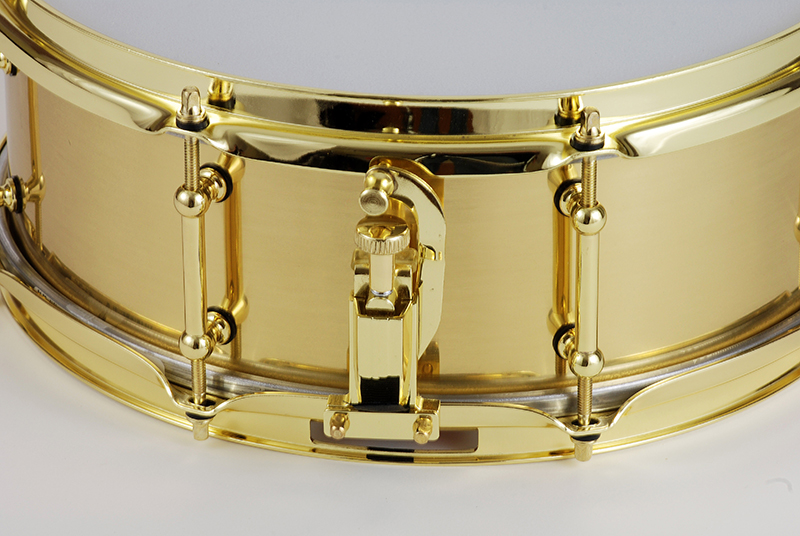
The Zildjian/Noble & Cooley snare drum was produced in very limited numbers (around 300 6.5 X 14” and 100 4.75 X 14”) starting in 1989 and stopping in the early 1990’s. It was the synthesis of two of the “elder statesmen” in the percussion business, the Zildjian Cymbal Company (founded in Psamatia [suburb of Constantinople], Turkey in 1623) and Noble & Cooley Drum Company (founded in Granville, Massachusetts in 1854). Together, they produced quite a special snare drum that the world had not yet ever seen; a drum shell cast out of the proprietary Zildjian cymbal bronze alloy and assembled by the masters at Noble & Cooley using their striking black coated brass hex lugs, die-cast hoops and trademark throw-off. Over time, these drums became extremely coveted for both their rarity and unique sound. The numbers of these bronze drums dwindled over time as cracks emerged in some drums due to issues with casting. This resulted in a bit of a “collector frenzy”, driving the value of these drums upward and making them difficult to find.
In 2002, I was fortunate to be contacted by Todd Remmy (then known as “The Drum Detective”) who stated that Dave Mattacks had a 4 ¾ X 14” Zildjian/Noble & Cooley snare that he was thinking of selling. Dave Mattacks was as legendary as the drum, having played with Fairport Convention, Joan Armatrading, Richard Thompson, Cat Stevens, Gary Brooker, Roger Daltrey, George Harrison, Paul McCartney, Jimmy Page…the list goes on… So to have a historical drum like this, one so finely crafted, a survivor and additionally graced by the hands of a master, I jumped at the chance. It arrived with a simple note from Dave: “This is to confirm that this Zildjian/Noble & Cooley snare drum is from my personal collection. It can be seen & heard on Richard Thompson’s, ‘Two letter Word’ CD. Enjoy! Regards, Dave Mattacks.” The inside of the drum was marked with serial # 09-097, signifying that it was made in 1990 and was the 97th drum of that production run. This only whetted my appetite further to know more about both Noble & Cooley and Dave Mattacks. I contacted both Jay Jones (owner, Noble & Cooley; Great-great-great grandson of James Cooley) and Dave Mattacks. They kindly gave me the benefit of some background info and their thoughts on the wondrous Zildjian/Noble & Cooley snare drum (circa 2003).
JAY JONES:
How was the Noble & Cooley drum company started originally, and when did you guys decide to go into making professional snare drums?
“Well, the company started in 1854. In 1853, Mr. Silas Noble had made some toy drums in his kitchen to give to family, friends, and neighbors for Christmas. He thought he had a good idea and went to Mr. James Cooley for financing. They incorporated it in 1854, and the company continued to grow making toy drums, and it is still the largest portion of the company, the toy portion, today. They had several innovations through the years; for example, they owned the patent on toothpick making machine. They made rolling hoops. They made all paper drums during the wars when there was a ban on metal. They were very innovative and continued to make toy products every year. In the 1950’s my predecessor, my dad, made some gift-ware items, ice buckets, waste baskets, lamps and had a whole drum shop line. That went up through the 1970’s; then we started making the professional drum line. I hooked up with Bob Gatzen in 1982 I believe, and it was through another gentleman who got one of our ice buckets or wastebaskets for his wife and saw that there was a steam-bent wooden hoop on it, and contacted us to see if we could make him a shell for his cracked Slingerland Radio King. I took a look at it and said, “no problem.” He said, “Really? Well there’s a real need for this type of drum.” So we were going back and forth, and it wasn't long before I realized he was running to Bob Gatzen to get his opinion, then taking Bob’s opinion and bringing it up to me. Once Bob and I hooked up, it made the path of communication a lot shorter. So we introduced our classic maple solid shell drum, with the classic SS back in 1984. That’s basically how we got into the music area. With Bob’s innovation, we were looking to something other than making toys here. It seemed to work out.”
One of the most collectible drums out there is the Zildjian/Noble & Cooley. How did that come about? That seemed to be something that came on and off quickly and I heard there were some problems with the sand casting?
“The pet project started with Bob Gatzen wanting to have a metal snare drum in the line. His mind just works in unbelievable ways; he’s just curious, and he finds out what are the other possibilities. “I know what a cymbal sounds like, so what would a drum made out of cymbal alloy sound like?” Talking with the Zildjian people, we ended up putting together a Zildjian alloy snare drum. We ran it for about three years. In that period of time, we did around 300 of the 6.5” version and just under 100 of the 4 ¾” version. The trouble with that drum was the sand casting. With the sand casting, it was very difficult to maintain the quality that we needed for the shell: no porosity, no sand inclusion, and no pits. The difference between an aluminum alloy and a brass alloy is the actual shell production stage; you’re dealing with a lot lower temperature with the aluminum that you are with the brass. The amount of rejects at the casting level from the foundry we were using was extremely high. Now, when they used all brand new material, they would get 70% good ones at the casting level. When they took the 30% of the bad ones and re-melted them down, only 30% of these were good ones because you ended up with lots of inclusions - some sand was melted into the brass. It just became very cost prohibitive to keep casting these rejects, and you wouldn't know it was a reject until you put on the lathe and turned it. So now you have the casting expense plus the machining expense. It was those multiple costs and being unable to control the process that made it difficult to continue. If the process was done in a permanent mold or a die-cast situation, taking the sand out of the equation, it would've been a much more viable project. However, the permanent tools for brass are very expensive and have a very short lifetime.”
So I take it there’s no thought about going back to that?
“Well, we kicked it around a couple times, and I’m not going to say it will never happen again. It might because of popularity of those drums, as we had no less that 3 or 4 calls a week. They were wondering how many were made and where they could find one. We keep getting this kind of response, so maybe there’s a chance we’ll do another project.”
Note: One year after this interview, Noble & Cooley did indeed refine their process and introduced the 380th Anniversary Zildjian/Noble & Cooley bronze cymbal alloy snare drum (limited run of approx. 500).
DAVE MATTACKS:
Before I ask you about the Zildjian/Noble & Cooley snare, I was wondering if you could give me a little background info - could you describe some of the snares you've used in your professional career and what did you like, what didn't you like?
“I've got a fairly large collection…at least 70 or 80 snare drums. It's been a passion over the last 30+ years. I started collecting snare drums and cymbals, and it came about from recognizing different sounds and timbres. The only things that I’ve discovered in terms of what I’m not keen on over the years are Slingerland Radio Kings. I think the main reason is because of the construction of the bearing edges. It's a very round, tubby sound. I had a 5 ½ X 14” that was beautiful, but I couldn't get a sound out of it that I liked. The last thing I was going to do was have the bearing edges changed because I don't believe in doing something like that to a vintage drum. So I swapped it for a cymbal and a Slingerland 5 X 13” Radio King and that's the only Slingerland that I've got. Slingerlands were the only drums over the years that did not appeal to me, great as they are. In the main, I've stayed with a hand full of custom people, predominantly Gary Noonan, although I've also got a Montineri, some Noble and Cooley’s, Craviotto’s, Stanbridge’s, Eames, and of course my Yamaha’s (which Dave proudly endorses). But the rest, over 50%, are vintage and are specifically WFL’s and/or 1940's through 1960's Gretsch.
The reason I like some of these custom drums, apart from the obvious fact that they are great sounding, is that these folk show a great amount of attention to detail. I think there's a lot of people out there assembling drums and making a good job of it, but it's that small 5-10% of people that really think about the details and equally important, they know their history. I've been doing this for some time and think I understand what they're doing. The people at Noble and Cooley are obviously in that league as far as I'm concerned. I've got the 5 ½” and 6 ½” classic maple’s. I went to the factory and got the Noble & Cooley 5 ½”; I remember hitting it once and thinking it was incredible. Like I said, it's that real attention to detail that makes the difference.”
So your drum collection is a mix of wood and metal shells then?
“Yes. The thing that I try to do is look at the shell construction and hoops and decide what the inherent area (in terms of the sound) that the drum is in. I then try to pick the heads and the tuning that goes with the sound of that drum. In other words, & I know this is kinda obvious to some, if I wanted to get a deep sound out of a snare drum, I'm not going to put thin heads on it; I'm going to go with a double-ply head or a dot head such as a "Power Center Reverse" (Evans), and use a 300 weight head on the bottom to help make a fatter sound. If I'm looking for a bright piccolo sound, then I MAY go with a metal shell and a single ply head. Depending on how the sound of the drum is, I might go with a 200 weight on the bottom, but generally I'll go with a 300 weight. Having said that, there are times when one can turn these so-called "rules" upside down - and that works too! I should add that wires make a big difference, and I'm happy there are some good choices on the market these days. Of course, the biggest way to affect your sound is your touch. ”
I believe you are a Yamaha endorser?
“Yes - since 1980 - and I love 'em! With Yamaha and other drums I have, I'm constantly experimenting. Initially, when I had the Zildjian/Noble & Cooley, I took the deep one and took the cast hoop off and put a triple flange on, but it lost something and to make a long story short, I put the cast hoop back on. I've done that with other drums where I've had brass hoops on them and thought the drum wasn't quite making it. I try and find a 2.3mm or 3.00mm steel triple flange - or sometimes go the other direction with a single flange hoop and hooks - and that will just put the bite back into the drum, but some drums don't need that. Like the one of Joe Montineri's, the 4 X 14”, that's got "conventional" triple flange hoops on it and that really works fine. If you put heavier hoops on, the ratio of the amount of hoop-to-drum you hear when you play a backbeat would change. It would thicken it up too much. So I'm always changing. Where it gets really interesting is that it depends on the type of tuning you're using, the shell construction, it’s bearing edges and the thickness of the head - and then all the other stuff then comes into play, such as how hard/light you naturally hit and the stick you use. In other words, if you're a hard hitter, you're going to lean towards a heavier head - you're going to need a thicker head to deal with that.”
So you had a 4 ¾ X14” Zildjian/Noble & Cooley snare drum. I noticed it had a triple-flanged top hoop and die-cast bottom hoop. Why no die-cast hoop on the top?
“The only die-cast hoops I like on snare drums are the Yamaha aluminum ones; they're light & malleable. They have the advantages of regular die-cast hoops (They "close " the drum down somewhat but retain tension better) – but without the “clonk” of their heavier cousins. The majority of my backbeats I play with a rim-shot, i.e., hitting the head of the drum at the same time as the rim. The proportion of rim-to-drum sound is way too biased toward the rim [sound] with a heavy die-cast. Triple-flange hoops "soften" that sound. Plus, I tune the part of the drum nearest me (the 6-o’clock position) lower than the rest of the head … this gives a slightly deeper sound at the point of impact … you kinda can't do that with a cast rim.”
(Many thanks to Jay & Dave for sharing their thoughts and experience! P.S. - Dave will be giving a clinic at the 2015 Chicago Drum Show: on “Drum tuning & cymbal selection live and in the studio.” Not to be missed!)
Well, I did try both the die-cast and triple-flange out on this drum. I have to agree with Dave; I favored the triple-flange. This drum is laser-focused and can make one’s ears bleed when hit with die-cast hoops. It does not compress when hit very hard. For some, that’s the sound they are looking for… However, for me the softer (as Dave put it), “cushier” (my description) sound of the triple-flange hoops tones down the attack of the drum and sounds great at both lower and higher tensions. I find the die-cast sound best at mid to high tensions only, and a bit harsh with the latter. A great drum for any drum arsenal.
It’s hard to believe that approximately 25 years have elapsed since the original release of the first snare drum made from bronze cymbal alloy, the Zildjian/Noble & Cooley. Others have followed (e.g., Paiste/Ocheltree Spirit of 2002, S-Bronze) but the mystique, rarity and collect-ability of the Zildjian/Noble & Cooley snares endure…
As always, questions or comments are always welcome: fallendrummer@mac.com