
So with the help of the master boat builder and much trial-and-error, Johnny began making his own one-ply drum shells. By 1984-85, Johnny had started to perfect his technique. Word of his drums spread until it caught the attention of Billy Gibson (Huey Lewis & The News). Billy asked Johnny to join forces with him to form a drum company, the Select (later changed to “Solid”) Drum Company.
Read moreCustom Drums: Really, Why So Pricey?
At one point in my life, I worked for an advertising agency – you know, the Mad Men thing. (Yes, there really were three-martini lunches.) A lot of prospective clients would ask us, in the course of getting acquainted, “How much is a brochure?” And the head of the agency would always answer, “How much is a car?” or whatever the client sold.
The answer depends completely on what kind of brochure, or car – or drum – you’re talking about. It’s all relative, and all about your needs, your goals, and your priorities.
My last article, about why custom work takes time, led me to another basic question: why custom drums cost what they do. You might find, or have found, yourself experiencing sticker shock over the price of a custom kit or snare. But usually that’s about expectations; you may be comparing the price to mass production drums, or you may be comparing the price to doing it yourself. But, in either case, why the difference? Let’s take the case of custom vs. mass-produced. Really, when you stop and think about it, why can’t the small, independent companies get the job done for less than the big guys? They’re not carrying the payroll, advertising expense, or sales teams. They’re not paying for big facilities or a huge stockpile of parts.
So why can’t they make a drum for less? It’s largely a question of scale and capital investment. A big company can commit lots of money to major orders from a supplier, and they may even have a financial interest in the supplier’s operation. Being that important to a supplier means they’re in a position to negotiate very favorably on terms and pricing. There are also advantages in limiting the choices – a major manufacturer is rarely going to offer more than a couple of lug styles, and usually only a few shell types, allowing them lots of inventory without the risk that it’ll sit on the shelf unused. So ordering ten lugs (small inventory, wide selection) produces a very different per-unit cost than ordering ten thousand lugs (big inventory, narrow selection) does; the pricing advantage goes to the big guys.
And, yes, the large manufacturer’s investment in tools and equipment is enormously higher. But paying for those investments has to come out of sales, so the smaller shop’s equipment cost might be divided over a few hundred kits sold over a period of time, while the big brand’s investment is covered by thousands of kits over a similar period, lowering the cost each sale needs to cover.
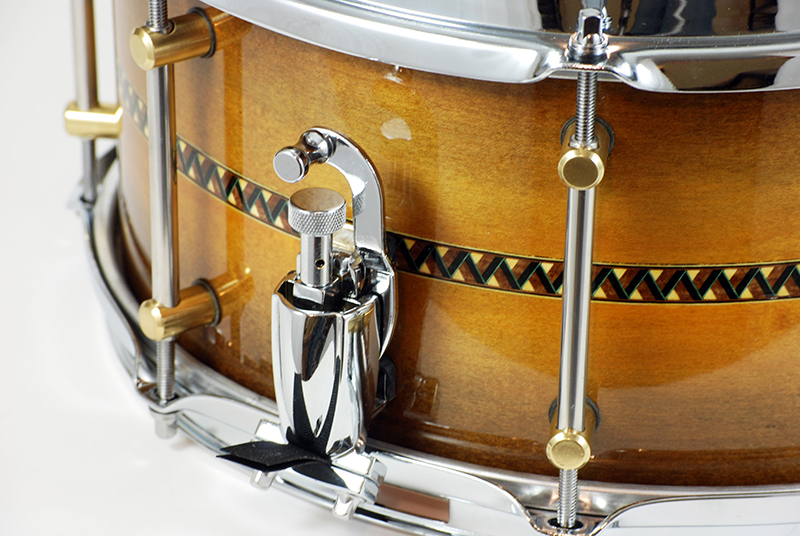

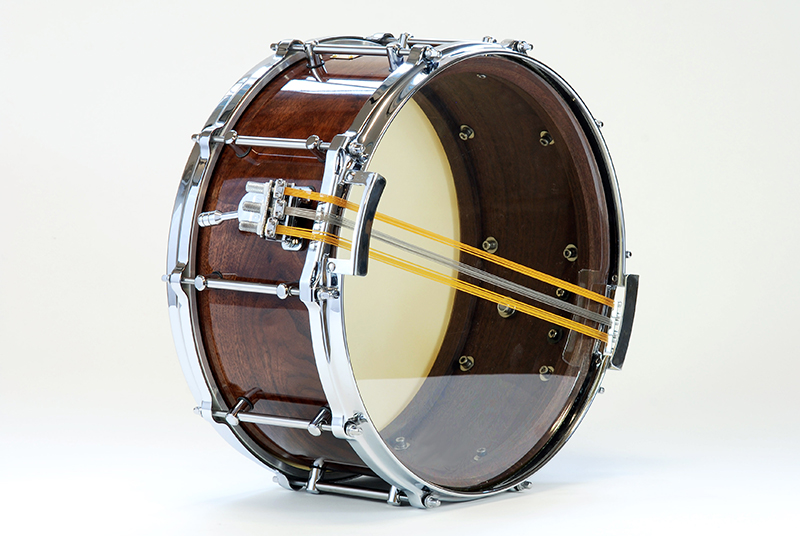
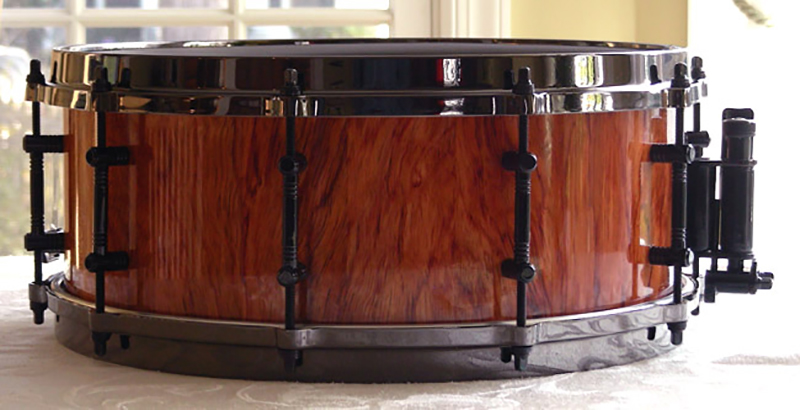
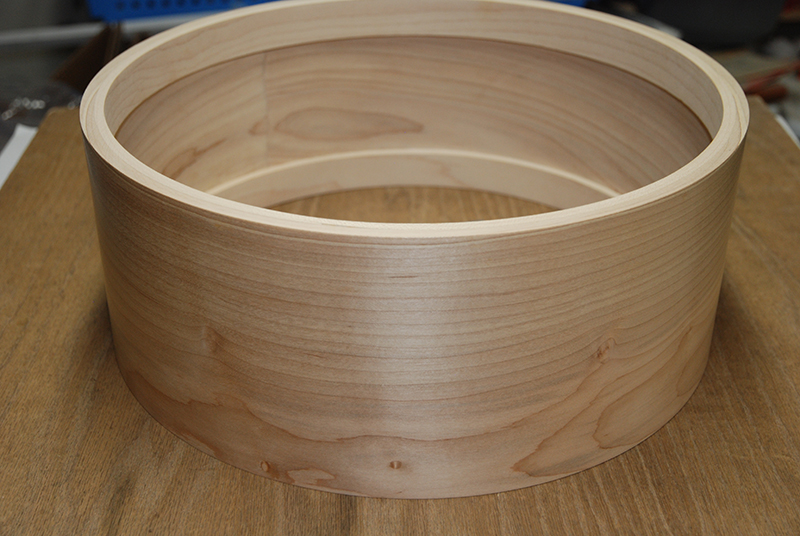
And then, of course there’s the question of labor cost. A big manufacturer needs to maximize efficiencies and minimize hours in order to meet a specific competitive selling price. A small builder, on the other hand, may want to put in more time because it allows the most effective end result for him, or because he’s addressing details that are not cost-effective for mass production, or even because he loves the actual hands-on process more than the business-operation side. I remember a conversation with a builder who told me he could wrap an entire kit in under an hour – and my reaction was, “What’s the fun in that?”
That brings me to custom vs. do-it-yourself. In this case, the comparison just isn’t fair. Yes, you can say that DIY is a way of saving all that labor cost, but it’s not exactly an apples-to-apples thing. You may have tools to build with, but the odds are good that the builder has tools that are more precise, more controlled, and better set up than yours. And in many cases, the builder may have access to parts, materials, or services that you simply can’t get.
Admittedly, doing it yourself saves on the overhead even a small builder has to cover – dedicated work space, maintaining shop materials, financing cash flow, managing bookkeeping and correspondence, website, etc.
But in terms of labor, the number of hours is only part of the story. A good custom builder brings a lot of background to your order. He’s seen different grades of parts and knows the ins and outs of working with them. He knows dozens of nuances about fitting and finishing, and the behavior of materials and shapes over time. He knows how to make design decisions to help get you the sounds and performance you want. It’s part of what he charges for – expertise that gets you much more than just a drum. Yes, you can put it together yourself, and you can even farm out some services like edging, drilling, and wrapping, but a good custom builder brings much more to the equation and the end result is not the same, even though the parts might be. So when you judge the price of a custom drum or kit, don’t evaluate it in the context of the price of a mass-production item or the cost of doing it yourself. Judge it in terms of its value to you – if it costs more, are you getting more? Is it better quality, better designed, or more exactly what you want? Does it perform better, feel better, or sound better? If the answer is yes, you may actually be getting more for your dollar from custom drums.
Adrian Kirchler Bob Meyer Model 7x14
George, A few years ago I was at [Steve] Maxwell's in NYC and tried AK's [Adrian Kirchler's] Damian Reed model with the same snare arrangement. Steve let me take it home for a week and I dug it except for 2 things. It was too dry for my taste and you couldn't separately adjust the inner parallel wires and the outer splayed wires for tension. Adrian designed his take on an old Dresdner throw off, changed the shell from copper to brass and plated it all with 24k gold for more warmth... voila! The Bob Meyer Model 7 x 14 - 2 piece shell (like a 20's BB) snare drum.
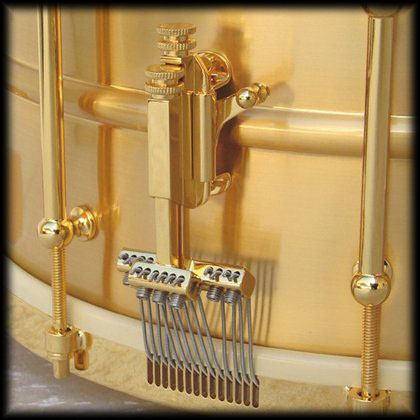
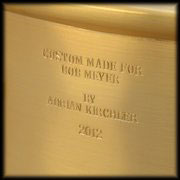
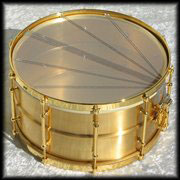
I often use wood shelled drums (8" 30s Radio kings, Leedy B'way Parallels, etc) but when I want a powerful drum with great dynamic range and sensitivity, this is it!
Best, Bob Meyer
Mlasko American Classic Drums 7x14 Vintage Mahogany

"Mlasko American Classic Drums are made in Nashville, Tennessee for drummers who can appreciate refined classic drum design without the limitations of vintage instruments. Owner, Aaron Mlasko has been building drums since 1994. He’s also worked as an in-demand touring and studio drum tech for folks like Matt Chamberlain, Matt Cameron, Alan White, Mario Calire and many others."
Read more
2x4 Famous Snare Drum
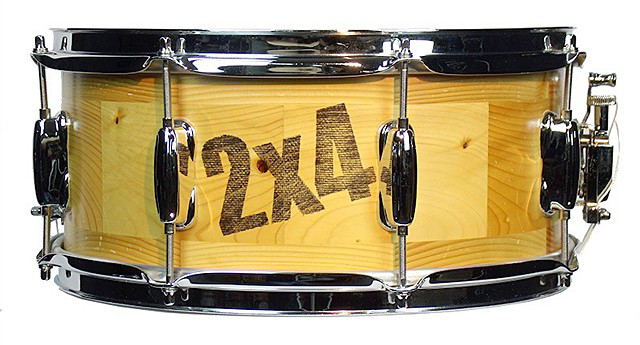
Famous Drums' "2x4" Custom Snare Drum
The 1990 Zildjian/Noble & Cooley Snare Drum – Some Insights from Jay Jones & Dave Mattacks

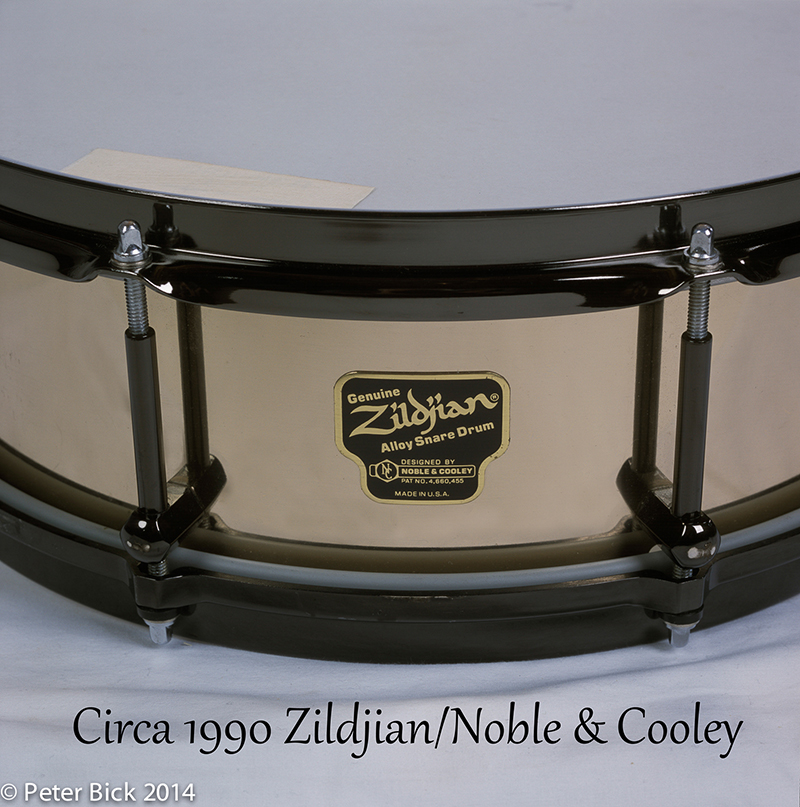


The Zildjian/Noble & Cooley snare drum was produced in very limited numbers (around 300 6.5 X 14” and 100 4.75 X 14”) starting in 1989 and stopping in the early 1990’s. It was the synthesis of two of the “elder statesmen” in the percussion business, the Zildjian Cymbal Company (founded in Psamatia [suburb of Constantinople], Turkey in 1623) and Noble & Cooley Drum Company (founded in Granville, Massachusetts in 1854). Together, they produced quite a special snare drum that the world had not yet ever seen; a drum shell cast out of the proprietary Zildjian cymbal bronze alloy and assembled by the masters at Noble & Cooley using their striking black coated brass hex lugs, die-cast hoops and trademark throw-off. Over time, these drums became extremely coveted for both their rarity and unique sound. The numbers of these bronze drums dwindled over time as cracks emerged in some drums due to issues with casting. This resulted in a bit of a “collector frenzy”, driving the value of these drums upward and making them difficult to find.
In 2002, I was fortunate to be contacted by Todd Remmy (then known as “The Drum Detective”) who stated that Dave Mattacks had a 4 ¾ X 14” Zildjian/Noble & Cooley snare that he was thinking of selling. Dave Mattacks was as legendary as the drum, having played with Fairport Convention, Joan Armatrading, Richard Thompson, Cat Stevens, Gary Brooker, Roger Daltrey, George Harrison, Paul McCartney, Jimmy Page…the list goes on… So to have a historical drum like this, one so finely crafted, a survivor and additionally graced by the hands of a master, I jumped at the chance. It arrived with a simple note from Dave: “This is to confirm that this Zildjian/Noble & Cooley snare drum is from my personal collection. It can be seen & heard on Richard Thompson’s, ‘Two letter Word’ CD. Enjoy! Regards, Dave Mattacks.” The inside of the drum was marked with serial # 09-097, signifying that it was made in 1990 and was the 97th drum of that production run. This only whetted my appetite further to know more about both Noble & Cooley and Dave Mattacks. I contacted both Jay Jones (owner, Noble & Cooley; Great-great-great grandson of James Cooley) and Dave Mattacks. They kindly gave me the benefit of some background info and their thoughts on the wondrous Zildjian/Noble & Cooley snare drum (circa 2003).
JAY JONES:
How was the Noble & Cooley drum company started originally, and when did you guys decide to go into making professional snare drums?
“Well, the company started in 1854. In 1853, Mr. Silas Noble had made some toy drums in his kitchen to give to family, friends, and neighbors for Christmas. He thought he had a good idea and went to Mr. James Cooley for financing. They incorporated it in 1854, and the company continued to grow making toy drums, and it is still the largest portion of the company, the toy portion, today. They had several innovations through the years; for example, they owned the patent on toothpick making machine. They made rolling hoops. They made all paper drums during the wars when there was a ban on metal. They were very innovative and continued to make toy products every year. In the 1950’s my predecessor, my dad, made some gift-ware items, ice buckets, waste baskets, lamps and had a whole drum shop line. That went up through the 1970’s; then we started making the professional drum line. I hooked up with Bob Gatzen in 1982 I believe, and it was through another gentleman who got one of our ice buckets or wastebaskets for his wife and saw that there was a steam-bent wooden hoop on it, and contacted us to see if we could make him a shell for his cracked Slingerland Radio King. I took a look at it and said, “no problem.” He said, “Really? Well there’s a real need for this type of drum.” So we were going back and forth, and it wasn't long before I realized he was running to Bob Gatzen to get his opinion, then taking Bob’s opinion and bringing it up to me. Once Bob and I hooked up, it made the path of communication a lot shorter. So we introduced our classic maple solid shell drum, with the classic SS back in 1984. That’s basically how we got into the music area. With Bob’s innovation, we were looking to something other than making toys here. It seemed to work out.”
One of the most collectible drums out there is the Zildjian/Noble & Cooley. How did that come about? That seemed to be something that came on and off quickly and I heard there were some problems with the sand casting?
“The pet project started with Bob Gatzen wanting to have a metal snare drum in the line. His mind just works in unbelievable ways; he’s just curious, and he finds out what are the other possibilities. “I know what a cymbal sounds like, so what would a drum made out of cymbal alloy sound like?” Talking with the Zildjian people, we ended up putting together a Zildjian alloy snare drum. We ran it for about three years. In that period of time, we did around 300 of the 6.5” version and just under 100 of the 4 ¾” version. The trouble with that drum was the sand casting. With the sand casting, it was very difficult to maintain the quality that we needed for the shell: no porosity, no sand inclusion, and no pits. The difference between an aluminum alloy and a brass alloy is the actual shell production stage; you’re dealing with a lot lower temperature with the aluminum that you are with the brass. The amount of rejects at the casting level from the foundry we were using was extremely high. Now, when they used all brand new material, they would get 70% good ones at the casting level. When they took the 30% of the bad ones and re-melted them down, only 30% of these were good ones because you ended up with lots of inclusions - some sand was melted into the brass. It just became very cost prohibitive to keep casting these rejects, and you wouldn't know it was a reject until you put on the lathe and turned it. So now you have the casting expense plus the machining expense. It was those multiple costs and being unable to control the process that made it difficult to continue. If the process was done in a permanent mold or a die-cast situation, taking the sand out of the equation, it would've been a much more viable project. However, the permanent tools for brass are very expensive and have a very short lifetime.”
So I take it there’s no thought about going back to that?
“Well, we kicked it around a couple times, and I’m not going to say it will never happen again. It might because of popularity of those drums, as we had no less that 3 or 4 calls a week. They were wondering how many were made and where they could find one. We keep getting this kind of response, so maybe there’s a chance we’ll do another project.”
Note: One year after this interview, Noble & Cooley did indeed refine their process and introduced the 380th Anniversary Zildjian/Noble & Cooley bronze cymbal alloy snare drum (limited run of approx. 500).
DAVE MATTACKS:
Before I ask you about the Zildjian/Noble & Cooley snare, I was wondering if you could give me a little background info - could you describe some of the snares you've used in your professional career and what did you like, what didn't you like?
“I've got a fairly large collection…at least 70 or 80 snare drums. It's been a passion over the last 30+ years. I started collecting snare drums and cymbals, and it came about from recognizing different sounds and timbres. The only things that I’ve discovered in terms of what I’m not keen on over the years are Slingerland Radio Kings. I think the main reason is because of the construction of the bearing edges. It's a very round, tubby sound. I had a 5 ½ X 14” that was beautiful, but I couldn't get a sound out of it that I liked. The last thing I was going to do was have the bearing edges changed because I don't believe in doing something like that to a vintage drum. So I swapped it for a cymbal and a Slingerland 5 X 13” Radio King and that's the only Slingerland that I've got. Slingerlands were the only drums over the years that did not appeal to me, great as they are. In the main, I've stayed with a hand full of custom people, predominantly Gary Noonan, although I've also got a Montineri, some Noble and Cooley’s, Craviotto’s, Stanbridge’s, Eames, and of course my Yamaha’s (which Dave proudly endorses). But the rest, over 50%, are vintage and are specifically WFL’s and/or 1940's through 1960's Gretsch.
The reason I like some of these custom drums, apart from the obvious fact that they are great sounding, is that these folk show a great amount of attention to detail. I think there's a lot of people out there assembling drums and making a good job of it, but it's that small 5-10% of people that really think about the details and equally important, they know their history. I've been doing this for some time and think I understand what they're doing. The people at Noble and Cooley are obviously in that league as far as I'm concerned. I've got the 5 ½” and 6 ½” classic maple’s. I went to the factory and got the Noble & Cooley 5 ½”; I remember hitting it once and thinking it was incredible. Like I said, it's that real attention to detail that makes the difference.”
So your drum collection is a mix of wood and metal shells then?
“Yes. The thing that I try to do is look at the shell construction and hoops and decide what the inherent area (in terms of the sound) that the drum is in. I then try to pick the heads and the tuning that goes with the sound of that drum. In other words, & I know this is kinda obvious to some, if I wanted to get a deep sound out of a snare drum, I'm not going to put thin heads on it; I'm going to go with a double-ply head or a dot head such as a "Power Center Reverse" (Evans), and use a 300 weight head on the bottom to help make a fatter sound. If I'm looking for a bright piccolo sound, then I MAY go with a metal shell and a single ply head. Depending on how the sound of the drum is, I might go with a 200 weight on the bottom, but generally I'll go with a 300 weight. Having said that, there are times when one can turn these so-called "rules" upside down - and that works too! I should add that wires make a big difference, and I'm happy there are some good choices on the market these days. Of course, the biggest way to affect your sound is your touch. ”
I believe you are a Yamaha endorser?
“Yes - since 1980 - and I love 'em! With Yamaha and other drums I have, I'm constantly experimenting. Initially, when I had the Zildjian/Noble & Cooley, I took the deep one and took the cast hoop off and put a triple flange on, but it lost something and to make a long story short, I put the cast hoop back on. I've done that with other drums where I've had brass hoops on them and thought the drum wasn't quite making it. I try and find a 2.3mm or 3.00mm steel triple flange - or sometimes go the other direction with a single flange hoop and hooks - and that will just put the bite back into the drum, but some drums don't need that. Like the one of Joe Montineri's, the 4 X 14”, that's got "conventional" triple flange hoops on it and that really works fine. If you put heavier hoops on, the ratio of the amount of hoop-to-drum you hear when you play a backbeat would change. It would thicken it up too much. So I'm always changing. Where it gets really interesting is that it depends on the type of tuning you're using, the shell construction, it’s bearing edges and the thickness of the head - and then all the other stuff then comes into play, such as how hard/light you naturally hit and the stick you use. In other words, if you're a hard hitter, you're going to lean towards a heavier head - you're going to need a thicker head to deal with that.”
So you had a 4 ¾ X14” Zildjian/Noble & Cooley snare drum. I noticed it had a triple-flanged top hoop and die-cast bottom hoop. Why no die-cast hoop on the top?
“The only die-cast hoops I like on snare drums are the Yamaha aluminum ones; they're light & malleable. They have the advantages of regular die-cast hoops (They "close " the drum down somewhat but retain tension better) – but without the “clonk” of their heavier cousins. The majority of my backbeats I play with a rim-shot, i.e., hitting the head of the drum at the same time as the rim. The proportion of rim-to-drum sound is way too biased toward the rim [sound] with a heavy die-cast. Triple-flange hoops "soften" that sound. Plus, I tune the part of the drum nearest me (the 6-o’clock position) lower than the rest of the head … this gives a slightly deeper sound at the point of impact … you kinda can't do that with a cast rim.”
(Many thanks to Jay & Dave for sharing their thoughts and experience! P.S. - Dave will be giving a clinic at the 2015 Chicago Drum Show: on “Drum tuning & cymbal selection live and in the studio.” Not to be missed!)
Well, I did try both the die-cast and triple-flange out on this drum. I have to agree with Dave; I favored the triple-flange. This drum is laser-focused and can make one’s ears bleed when hit with die-cast hoops. It does not compress when hit very hard. For some, that’s the sound they are looking for… However, for me the softer (as Dave put it), “cushier” (my description) sound of the triple-flange hoops tones down the attack of the drum and sounds great at both lower and higher tensions. I find the die-cast sound best at mid to high tensions only, and a bit harsh with the latter. A great drum for any drum arsenal.
It’s hard to believe that approximately 25 years have elapsed since the original release of the first snare drum made from bronze cymbal alloy, the Zildjian/Noble & Cooley. Others have followed (e.g., Paiste/Ocheltree Spirit of 2002, S-Bronze) but the mystique, rarity and collect-ability of the Zildjian/Noble & Cooley snares endure…
As always, questions or comments are always welcome: fallendrummer@mac.com
Outlaw Drums: Heart Pine Reborn
Anytime I come across an early American drum, I’m interested. When the drum in question can be somehow identified, I’m really interested. But how often do you come across a drum maker that identifies the origins of his drum making story to a civil war soldier and his house? Now you have my attention. Michael Outlaw attributes the origins of the drums he builds to an old dilapidated building he saw on the verge of being torn down and destroyed back in 2006. Looking for something different to build with, he asked for some of the wood from the house and took a load of it away to his shop.
The wood came from the former home of Charles Edward Wilder, who as a youth in the 1860’s, enlisted in the 17th Georgia (GA) Infantry as a private. A large portion of the 17th GA’s service was as part of Benning’s GA Brigade in Hood’s Division, Longstreet’s Corps, operating in the Army of Northern Virginia. Wilder fought in many of the Civil War’s most notable battles in both the Eastern and Western Theaters. Surviving the War, Wilder received 10 acres near Albany, GA from the State for his service as that was about all that was available to the returning veterans for any means of compensation. The land was rich with virgin long leaf pine trees suitable for building. Charles Wilder built the house from the wood of those trees in the 1880’s; the very same house Michael Outlaw procured wood from to build the first Outlaw Drums well over 100 years later.
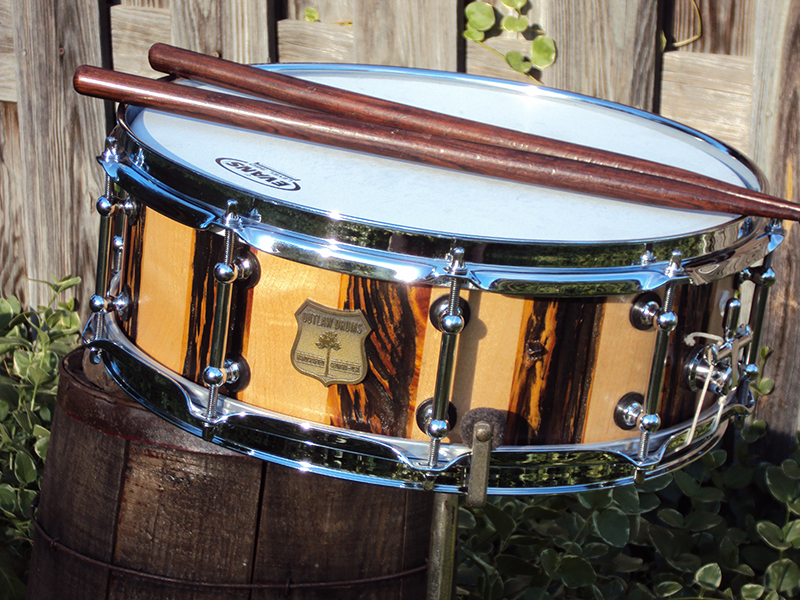
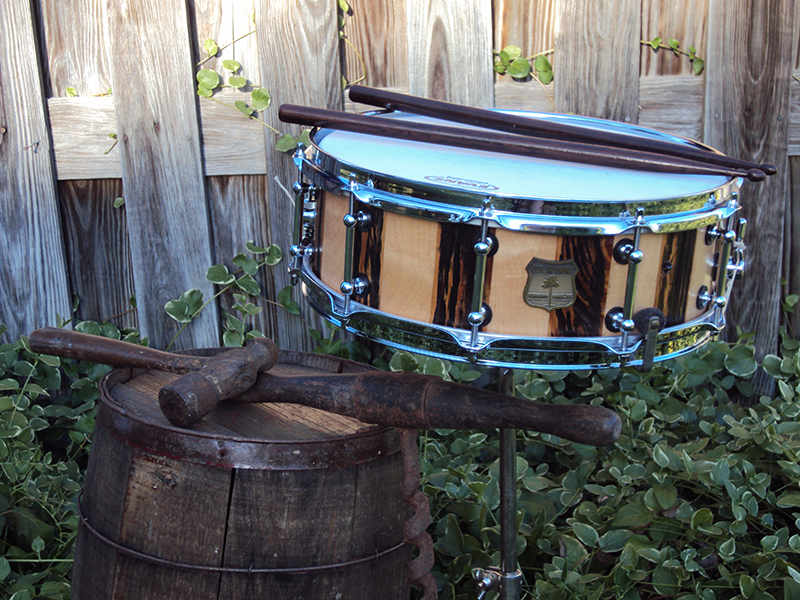
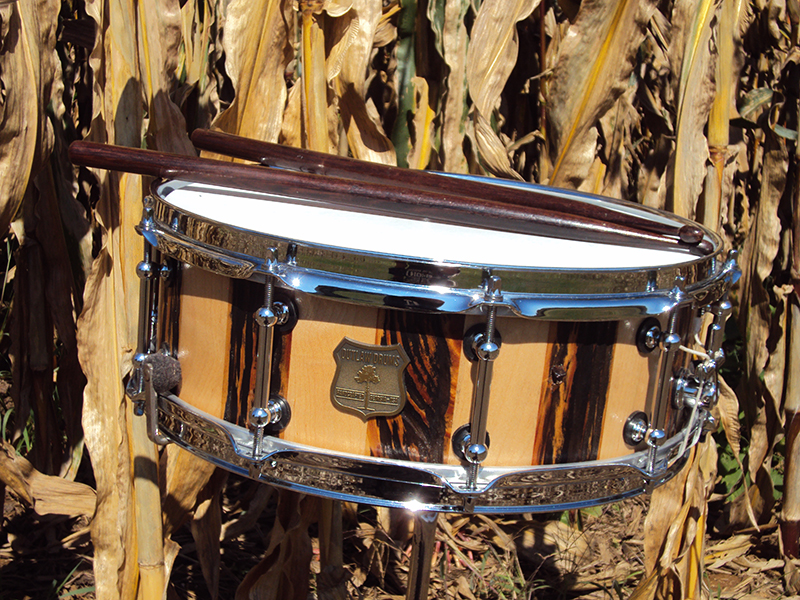
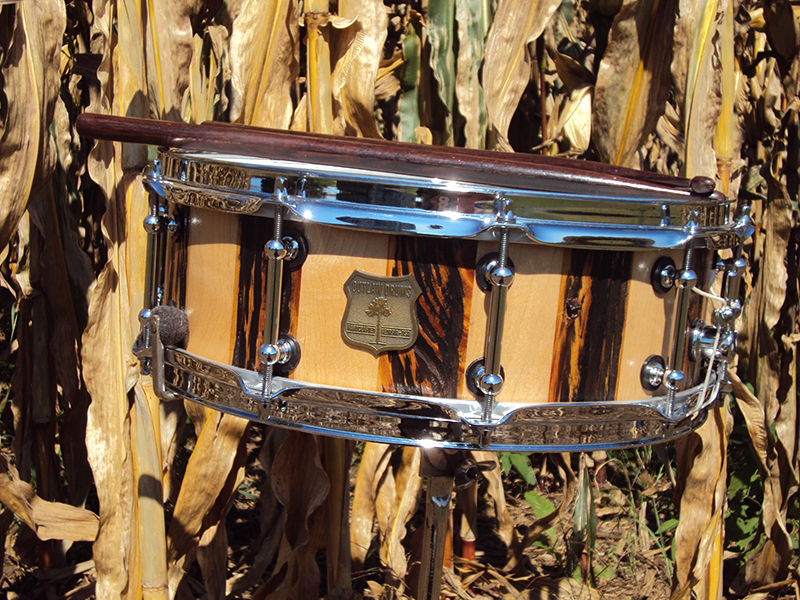
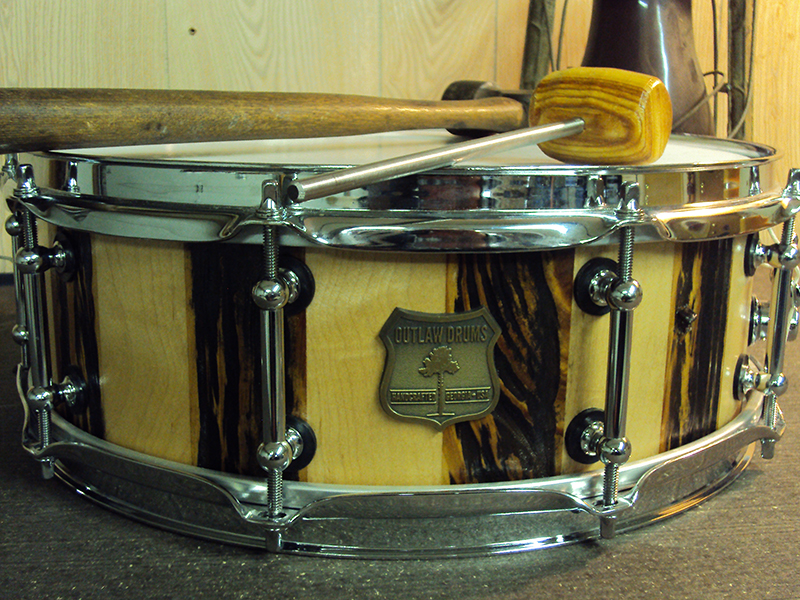

Why is the wood so special? Most of it dates back toward the 1600’s. These trees grew at an exceptionally slow rate of growth. They were virgin American trees that typically lived over 300 years and could grow to over 150 feet high. The resin in the wood was thick and the grow rings tight. Harvested from houses, mills, and barns built before 1900, the wood has had plenty of time to age and dry naturally. This results in very special sound quality characteristics that new growth wood just doesn’t seem to have.
Hailing from Sylvester, Georgia, Michael Outlaw, the master wood craftsman behind Outlaw Drums, combines his skills as an accomplished furniture maker with the drummer within him. I’ve found in researching the company that Michael has done a fine job in marketing the brand, so I’ll try not to be too redundant in what he has already made available. His presence on the web is solid and informative. He includes the history, current reviews, process, galleries, sound bites and videos.
I first ran into Outlaw drums at the 2014 Nashville Drum Show. The display was very eye-catching, built to resemble the old shacks the wood for his drums originated from. But it was the drums within the booth that weren't something I could just walk away from. They were beautiful! Something I don’t think I’ve seen before was the textured wood on the outside of the shell. After taking a good look I started tapping. They sounded as good as they looked. By the end of the show, Michael ended up sending a drum and a wooden bass drum beater home with me to review for Not So Modern Drummer Magazine.
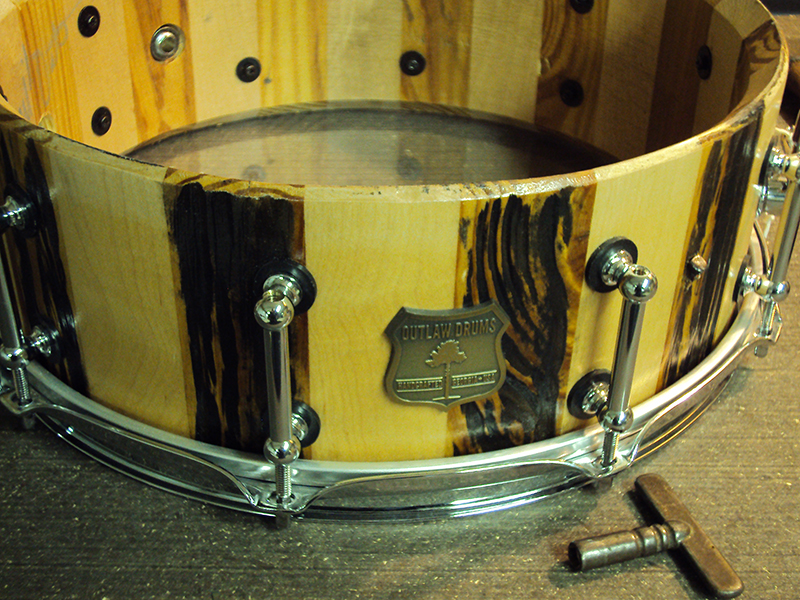
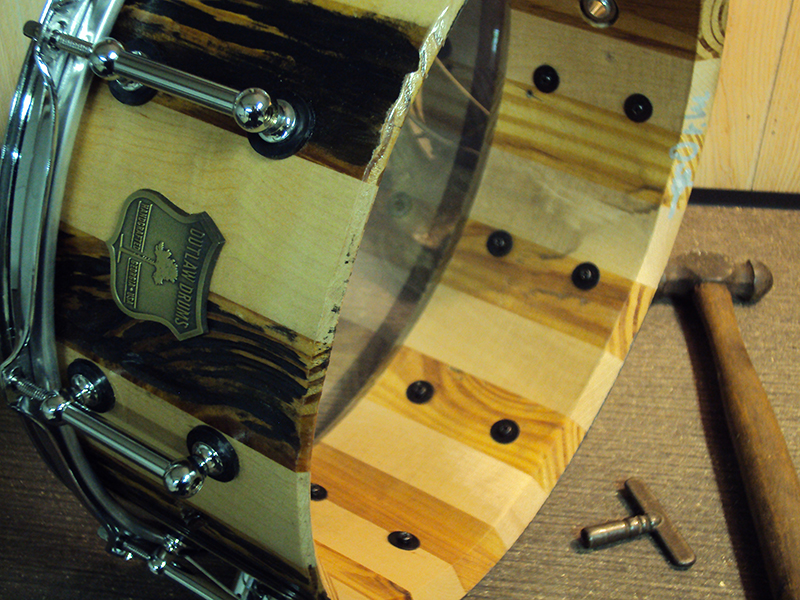
The drum I picked was one from the Heart Pine Reborn group; a stave construction combination of new growth maple and old growth heart pine. The shell measures 5”x 14” with 24 half inch thick staves of pine and maple equally alternating. The combination of the two woods made a great sound; lively and solid no matter how I tuned it. It also contained that “thump” I’ve come to love in those old growth, stave constructed drums that makes them sound like much beefier tubs.
The sensitivity and snare response was also incredible. Everything from a hard hitting backbeat to ghost notes came out crystal clear regardless of tuning. Cranking it up brought out very crisp, solid notes. Low-end tuning brought out even fatter sound qualities. Very quiet playing still netted great snare response, again, regardless of the tuning pitch. No matter how hard I hit the drum, I couldn’t get it to choke; performing very well in the big rooms and outside situations. With snares off, the drum has a great sound, full and clean. The lively-ness of the drum without the snares on sounded great with Latin tunes. My personal opinion is that this is a top-notch, all-around “go-to” drum
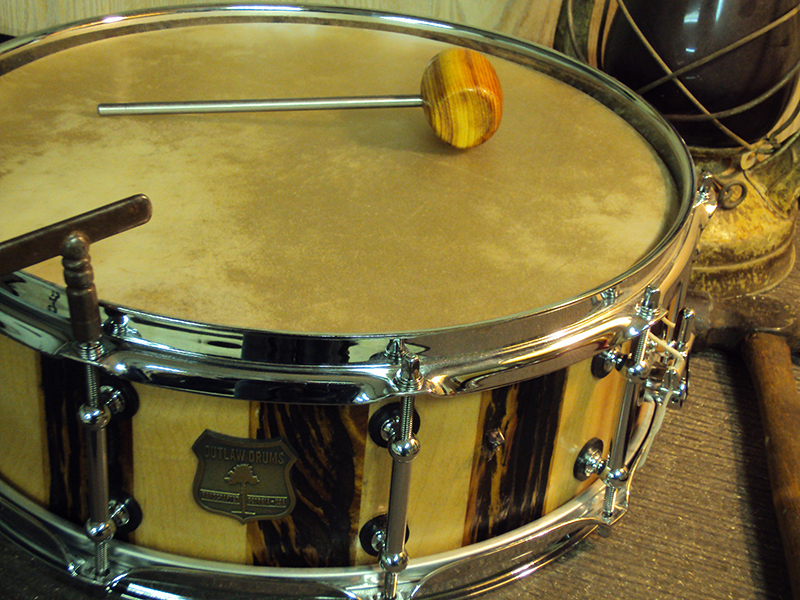
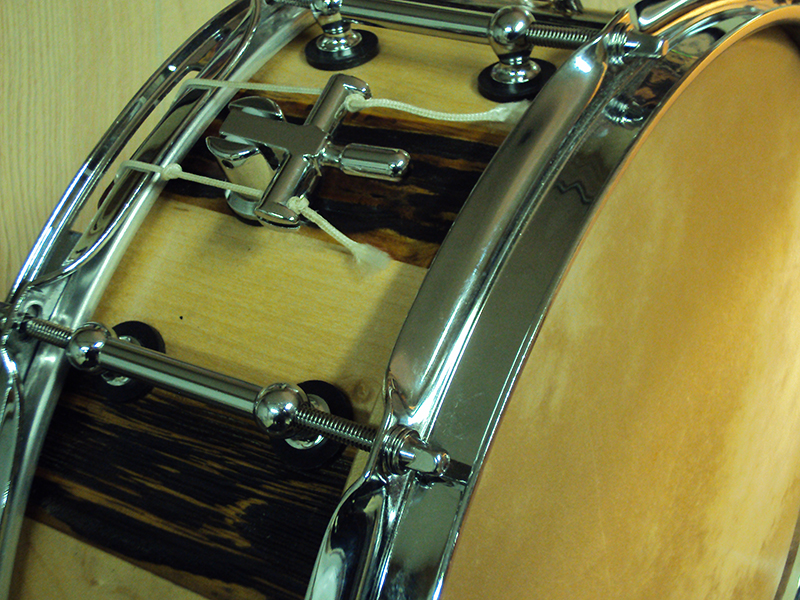
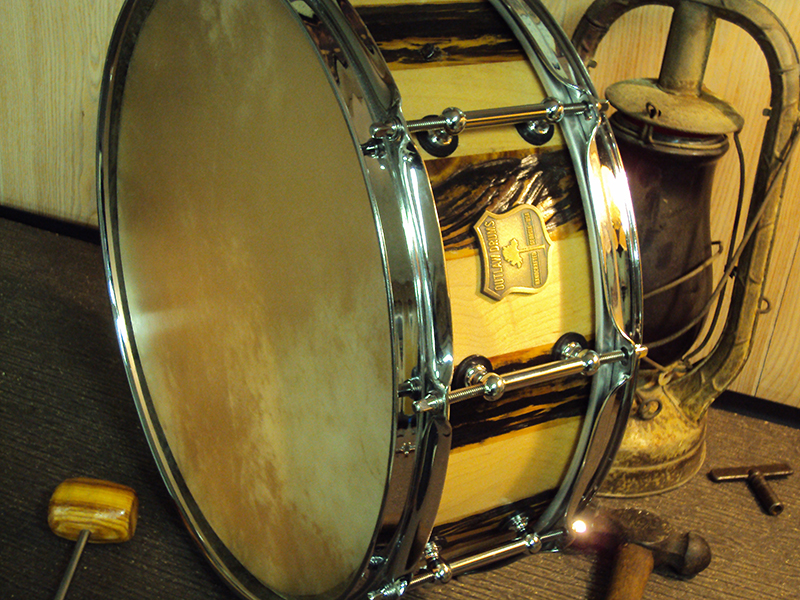
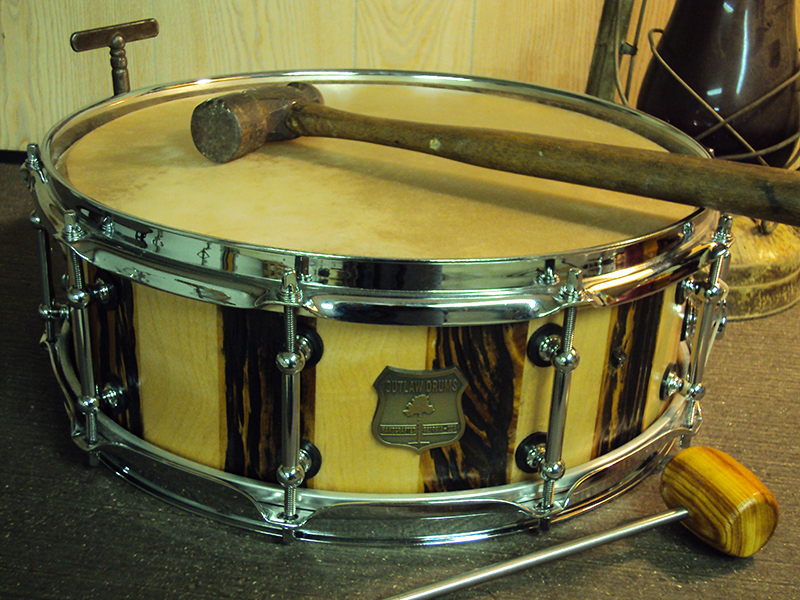
Since the overall vibe of Outlaw drums tends to pull on the heart-chains of my American history “Jones,” the notion to try a calf skin head naturally came to mind. I generally keep a few mounted skins in my shop that I receive from CT Pro Percussion for just this purpose. The sound of calf skin on this drum was truly exceptional. Very warm and responsive, the drum took on the tone of a much older sounding instrument while remaining quite sensitive and crisp over-all.
This particular model came with chrome plated hardware including triple-flanged hoops, tube lugs, vent grommet, and a George Way “beer tap” throw off by Gibraltar. Top and bottom feature Evans Level 360 heads along with sixteen-strand Puresound snares. The Outlaw Drum badge is solid brass and made to reflect the U.S. Forestry Service badges in honor of the history and repurposing of this native American wood. The bearing edges are a double 45 degree design.
Each Outlaw drum I played had a uniquely individual sound quality. This is in part to the actual lumber used as well as the combinations of wood, dimensions, heads, and hardware selected. Wood choices include, but are not limited to, White Pine, Maple, Oak, Vintage Cypress and Fur, Sapele, Lyptus, Southern Yellow Pine, and of course…..Heart Pine. There is a full and ever-changing selection of wood and hardware finishes also available for your choosing.
Complete stave constructed drum kits are available in a variety of sizes and finishes to match any snare they make. There is also a line of kick drum beaters affectionately known as the “Hammer.” This wooden beater will bring exceptional power and massive thump out of your kick with its incredibly dense wood, each with three angled impact choices.
Michael Outlaw has hit a complete home run as a drum builder, all while managing to bring the history of the wood that has touched countless lives in countless ways back to life in the voice of a drum. From out of the Southland, these drums look good enough to be thought of as fine American furniture. There is even a hand-cut nail still attached in the wood shell from when it was part of a building. Closer inspection of the interior found an old nail hole still present in the old wood. If the history is still with the wood when comes into the shop, there’s good chance it will still be attached when it leaves the Outlaw Drum Shop as a drum. All-in-all….this drum just sounds great!
From Lancaster County, PA…....Thoughts from the shop. Brian Hill
John Aldridge Engraved Black Beauty

"A Drum Geek Xmas" Here's a nice gift. My wife and kids had my Ludwig Brass on Brass Black Beauty engraved by master engraver John Aldridge. The really cool thing is that John sneakily engraved my daughters names inside two leaves of the scroll pattern. I'm so thrilled with it, I had to share.
Happy Holidays, David
Why does custom take so darned long?
One thing that’s common with today’s consumers is that when they want something, they want it now. I blame technology – buy an item on-line and it’ll usually be pulled from stock, packaged up, and started in the shipping process within hours. That new norm has changed our expectations enormously.
The same thing holds true when you’re buying drums. Buy from a brick-and-mortar store and you take them home with you. Buy on-line and you have them within a few days. If they’re not in stock, the retailer can usually special order from the manufacturer and get them to you in a few days or a few weeks.
But order something from a custom builder and it can seem like someone slams on the brakes. Suddenly you’re talking about anywhere from several weeks to several months, and you feel like the kid in the back seat of the car – are we there yet, are we there yet?

Frustrating, for sure. But knowing what to expect and how to participate in the process can help a lot.
Understand that drum building is not an industry of enormous factories and many thousands of workers. It’s mostly a community of very small shops and tiny staffs. Even many of the well-known builders are much smaller operations than you’d think. That means that if someone’s out sick or there’s a personnel change, it can affect the production schedule. Major weather problems can affect the production schedule. Specialized tools and their maintenance can affect the production schedule. Material shortages or subcontractor delays can affect the production schedule.
So, really, why does it take so long? Most of those how-it’s-done videos seem to have the drum finished in a matter of hours, if not minutes. Maybe, you wonder, the builder isn’t organized, or doesn’t want to work hard, or isn’t a stable business, or just doesn’t care. But, overall, the reality is that the custom build is a very different process from mass production.
Bear in mind that with mass production there are routine materials, sizes, components, and processes – a lot gets done with programmed machinery, templates, and assembly-line setups. But when you’re talking about custom, made-to-order work, it’s difficult to standardize production because of the frequent need to modify setups and processes.
For example, mass production of wood shells usually involves only a few species to choose from. But if you decide you want something different, a custom builder is going to have to source raw materials especially for your order. Specific dimensional requirements (and appearance, for anything that’s not covered by wrap, paint, or veneer) mean it’s not just a matter of popping out to the nearest home improvement center.
And actually making a shell can be a long process as well. If you want something that’s bent, glued, or molded, the material has to be shaped, sized, and fine-tuned to be within specifications. If it’s solid wood, it may need to stabilize for days at a time, or have moisture content slowly altered at certain stages. Occasionally, there can even be a failure – imperfections or weak spots inside the material that didn’t show on the outside, stresses during the process that damage the material, or sections that aren’t stable until fully assembled.
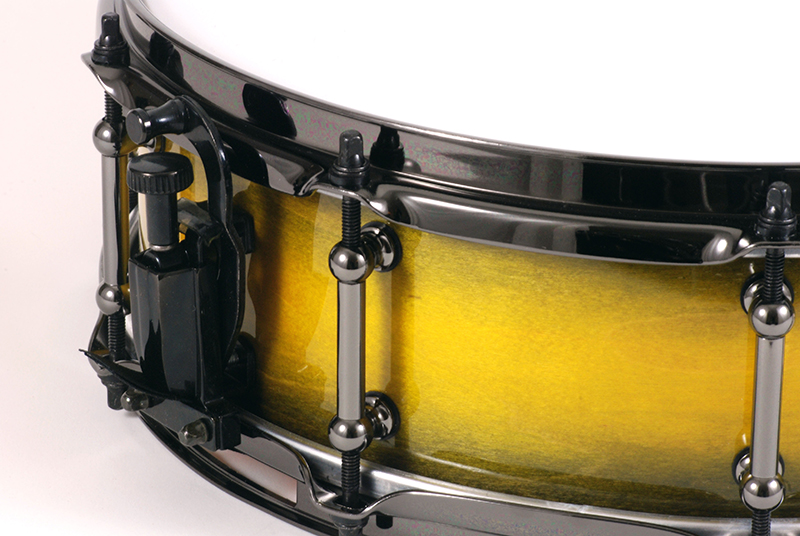
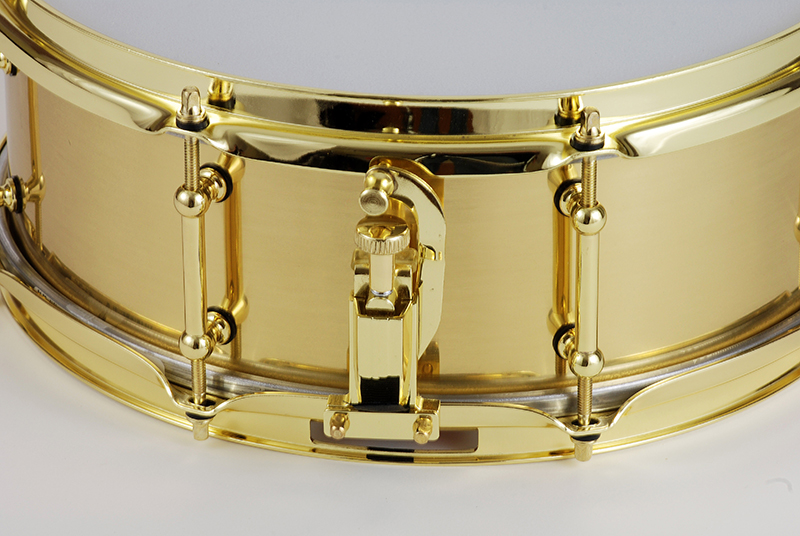
Your order might require special wraps, designs, artwork, etc., that can take time – sometimes a little, sometimes a lot – or specialized hardware that has to be fabricated. Even with mass-produced, relatively standard parts there’s always the possibility of a back order or limited availability. And pulling together all the materials and components for your project could involve a fair amount of shipping time in addition to fabrication time.
Then you may want special fittings, such as reinforcement rings, inlays, decorations, and so forth. Some of these take only an hour or so to install, others can take days to complete. And any custom parts usually mean there’s custom layout and drilling involved as well. Simple wraps can be installed quickly, but some finishes involve mixed materials, custom-blended tints, multiple applications, or lengthy curing times.


So it’s sounding like there are no reasonable limits on how long a custom order can take, right? Well, there are a few things you can do to help this process along and make it more comfortable and enjoyable for you. After all, it’s not just the builder’s project; it’s yours, too.
- You probably asked at the beginning for a rough estimate of how long an order would take. But once all of the final specs are agreed on, ask whether anything has altered that projection.
- If the adjusted timeline sounds longer than you’re comfortable with, check to see if any changes in the design might speed up the process.
- Once things are underway, don’t hesitate to ask for updates on progress (within reason, of course). Sometimes a normally slight delay turns out to be longer than expected, and you’re entitled to know what’s going on. If there’s a roadblock, the builder should be willing to tell you what it is and what solutions he’s pursuing. (And, yes, there are such things as unreasonable or avoidable delays that you shouldn’t have to accept.)
- Lastly, do your part to keep things in motion: respond to questions, raise concerns, don’t keep rethinking your plan once it’s underway, ask for information when you need it. A custom drum project should be a collaborative partnership between artist and artisan – and that’s an approach that can give you a great experience as well as a fine instrument.
The 2014 Snare Drum Olympics

The Art of snare drum building is thriving. There were 22 drum badges from the largest manufacturers, established independent builders, and the builders new to the scene. The art and science of custom drum building has become big business over the past few years so there was some stiff competition.
Read more2014 Snare Drum Olympics Results
The results of the 2014 Snare Drum Olympics are posted at www.snaredrumolympics.com along with corresponding videos, info and click-to-buy links for select snare drums entered in the event.
The Snare Drum Olympics event was started by Not So Modern Drummer founder John Aldridge in 1998 as “basically an excuse to get a bunch of really cool drums into one room at the same time.” It has evolved into an international showcase for some of the best snare drums in the world. It is a huge publicity event that has been heavily promoted by the drum manufacturers, the major drum magazines, and online drum sites and forums. YouTube. Facebook, Twitter and other social media have added another big layer of publicity over the past couple of years. The new SnareDrumOlympics.com website was recently launched this year. Each drum has its own page with videos, info and an optional click-to-buy link.
The 2014 judges were Jim Riley, drummer for Rascal Flatts, Ben Sesar, drummer for Brad Paisley, Keio Stroud drummer for Big and Rich, Beth Gottlieb, percussionist for the Gary Sinise and Lt. Dan Band, and Scott Radock, pro NYC drummer. The judging was held at Jim Riley’s Drum Dojo in Nashville TN on October 16.
The snare drums were categorized by shell composition and judged in two events; objective/blind and subjective/hands on. The results are reported as the top three scores in each shell category in each event, as the top three accumulative scores of the two events, and as the top three scores of all the drums. Also reported are the results from the public judging at the 2014 Nashville Drum Show this past September.
Brands participating this year were:
David Lee Drums Chicago Drum Infinity Drumworks DTS Custom Snare Drums Taye Drums Hayward Custom Drums Hogchain Custom Drums Klemm Drums Rasch Drums Guru Drums Holloman Custom Drums Artisan Drum Works Swindoll Custom Drums Goodman Drum Company Castle Drum Company Laudo Drums Outlaw Drums Gretsch Drums Pearl Drums Eccentric Systems Drums Bello Drums Furcinitti Custom Drums RotodruM
For more information, visit www.snaredrumolympics.com.
Orlich 9/11 Memorial Glass Drum Kit
A little over 13 years ago, I came across a picture of Alan White (YES) playing what looked to be a set of glass and brass drums. Being a drum nerd, my curiosity got the best of me. Were these gimmicks, art, or perhaps something more? I became obsessed with finding out more... So in 2001, I contacted John Orlich to learn about Orlich Percussion Systems. I later had the opportunity to speak with Alan White and Tris Imboden (CHICAGO) about their Orlich glass drums. After that, I was hooked. I wanted a set of these drums! But let me tell you the whole story from the start…
Read moreThe Dragon Drum

Recently I was asked by some friends if I could design a drum with a Renaissance Faire crowd in mind. So in true CT Pro Percussion / Charter Oak Drums fashion when left to our own devices, came up with the dragon drum that you see here. The prototype you see here has been made with a reclaimed shell and hoops and is fitted with calfskin heads both top and bottom along with custom ears. We will be offering this drum as a regular production item with choices of color including red/black, green/black, yellow,black or solid black as well as your choice of plastic, calfskin or Kevlar heads. Matt Alling CT Pro Percussion www.ctpropercussion.com
Read moreIs it custom? Is it boutique? Does it make a difference?
I live in an area that has a lot of local breweries, and people around here talk and write about beer a lot. So recently, when I saw an article about the blurring of lines as to what’s considered a “craft brewery” and what isn’t, I realized that there’s a connection between drums and beer that I hadn’t considered: confusion about industry categories and how to describe them.
Read moreFurcinitti Custom Drums

Italian Pride!
This custom drum comes to us from Furcinitti Custom Drums of Austin, TX. Their motto is "quality, beauty, clarity" and it shows! Check this drum out at the Nashville Drum Show's Snare Drum Olympics, this September 20-21st.
For more information on Furcinitti Drums, visit: www.spfdrums.com.
Lowrider Crush Custom Drum Set
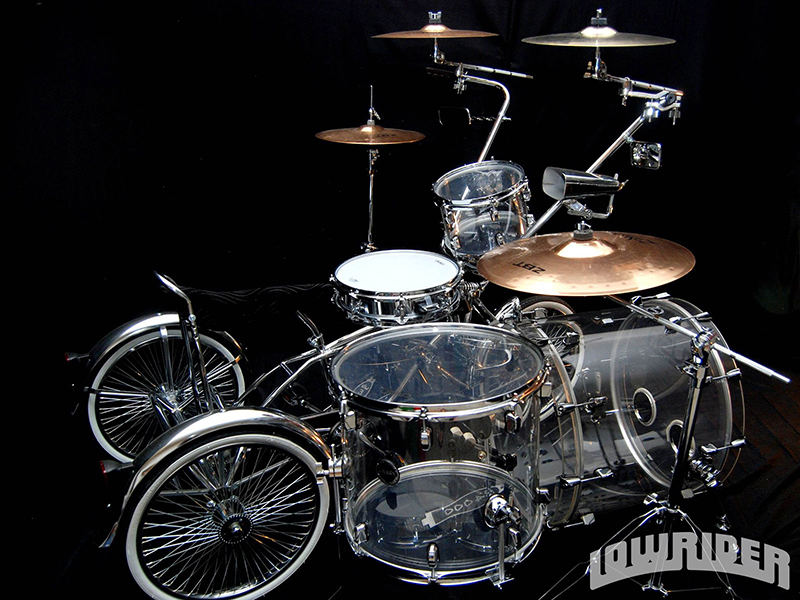
From Lowrider Magazine...
When it comes to the Lowrider influence and style, drummer and bike owner Austin Comnick shows us that he travels to the beat of a different drum as he says "I have to admit, I love chrome on cars and bikes like a woman loves diamonds. So the first time I saw an all-chrome lowrider bike on white walls my mind was officially blown! As a former touring musician I am always thinking of ways to make a live show as amazing as I can through the eyes of a spectator. So what better way than blowing peoples minds with a custom trike drum kit?"
Built around a 20-inch lowrider trike is a 4-piece clear acrylic Crush drum set. A chrome piccolo snare sits mounted to the bikes frame just in front of the custom ape hangar handlebars that double as a mount for two crash cymbals, a rack tom and an all chrome (of course) cowbell. A 22-inch kick drum, 16-inch floor tom and a ride cymbal sit next to the trike. The kit is fully functional and as easy to play as a normal kit but instead of sitting on a drum throne, you"re upon a lowrider.
I feel I met my goal to combine style and live music; the only problem is do you want to ride it, play it or stare at it?
Read more about this set and browse more pics here: http://www.lowridermagazine.com/features/1309_custom_tricycle_drum_kit/
Eddie Ryan Trixon Reproduction

Trixon set? Think again! Eddie Ryan Drums of Essex, England created this reproduction of a 1960's double bass drum with separate chambers and calf heads.
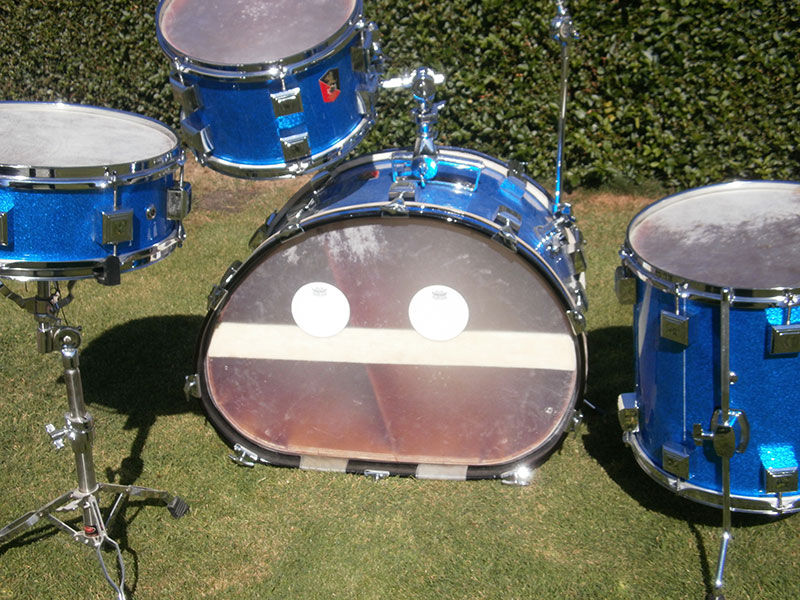
Chicago Drum Co. "American Classic" 6.5x14
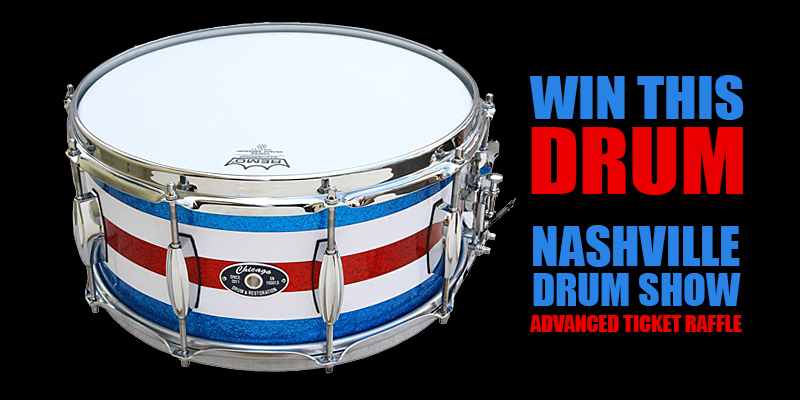
Chicago Drum Company American Classic Series with a "Red, White and Blue" finish. The shell is a 5 ply 3/8" maple/poplar shell, with 30 degree w/roundover edges. It features solid maple steam bent reinforcing rings, chromed steel stick saver hoops, 20 strand Pure Sound wires, and a 3 point vintage throw off. This drum really sings - and is a fine work of art.
Did you know you can WIN THIS DRUM? All you have to do is buy an advanced ticket to the Nashville Drum Show. Advanced ticket holders will be entered into a drawing to win this $800 drum. You do not need to be present to win, and advanced tickets start at $15!
To buy your ticket and enter this raffle, click here.
Delta Triangular Drums

Isosceles, equilateral, or scalene? Those crazy French. I guess this is their answer to Trixon. What's your opinion on these drums? Let us know below in the comments.
MBW Drums 6.5x14 Aluminum Snare

Even though this is a review drum in this issue, we couldn't keep it from being the Custom Drum of the Month! Read the review here: http://www.notsomoderndrummer.com/website/product-reviews/mbw-drums-sleeping-beauty-6-5x14-aluminum-snare-drum/